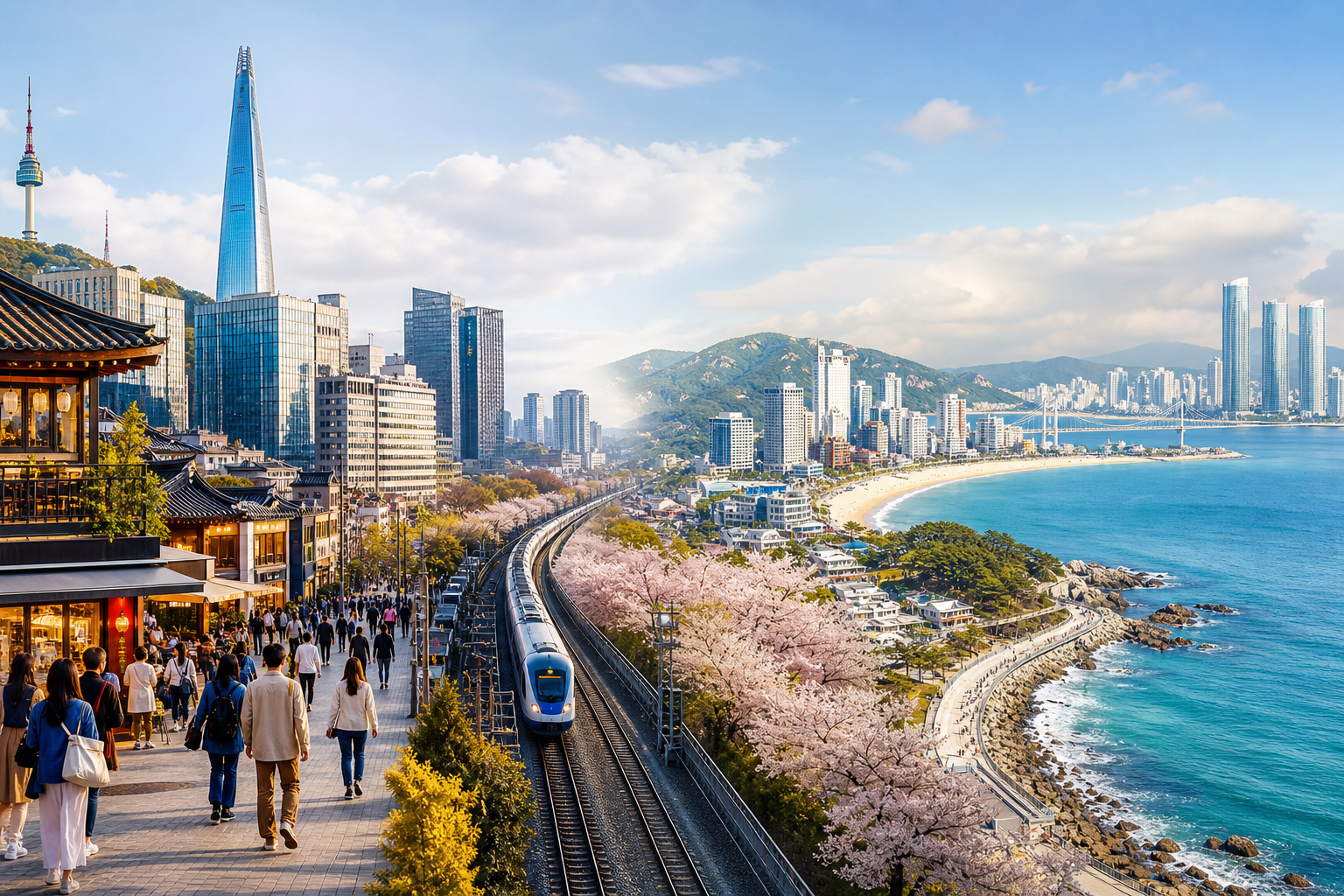
A lot of first-time visitors make the same mistake when planning a 7-day Korea trip.
They try to do too much.
They look at Seoul, Busan, Jeju, day trips, shopping districts, palaces, beaches, cafés, and famous food areas all at once, then build an itinerary that looks exciting on paper but exhausting in real life.
That is not the best way to use one week in Korea.
If this is your first trip, the smartest move is usually much simpler:
- keep the route focused
- reduce long transfers
- protect your energy on arrival and departure days
- choose a few high-value areas instead of chasing every famous place
For most travelers, the best first 7-day Korea itinerary is Seoul + Busan.
It gives you:
- the capital-city side of Korea
- a different coastal city atmosphere
- enough variety to feel satisfying
- enough simplicity to stay enjoyable
This guide gives you a practical first-time route, not an overengineered race.
The short answer
Fast decision: for a first Korea trip with 7 days, use 4 nights in Seoul and 2 nights in Busan, with the Seoul-to-Busan transfer treated as a real half-day. This gives you enough Seoul depth, one clear coastal contrast in Busan, and fewer itinerary failures than adding Jeju, Gyeongju, or Jeonju too early.
The clean default is not “see as much Korea as possible.” The clean default is:
| Decision | Best choice for most first-timers | Why it works |
|---|---|---|
| Main route | Seoul + Busan | Two strong bases, one efficient long-distance transfer, clear city contrast |
| Seoul time | About 4 days including arrival buffer | Enough for classic sights, neighborhoods, shopping, food, and weather margin |
| Busan time | About 3 days including transfer/departure time | Enough for one full coastal day without turning Busan into a rushed checklist |
| Gyeongju add-on | Only if you have 8+ days or cut Busan depth deliberately | It is valuable, but it competes with your recovery time in a 7-day route |
If one week already feels tight, compare the shorter route in the 5-day Korea itinerary. If the Seoul portion is your biggest uncertainty, decide that first with how many days in Seoul you need.
The route logic is simple: start in Seoul because it has the easiest arrival infrastructure, move to Busan after the core Seoul days, then keep the final day light enough that departure logistics do not destroy the trip. Use the Seoul to Busan transport guide before booking the transfer.
Do Seoul and Busan well, and do not try to complete Korea in a week.
Why Seoul and Busan are the best first-trip pair
A good first itinerary should balance three things:
- variety
- simplicity
- recoverability
Seoul and Busan do that better than most other 7-day combinations.
Why Seoul works
Seoul is the easiest place to start because it covers the widest range of first-time travel goals in one city.
You can experience:
- classic palace-and-history zones
- modern shopping and café neighborhoods
- easy public transport
- strong hotel choice across different budgets and trip styles
It is also where many first-time travelers arrive, which reduces early friction.
Why Busan works
Busan is the best second stop for many first-time visitors because it changes the mood of the trip without making the route too complicated.
Instead of just staying in Seoul for a full week and trying to simulate variety through different neighborhoods, Busan gives you a genuine shift in atmosphere:
- sea views instead of only urban density
- a more spread-out pace
- different food and market energy
- a lighter, more scenic final stretch
That contrast matters.
A first trip feels better when the second city feels truly different.
Why not add more cities by default?
Because 7 days is not as long as it looks.
Once you include:
- arrival fatigue
- hotel check-in and check-out
- intercity movement
- station or airport time
- weather shifts
- real walking energy
your schedule gets tight quickly.
Trying to add Jeju, Gyeongju, or multiple day trips on top of Seoul and Busan usually makes the trip more fragmented, not more impressive.
A cleaner itinerary is often a better itinerary.
Before you lock the route
Before the day-by-day plan, get the operational basics right.
That is what makes the itinerary actually work.
1. Choose the right season for your travel style
Korea has four distinct seasons, and your comfort level changes dramatically depending on when you go.
If you want the easiest walking conditions for a first trip, spring and autumn are usually the safest default choices.
Summer can still be fun, especially if you care about green scenery and beach energy, but it brings more heat, humidity, and rain risk.
Winter can be excellent if you actively want cold-weather atmosphere, but it needs more deliberate clothing and energy planning.
If you have not decided your timing yet, start with Best Time to Visit Korea by Season before locking flights and hotels.
2. Pick stay areas that reduce transit stress
Do not choose your hotel based only on price or hype.
In a short trip, your base matters a lot.
In Seoul, the right area can make palace visits, evening walks, airport transit, and food runs much easier. In Busan, the wrong base can create too much city-crossing for a short stay.
If you still need to decide that part, use:
3. Decide your arrival plan before you land
Your first two hours in Korea shape the rest of Day 1 more than most travelers expect.
If you land tired and have no clear airport-to-city plan, even a good itinerary starts badly.
Set that up in advance with Incheon Airport to Seoul in 2026.
4. Set up the basics before departure
Your itinerary gets smoother when these decisions are already solved:
- entry / K-ETA check if relevant
- mobile data plan
- transport card setup
- payment backup
Those are not side details. They directly affect how easy the route feels in real life.
How to choose the right 7-day Korea route
Use the route as a decision system, not as a fixed sightseeing race. First, decide whether your real priority is Seoul depth, coastal contrast, or adding a heritage stop.
- If you want the safest first trip: keep this Seoul + Busan route.
- If you are worried one week is too rushed: compare the 5-day Korea itinerary and remove Busan rather than rushing every day.
- If you have more than a week: use the 8-day Seoul, Busan, and Gyeongju itinerary before forcing Gyeongju into this 7-day plan.
- If Gyeongju is already a priority: check Busan to Gyeongju: day trip or overnight and understand what you would cut.
This is the planning transition that matters most: every extra city has a cost. In a 7-day route, adding Gyeongju usually means cutting Seoul depth, reducing Busan recovery time, or making departure day fragile.
7-day Korea itinerary overview
Here is the simplest version of the plan:
- Day 1: Arrive in Seoul and keep it light
- Day 2: Classic first-time Seoul day
- Day 3: Seoul neighborhood day based on your travel style
- Day 4: Flexible Seoul day with built-in breathing room
- Day 5: Travel to Busan and enjoy a lighter coastal evening
- Day 6: Full Busan day
- Day 7: Simple Busan wrap-up and departure
This structure works because it respects how travelers actually feel.
It does not assume you will land fresh, walk at full speed every day, and never lose time to transfers or weather.
Day 1: Arrive in Seoul and protect your energy
The biggest mistake on arrival day is overscheduling.
A lot of first-time travelers feel pressure to “start sightseeing immediately” because they only have one week. That usually backfires.
Arrival day should do one job well:
get you into the trip smoothly
That means:
- get from the airport to your hotel with a clear plan
- check in or drop bags
- have one easy first outing near your base
- eat early
- reset your body instead of forcing a packed evening
What a good Day 1 looks like
If you stay in a convenience-first area like Myeongdong, Day 1 can be:
- airport transfer
- hotel check-in
- light walk around the neighborhood
- simple dinner
- early night
If you stay in Hongdae, your first evening can lean more café-heavy and youthful. If you stay in Gangnam, it may feel more polished and modern.
What matters is not “seeing a lot.” What matters is starting without friction.
If your flight lands late, make Day 1 even smaller. That is not wasted time. It is what protects the rest of the week.
Day 2: Do the classic Seoul core well
This should be your most classic first-time Seoul day.
Do not scatter across the city. Choose a route that makes geographic sense and gives you the classic side of Seoul without excessive backtracking.
A strong default Day 2 is:
- palace area in the morning
- Bukchon / nearby traditional streets
- Insadong or a similar culture-and-shopping corridor
- Myeongdong or another easy evening area
Why this works:
- it gives first-time visitors the “this is Seoul” feeling quickly
- it combines history, walking, atmosphere, and food in a coherent shape
- it avoids wasting half the day on unnecessary cross-city movement
This is also the day to pace yourself.
You do not need every palace, every museum, and every famous café in one stretch. A better Day 2 is one that still leaves you with energy at dinner.
Keep this day simple
Do not overload this part of the trip with too many “must-sees.”
Your goal is not to prove productivity. Your goal is to establish the city confidently.
Day 3: Choose your Seoul mood instead of forcing everything
Day 3 is where many itineraries become smarter.
Instead of trying to cover every major district in one giant loop, choose the version of Seoul that best fits your interests.
Option A: Youthful and lively Seoul
Choose this if you want:
- café culture
- shopping streets
- late-day energy
- a more social or youthful atmosphere
This usually points toward areas like Hongdae and nearby neighborhoods.
Option B: Modern and polished Seoul
Choose this if you want:
- newer urban energy
- trend-focused shopping
- a more polished city atmosphere
- a different feeling from palace-centered Day 2
This usually points toward areas like Gangnam.
Option C: Slower and more flexible Seoul
Choose this if you want:
- a lighter pace
- museum time
- a longer lunch or café break
- less pressure to move constantly
This is often the best choice for travelers who walk a lot on Day 2 and realize they need more balance.
The strategic point of Day 3
This is where personalization matters more than optimization.
A first Korea trip does not need to be identical for everyone. It needs to be coherent.
If you choose one clear Seoul mood for Day 3 instead of trying to sample everything, the trip feels more intentional and less fragmented.
Day 4: Use Seoul for flexibility, not for panic
Day 4 is one of the most important parts of the itinerary because it keeps the whole week from becoming brittle.
Many bad 7-day itineraries fail because every day is packed to maximum capacity. Then one late start, one bad weather block, or one tired morning starts breaking the whole route.
Day 4 should be the buffer.
That does not mean it has to be boring. It means it should be flexible enough to absorb reality.
Good uses for Day 4
You can use this day for:
- a market-focused half day
- shopping without rush
- a river or park break
- one more district you genuinely care about
- slower food and café time
- catching something you skipped earlier
What not to do
Do not automatically turn Day 4 into a far day trip just because you see other itineraries doing it.
If this is your first Korea trip and you only have 7 days, a default day trip often weakens the overall structure. It adds more train logic, more timing pressure, and more fatigue right before the city transfer to Busan.
A calmer Day 4 usually improves Day 5 and Day 6 too.
Day 5: Move to Busan and change the trip’s rhythm
Day 5 is not just a transport day. It is the pivot that changes the feel of the trip.
The right approach is simple:
- check out cleanly
- move to Busan without overcomplicating the morning
- drop bags at your hotel
- make the Busan evening light and scenic
You do not need to squeeze a full Seoul sightseeing block and a full Busan sightseeing block into the same day. That is exactly the kind of overplanning this itinerary is trying to avoid.
Transport decision: treat this as a planned route change, not a gap between sightseeing days. Most first-timers should compare KTX, bus, and flight in the Seoul to Busan route guide before choosing hotel checkout time.
Why the Seoul–Busan shift works
This is where the trip starts feeling broader.
Seoul gives you density and variety. Busan gives you space, sea, and a different visual rhythm.
A lighter first Busan evening works well because it lets the city arrive gradually. Depending on where you stay, this can be:
- a beach-side walk
- a relaxed dinner with open views
- an easier neighborhood evening instead of another packed checklist
If you have not picked your Busan base yet, solve that before booking with Best Areas to Stay in Busan.
Day 6: Give Busan one full day that actually feels like Busan
Busan should not feel like Seoul with beaches added.
It should feel distinct.
That means your full Busan day should combine:
- one scenery-focused zone
- one food or market zone
- a route that does not force too many long city crossings
A strong Day 6 shape
A practical version is:
- a scenic/coastal start
- a slower lunch and viewpoint or neighborhood segment
- an evening zone with food, market, or harbor atmosphere
The exact places can vary. What matters is that the day reflects Busan’s strengths:
- sea-facing energy
- wider views
- different pacing
- a more relaxed urban mood than Seoul
Do not over-fragment Busan
Busan is spread out enough that too many “must-see” points can create a choppy day.
For a short first trip, it is better to experience two or three zones properly than to spend the day proving you crossed the map.
Day 7: Keep the final day simple and exit cleanly
The last day should be honest about departure reality.
A lot of itineraries pretend Day 7 is a full sightseeing day when it really is not.
Your final day depends on how you leave Korea.
If you depart from Busan
This is the easiest version.
Use the day for:
- a calm breakfast
- one short final neighborhood or seaside stop
- souvenir time if needed
- an unhurried airport or station transfer
If you return to Seoul to fly out
This can still work, but it is less elegant.
If you do this, stay disciplined. Do not pretend the day is wide open. A same-day return to Seoul before an international flight compresses your margin and makes the last day more functional than exploratory.
That is why, if flight pricing is reasonable, an open-jaw structure can be attractive:
- arrive in Seoul
- depart from Busan
But if round-trip Seoul is materially better for your budget, the itinerary can still work. Just be honest that it reduces flexibility.
If you are tempted to add one more historic stop from Busan, do not guess. Read Busan to Gyeongju: day trip or overnight and decide whether the tradeoff belongs in this 7-day route or in an 8-day version.
What to cut if this itinerary already feels busy
This is where most travelers make better decisions.
If you read the outline and still feel tempted to add more, cut before you add.
Cut these first
- Jeju by default — great destination, wrong default addition to a first 7-day Seoul + Busan route
- multiple day trips — they dilute the main trip unless you have a very specific reason
- too many hotel moves — they add friction faster than people expect
- every famous Seoul district — not all of them need to fit into one week
- over-optimized attraction lists — they look efficient and often feel exhausting
The better rule
If something new adds more transfer pressure than actual enjoyment, it does not belong in this version of the trip.
That rule alone improves most first-time itineraries.
My recommendation for most first-time visitors
If you want the cleanest version, this is the default I would recommend:
Best practical split
- 4 nights in Seoul
- 2 nights in Busan
- with Day 5 used for the intercity move
That gives you:
- enough time to settle into Seoul
- enough time to make Busan feel worthwhile
- enough structure to enjoy the week without constantly repacking or recalculating
Best mindset
Do not ask:
- “How much can I fit into 7 days?”
Ask:
- “What is the strongest version of one week that still feels good while I am living it?”
That is the right planning question.
A first Korea trip is better when it feels clear, steady, and memorable. Not when it feels like a race against your own spreadsheet.
Related Guides
Use these live guides to turn this 7-day route into a safer day-by-day plan:
- How Many Days in Seoul Do You Need? — lock the Seoul portion before choosing extra stops.
- 5-Day Korea Itinerary for First-Time Visitors — use this if one week feels too rushed.
- Seoul to Busan: KTX vs Bus vs Flight — choose the transfer that protects Day 5.
- Busan to Gyeongju: Day Trip or Overnight? — decide whether Gyeongju belongs in a longer route.
- How Many Days in Korea Do You Need for a First Trip? — compare 5, 7, 8, and 10-day trip lengths.
- 8-Day Korea Itinerary: Seoul, Busan, and Gyeongju — the cleaner version if you want Gyeongju.
- 10-Day Korea Itinerary: Seoul, Busan, Gyeongju, and Jeonju — use this for a broader heritage route.
- Where to Stay in Seoul for First-Time Visitors — reduce wasted transit on Days 1-4.
- Best Areas to Stay in Busan — choose the Busan base that fits Days 5-7.