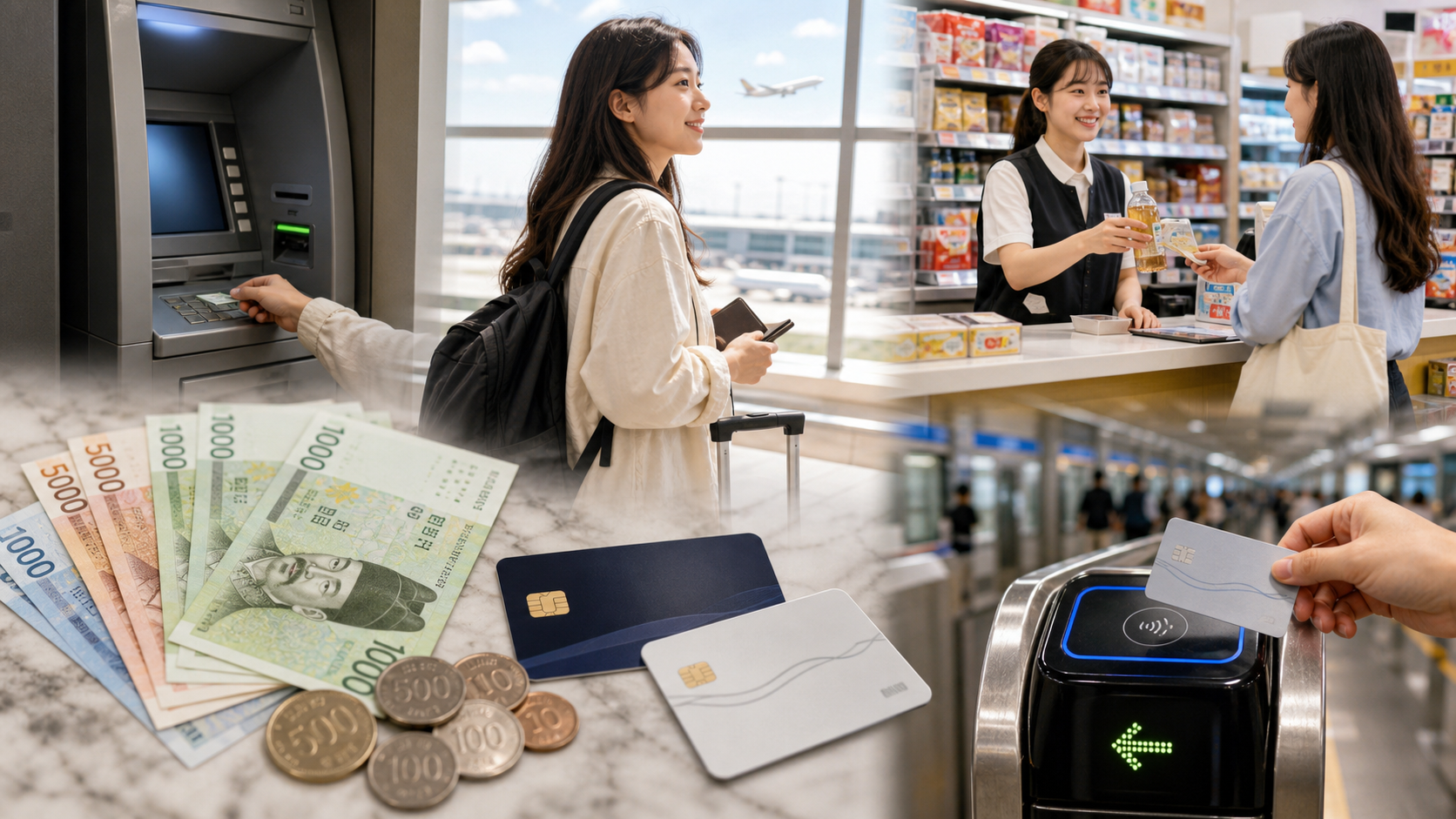
Quick answer: the payment setup that works for most trips
For a first trip to Korea, bring one internationally enabled credit or debit card, a second card from another bank or network if possible, and some Korean won. Use your bank card for most purchases, but keep cash for ordinary T-money purchase and top-up. Do not expect a foreign contactless card to work as a universal tap-in transit card yet.
In Seoul, there is one useful 2026 exception: new ticket machines at selected subway stations accept international cards for Climate Card short-term passes and single-journey tickets. They do not reload ordinary T-money.
Before flying, check foreign transaction fees, overseas cash-withdrawal settings, daily limits and how your bank sends fraud alerts. When a terminal offers to charge in your home currency, inspect the rate and fees; choosing Korean won is the simpler default unless you have compared the conversion offer.
Fast decision box
- Main spending: internationally enabled physical credit or debit card
- Backup: a second card, stored separately
- Transit: T-money or EZL for regular subway and bus travel
- Cash: Korean won for ordinary T-money purchase/top-up and as a fallback
- Do not assume: a foreign bank card can replace a local transit card at the fare gate
- Seoul exception: selected Lines 1–8 machines take international cards for short-term Climate Cards and single tickets, not T-money reloads
Who should use this setup—and who can simplify it
This setup is best for first-time visitors, independent travelers, families and anyone using subways or buses regularly.
You can simplify the plan if a tour operator handles your transport and most major costs, or if you will use prearranged transfers and rarely take public transit. Even then, bring one physical card and a modest Korean-won reserve.
Skip the local transit card only if your itinerary genuinely does not need it. A traveler making one or two Seoul subway journeys may prefer single-journey tickets; a regular transit user will usually find a reloadable card more practical.
Your four-part payment plan
1. Use an international card for most purchases
Korea is card-friendly, but not card-universal. VISITKOREA’s currency guide says credit cards are widely accepted at major hotels, department stores and general shops, while noting that some stores may not offer card service. Visa, Mastercard and American Express are among the card types it names. That supports a card-first strategy, not a card-only strategy.
Before departure:
- Confirm that overseas purchases are enabled.
- Check the foreign transaction fee and your daily purchase limit.
- Find out whether your bank still asks for a travel notice.
- Confirm how you will receive and approve fraud alerts abroad.
- Save the issuer’s support number somewhere other than your wallet.
- If possible, bring a second card from a different issuer or network.
Keep the backup card separate. Two cards in the same lost wallet are not a useful backup.
2. Carry Korean won for the specific job cash still does
The clearest current reason to carry cash is local transit-card setup. The official Tmoney foreigner guide tells users to present the card and cash in Korean won for top-up at Tmoney sales locations. Those locations include convenience stores, subway top-up machines or information centers, and Tmoney Town.
You do not need to fund the whole trip in cash. Carry enough for your first transit-card purchase and load, plus a personal fallback amount if a card is declined. How much that means depends on your group size, route and comfort with withdrawing money later; a universal daily cash figure would be misleading.
If you want to exchange money on arrival, VISITKOREA lists bank branches and money exchangers at Incheon Airport. Hours and locations vary, so check that official page again before your flight rather than building an arrival plan around an old timetable.
3. Use a local card for routine public transport
For regular subway and bus travel, choose a local transportation card rather than assuming you can tap a foreign bank card at every gate. The current VISITKOREA transportation-card guide lists Tmoney and EZL as reloadable prepaid cards sold at convenience stores nationwide. It also covers visitor-oriented options such as WOWPASS and Seoul’s Climate Card.
For most visitors, the practical distinction is:
- Tmoney or EZL: reloadable stored-value cards for routine public transport and participating merchants displaying the relevant logo.
- Climate Card: a Seoul-focused pass whose usefulness depends on your dates and routes.
- Single-journey ticket: suitable when you need only an occasional subway ride.
The standard Tmoney rule remains simple: expect to use Korean-won cash to buy or reload it. Korea Tourism Organization’s transportation payment guide also labels ordinary Tmoney purchase and recharge as cash only for foreign-issued cards.
4. Keep access to your bank while abroad
You may need data to review a bank alert, unlock a card, check an account or contact your issuer. Make sure your roaming, eSIM or local SIM plan will let you access the banking method you use. Download booking confirmations and keep your accommodation address offline too.
The point is not to add another payment product. It is to make a card problem easier to resolve.
Seoul’s 2026 international-card ticket machines: useful but limited
Since March 17, 2026, Seoul has operated 440 new vending machines at 273 subway stations on Lines 1–8. According to the Seoul Metropolitan Government announcement, these machines accept internationally issued credit and debit cards for:
- Climate Card short-term-pass purchase and recharge
- Single-journey subway tickets
The city reports an average service fee of approximately 3.7% on those international-card transactions. Check the amount displayed before paying.
The important limit: this is not ordinary Tmoney reload support. If you want a standard stored-value Tmoney card, continue to plan around Korean-won cash for purchase and top-up.
At AREX stations, a separate VISITKOREA notice says credit cards can be used to buy single-use subway cards from Incheon Airport Terminal 2 Station through Seoul Station. That solves a specific ticket purchase; it does not turn your bank card into a general transit pass.
Direct open-loop tapping with overseas cards is still a rollout plan, not a systemwide feature. Seoul’s open-loop payment roadmap describes gradual conversion through 2030. Until official guidance says otherwise for your exact route, use a local transit card or the supported ticket option.
ATMs: prepare your card before you depend on one
ATM compatibility, limits and charges can vary by bank, card network, issuer and machine. Current official visitor guidance does not justify promising that a particular bank’s machine will accept every foreign card. Treat cash withdrawal as a planned option with a backup, not a guarantee.
Ask your card issuer these questions before travel:
- Is international cash withdrawal enabled on this debit card?
- What foreign ATM and currency-conversion fees apply?
- What is the daily withdrawal limit?
- Will my usual PIN work overseas?
- What should I do after a decline or security block?
At the machine, read every screen, confirm the withdrawal amount and review any operator fee before accepting. Keep the receipt or transaction record until the account entry settles. If a withdrawal fails, do not repeat it rapidly without checking whether your account shows a pending transaction; contact the issuer when the card or account status is unclear.
Using a credit card for cash may be treated as a cash advance under your issuer’s rules. Check those terms before choosing that route.
Dynamic currency conversion: read the choice before you tap “accept”
A shop terminal or ATM may offer to charge you in your home currency instead of Korean won. This is dynamic currency conversion, or DCC. The familiar home-currency number is not automatically the better deal.
Visa’s DCC guidance says the offer should disclose both the local-currency and cardholder-currency amounts, the exchange rate, and any additional fee or markup. It must also give the cardholder a choice to accept or decline.
A practical response:
- Pause rather than accepting the first currency shown.
- Check the KRW amount, home-currency amount, exchange rate and markup.
- Compare the offer with your issuer’s foreign-transaction terms if you can.
- If the required details are missing or you feel pressured, decline the conversion and contact your issuer.
Choosing KRW and letting the card issuer perform the conversion is a clear default, but it is not a promise that one option is always cheapest. Your card’s own fees still matter.
A simple arrival-day sequence
Payment setup is easiest before you are standing at a subway gate with luggage.
- Connect your phone. Confirm you can reach your bank app and receive its security prompts.
- Secure some Korean won. Exchange or withdraw enough for your transit-card plan and fallback needs.
- Match payment to the airport transfer. Check the official booking channel or counter for your chosen train, bus or taxi option.
- Buy the right transit product. Choose Tmoney or EZL for routine pay-as-you-go travel, or a Climate Card only if its covered area and duration fit your plans.
- Store the backup separately. Split your cards and cash before leaving the airport or accommodation.
If you are still choosing an airport route, read Getting from Incheon and Gimpo Airports to the City and the Korea Transport and Arrival Guide.
Common payment mistakes to avoid
- Arriving with one card and no Korean won. One bank security block can then interrupt both spending and transit setup.
- Assuming contactless means transit-compatible. A foreign card may work for a purchase without working as a universal subway or bus tap card.
- Confusing Seoul’s new machines with Tmoney reload support. Their international-card function covers Climate Card short-term passes and single tickets.
- Accepting DCC without reading the rate and markup. The home-currency display is a conversion offer, not a neutral convenience.
- Keeping every payment method together. Separate the backup card and reserve cash.
- Leaving issuer checks until departure day. Overseas permissions, PIN questions and cash-withdrawal limits are easier to resolve from home.
Related Guides
- Plan Your Korea Trip
- Korea Transport and Arrival Guide
- Seoul Subway Guide for Foreigners 2026
- Seoul Climate Card vs T-money for Tourists
- WOWPASS vs Credit Card in Korea
- Korea Tax Refund 2026
- Getting from Incheon and Gimpo Airports to the City
FAQ
Can I travel in Korea without cash?
A card can cover much of a trip, but cashless-only is a poor plan for regular public-transport users. Ordinary Tmoney purchase and top-up still require Korean-won cash under the official foreign-visitor guidance. Carry some won even if most of your spending goes on a card.
Can I tap my foreign credit card on Seoul buses and subways?
Do not assume so. Systemwide open-loop acceptance is still being introduced in stages toward 2030. Use Tmoney, EZL or another valid local transit product unless current official instructions for your exact route say your card is accepted.
Can I reload Tmoney with an international card in 2026?
The official standard flow remains cash only. Seoul’s new international-card machines support Climate Card short-term passes and single-journey tickets, not ordinary Tmoney reloads.
Should I choose KRW or my home currency at a terminal?
KRW is the straightforward default unless you have compared the displayed DCC exchange rate and markup with your issuer’s terms. If the conversion details are missing or someone chooses for you, decline the conversion and contact your card issuer.
Are Tmoney and EZL the only transit-card options?
No. VISITKOREA’s August 2026 guide also describes WOWPASS and the Climate Card. The right choice depends on where you will travel, how often you will use transit and whether you want stored value or a time-limited pass.
Will my foreign card work in Korean taxis or transport booking channels?
Korea Tourism Organization’s current transportation guide lists foreign-card acceptance at taxi card readers and several rail, bus, taxi-hailing and rental-car channels. That is useful route-specific guidance, not a guarantee for every card, terminal or booking path. Check the exact service you plan to use and keep a second payment method.
Final recommendation
Use a physical international card for most spending, carry a separately stored backup card, and keep Korean won for ordinary transit-card setup and contingencies. Choose Tmoney or EZL for regular public transport; use Seoul’s international-card ticket machines only when a short-term Climate Card or single ticket matches your journey. Read DCC screens instead of accepting the familiar currency automatically.
This advice was checked against official sources on September 21, 2026. Payment acceptance, fees, machine coverage and transit rules can change. Recheck your issuer’s terms and the linked VISITKOREA, Tmoney and Seoul pages before departure, especially if one payment method is essential to your arrival route.