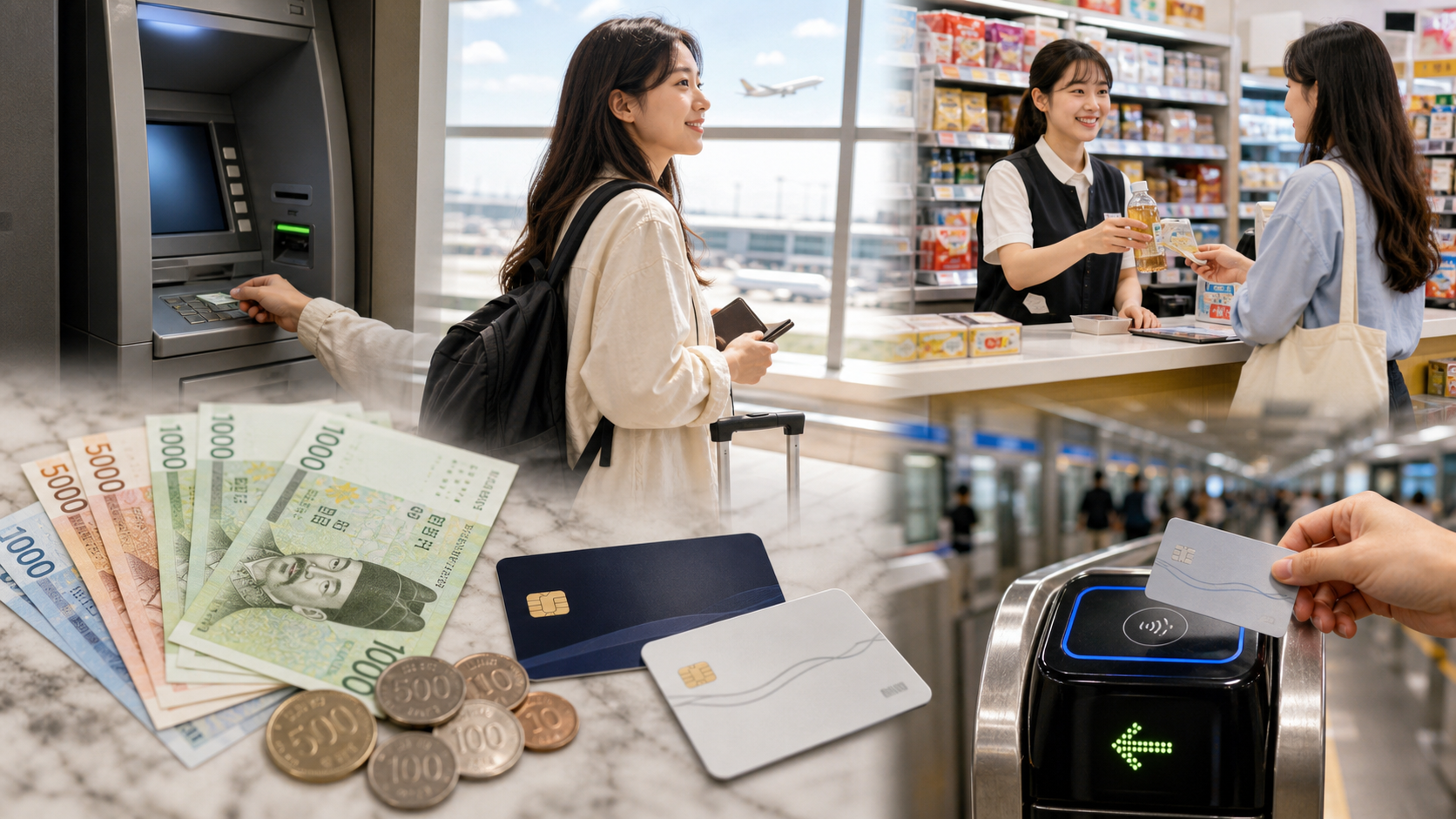
Money friction in Korea usually does not come from one big problem. It comes from small moments: a card that fails in a taxi, an ATM that does not accept your card, a transport card that needs cash top-up, a restaurant that prefers a local payment method, or a bank app that requires SMS verification while your phone is not connected.
For a first trip, the goal is not to predict every price. It is to build a payment setup that keeps you moving even when one method fails. Korea is card-friendly in many everyday situations, but first-time visitors should still carry some cash, understand transport card top-ups, and check card and ATM rules before departure.
Use this guide with the Korea trip planning guide and the Korea transport and arrival guide, especially if you are planning your first airport transfer and first subway or bus ride.
Quick answer
For a first Korea trip, bring a layered payment setup:
- At least one international credit card for hotels, restaurants, shopping, and many everyday purchases.
- A backup card from a different bank or network if possible.
- Some Korean won cash for transport card top-ups, markets, small shops, older machines, and payment failures.
- A transportation card such as T-money or Cashbee for subway and bus travel.
- A working phone connection so you can approve bank alerts, check balances, and solve payment problems.
Do not arrive with only one card and no cash. Do not assume your home mobile wallet will work everywhere. Do not leave transport card setup until you are already blocking a ticket machine with luggage.
The best first-day money plan
Your first day should be simple. You may be jet-lagged, carrying bags, and trying to reach your accommodation. Avoid building an arrival plan that depends on perfect card acceptance at every step.
Before leaving the airport, aim to have:
- A working data connection or roaming backup.
- A way to pay for your airport transfer.
- Some Korean won cash.
- A transport card if you will use subway or bus soon.
- Your hotel address saved in English and Korean.
- A backup card accessible but stored separately.
If you are still choosing how to leave the airport, read getting from Incheon and Gimpo airports to the city. Your payment plan should match your transfer choice.
Cards in Korea: useful, but not your only plan
International credit cards are widely useful in Korea, especially at hotels, department stores, larger restaurants, cafes, chain shops, convenience stores, and many tourist-facing businesses. A card-first strategy can work well, but it should not be card-only.
Cards are usually practical for:
- Hotels and accommodation payments.
- Many restaurants and cafes.
- Convenience stores.
- Major shops and malls.
- Train or airport-related purchases.
- Larger attractions and activities.
Cards may be less predictable for:
- Some small restaurants or older shops.
- Traditional markets and street food.
- Certain ticket machines or kiosks.
- Some taxis, depending on the situation.
- Online booking systems that prefer Korean-issued cards.
- Backup transport card top-ups.
Before travel, check:
- Whether your card works internationally.
- Whether you need to set a travel notice.
- Foreign transaction fees.
- ATM cash advance rules if using a credit card for cash.
- Daily limits and fraud alert behavior.
- Whether your bank sends verification by SMS, app notification, or email.
- Whether your phone number will work abroad.
The best card is not only the one with good rewards. It is the one that keeps working when your bank sees a foreign transaction.
Why you still need cash
Korea is modern and card-friendly, but cash still solves visitor problems. The most important reason is transport card top-up: many travelers still need cash to load or reload a transportation card at machines or convenience stores, depending on location and method.
Cash is useful for:
- Loading a T-money or Cashbee card.
- Markets and street food.
- Small shops or older businesses.
- Backup taxi situations.
- Coin lockers or older machines where applicable.
- Splitting small expenses with travel companions.
- Emergency fallback if your card is blocked.
You do not need to carry all trip funds as cash. In fact, that creates its own risk. But you should have enough Korean won for arrival, transport setup, small purchases, and a day or two of backup needs.
Transportation cards: separate from normal payment cards
For subway and bus travel, first-time visitors should understand that a transportation card is not the same thing as simply tapping any foreign credit card. Korea’s transport system is easier when you use a local transit card such as T-money or Cashbee.
A transport card helps with:
- Subway rides.
- City buses.
- Transfers where applicable.
- Avoiding single-ride ticket friction.
- Moving quickly through gates.
Plan for two steps:
- Get the card. You can usually buy transportation cards at convenience stores or transport-related locations.
- Load value onto it. Be prepared to use cash for top-up if needed.
For details, use the T-money and Cashbee guide. If your first day includes trains, subways, buses, or taxis, pair it with the Korea transport and arrival guide.
ATMs and withdrawing Korean won
ATMs can be useful, but not every machine is equally friendly to foreign cards. Look for machines or bank ATMs that clearly indicate international card support. Airports and major areas are usually easier than quiet neighborhoods, but you should still have a backup.
Before relying on ATMs, check:
- Whether your debit card is enabled for international withdrawals.
- Your bank’s foreign ATM fee and exchange rate policy.
- Daily withdrawal limits.
- Whether your PIN format works internationally.
- Whether your card network is commonly accepted abroad.
- What to do if the ATM declines or keeps giving errors.
At the ATM, watch for:
- Language selection.
- Foreign card or global card option.
- Bank fees shown before confirmation.
- Dynamic currency conversion prompts.
- Receipts and transaction records.
If an ATM fails, do not panic. Try a different bank or a machine in a more international location. But do not wait until you have zero cash to attempt your first withdrawal.
Dynamic currency conversion: choose carefully
Some card terminals or ATMs may offer to charge you in your home currency instead of Korean won. This is called dynamic currency conversion. It may feel convenient because you recognize the number, but the exchange rate can be less favorable than letting your own card network or bank convert the charge.
A practical rule:
- If offered a choice, compare carefully before accepting your home currency.
- Many travelers prefer being charged in Korean won and letting their card issuer handle conversion.
- Check your own card’s terms before travel.
Do not rush through currency screens at ATMs or card terminals. Slow down when a machine asks which currency to use.
Mobile payments and QR payments
Korea has strong local mobile payment systems, but international visitors should not assume every home-country mobile wallet, QR payment app, or tap-to-pay setup will work everywhere. Some systems depend on Korean-issued cards, Korean phone numbers, or local identity verification.
Mobile wallets may work in some places, especially where contactless or international card acceptance is supported, but they are not a complete replacement for cards and cash.
Before travel, check:
- Whether your cards are enabled in your mobile wallet abroad.
- Whether contactless payments are widely supported by the specific businesses you expect to use.
- Whether your hotel or activity bookings require a physical card.
- Whether your bank app can approve transactions without your home SIM active.
- Whether you know your physical card PIN if needed.
Bring the physical card even if you usually pay by phone at home.
Taxis and payment friction
Taxis are useful in Korea for late nights, luggage, rain, family travel, and final connections from a station to a hotel. Many taxis can accept cards, but first-time visitors should still keep a backup payment method.
Payment friction can happen when:
- A foreign card is declined.
- A driver or terminal has trouble processing the card.
- You entered a destination that needs clarification.
- You are tired and cannot easily troubleshoot.
- Your phone battery or data connection is low.
For taxis, prepare:
- Your destination in Korean.
- A working map or taxi app if you plan to use one.
- A physical card.
- Some cash as backup.
- Hotel phone number or address screenshot.
Read the complete guide to using taxis in Korea before relying on taxis for arrival, late-night travel, or luggage-heavy transfers.
Markets, street food, and small restaurants
Some of Korea’s best first-trip experiences happen in markets, small restaurants, snack stalls, and local shops. These are exactly the places where payment can be less predictable for visitors.
Use cash or a backup card for:
- Street food.
- Market snacks.
- Small independent shops.
- Older restaurants.
- Temporary stalls or festivals.
- Places where the card terminal struggles with foreign cards.
A first-time visitor mistake is treating cash as only an emergency tool. In practice, small cash makes everyday food exploring smoother.
Hotels, deposits, and booking cards
Hotels are usually straightforward, but payment details still matter. The card used to book may be requested at check-in, and some properties may place a hold or require a deposit depending on policy.
Before arrival, check:
- Whether the hotel charges before arrival or at check-in.
- Whether the booking card must be presented.
- Whether a deposit or card hold is required.
- Whether the property accepts your card type.
- What happens if you arrive late.
- Whether the hotel can help with taxi directions in Korean.
If your bank is sensitive to foreign transactions, a hotel payment right after landing can trigger fraud checks. Make sure you can receive alerts and approve the transaction.
Online bookings and Korean-issued card issues
Some Korean online systems can be difficult for foreign visitors, especially when they expect local cards, local phone numbers, or identity verification. This does not mean you cannot travel independently; it means you should not leave every ticket or reservation to the last minute.
For first-time visitors:
- Book key hotels and intercity transport through systems that accept your card.
- Confirm cancellation and payment rules.
- Keep screenshots or PDFs of reservations.
- Have a backup plan for activities that require local payment methods.
- Do not assume every local app will accept a foreign card.
If a local system rejects your card, try an official alternative, an international booking platform, an in-person counter, or a different card. Avoid depending on one exact payment route for an essential transfer.
How much cash should you carry?
There is no single correct amount because trip length, group size, spending style, and ATM comfort vary. Instead of using a fixed number, think in layers.
Carry enough cash for:
- First airport-to-city needs if your card fails.
- Transport card purchase and top-up.
- A few casual meals or market purchases.
- A taxi backup.
- One day of basic expenses if your card is temporarily blocked.
Do not carry so much cash that losing your wallet would seriously damage the trip. Replenish from ATMs as needed, and store backup cash separately from your main wallet.
Payment setup checklist before you fly
Before departure, complete this checklist:
- Tell your bank you are traveling if your bank recommends travel notices.
- Bring at least two cards if possible.
- Use cards from different banks or networks if available.
- Check foreign transaction and ATM fees.
- Confirm your debit card works for international ATM withdrawals.
- Know your PINs.
- Save bank support numbers and app login access.
- Confirm how fraud alerts are delivered.
- Make sure your phone connectivity plan supports bank verification.
- Download offline copies of hotel and booking confirmations.
- Prepare a small arrival cash plan.
- Read the transport card guide before your first subway or bus ride.
Payment preparation is boring until it saves the day. Do it before the trip, not while standing beside a machine with luggage.
Common first-time payment mistakes
Avoid these mistakes:
- Arriving with one card and no cash.
- Assuming a foreign credit card can replace a transport card.
- Forgetting cash may be needed for transport card top-up.
- Depending entirely on a mobile wallet.
- Not checking ATM fees and withdrawal rules.
- Ignoring dynamic currency conversion choices.
- Keeping all cards and cash in one wallet.
- Letting your phone lose data access when bank verification is needed.
- Waiting until the last moment to book transport or activities.
- Treating taxis as cashless in every possible situation.
Most payment problems are manageable if you have one backup. They become stressful when every option depends on the same card, same phone, or same wallet.
Best setup by traveler type
Solo traveler
Bring one main card, one backup card if possible, and enough cash for arrival and small purchases. Keep emergency cash separate from your wallet.
Couple
Each person should carry a card. Do not put every payment method in one bag. Share transport and cash plans before separating for shopping or cafes.
Family
Carry more cash buffer than a solo traveler because taxis, snacks, and small emergencies multiply. Give one responsible adult the main wallet and another adult a backup card or cash reserve.
Budget traveler
Use public transport and casual food, but do not make the budget fragile. Keep enough cash for transit top-ups and one unexpected taxi or ATM issue.
Comfort-focused traveler
Use cards for hotels, restaurants, taxis, and shopping, but still carry cash for markets, transport card top-ups, and moments where convenience beats searching for another payment option.
Final recommendation
For a first Korea trip, use a layered money plan: card for most spending, backup card for failures, cash for transport and small purchases, and a transport card for everyday movement. Check your bank, ATM, phone verification, and card rules before departure. Then set up cash and transport payments early on arrival day.
Korea is not a difficult place to pay for things, but it rewards preparation. The smoother your payment setup, the less time you spend troubleshooting and the more time you spend actually enjoying the trip.
Payment caveat: card acceptance, ATM access, T-money charging options, mobile-payment availability, fees, and limits can vary by issuer, card network, machine, store, and current policy, so verify critical payment details before departure and again on arrival.