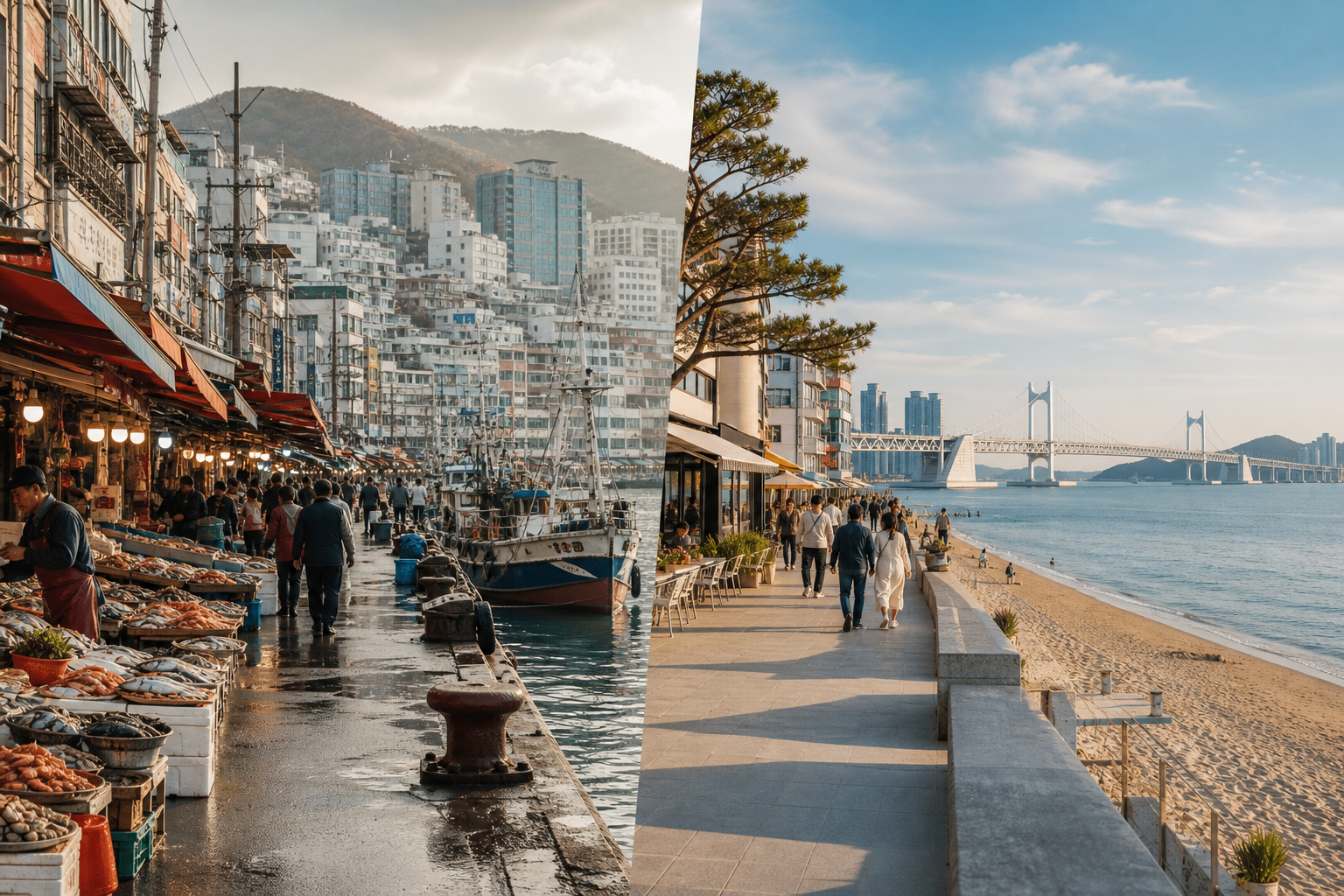
Nampo and Gwangalli are both good places to stay in Busan, but they are good in very different ways.
If you are deciding between them, the best answer is not about which area has “more things.” Both have enough to justify staying there. The better question is this:
Do you want your Busan base to feel more like old-city texture and food-driven exploration, or more like scenic waterfront evenings and a relaxed beach rhythm?
That is the real trade-off.
- Nampo is stronger for classic market energy, practical old-city sightseeing, and food-first travelers.
- Gwangalli is stronger for scenery, waterfront walks, and a more polished evening mood.
Neither is automatically better. The right answer depends on what kind of Busan trip you are actually trying to have.
Quick Answer: Nampo or Gwangalli for a First Busan Trip?
Choose Nampo if you want:
- easier access to classic markets and old Busan atmosphere
- a food-first travel rhythm
- practical sightseeing density
- a base that feels urban, local, and active
Choose Gwangalli if you want:
- sea views and a more scenic hotel area
- calmer waterfront evenings
- cafés and restaurants with atmosphere
- a more relaxed and couples-friendly stay feel
If you are unsure, the simpler rule is this:
- choose Nampo for food and old-city character
- choose Gwangalli for views and evening mood
Why This Comparison Is Different from Nampo vs Haeundae
This matters because many travelers flatten all Busan beach comparisons into the same answer.
That is a mistake.
Nampo vs Haeundae is often a question about old-city practicality versus a bigger, more resort-like beach zone.
Nampo vs Gwangalli is different.
Here, the tension is:
- historic-market city texture versus
- livable scenic beach atmosphere
Gwangalli is not trying to compete with Nampo on traditional market density. Nampo is not trying to compete with Gwangalli on waterfront mood. That makes this comparison cleaner and more useful.
Nampo: Best for Food, Markets, and Old Busan Character
Nampo is the stronger choice if you want your stay to feel rooted in the older, denser, more food-driven side of Busan.
It works well for travelers who enjoy:
- market streets
- seafood culture
- practical old-city sightseeing
- a more active urban atmosphere
This is the part of Busan where the trip can feel tactile and flavorful. It is less about broad scenic calm and more about being surrounded by movement, signs, food smells, and classic city texture.
Why Nampo works so well
Nampo is strong because it gives you:
- access to traditional-feeling Busan
- strong food logic
- dense sightseeing and walking potential
- a more budget-friendly practical feel in many cases
It also connects well to the kind of traveler who wants to explore Busan through markets, casual meals, and harbor-side city texture rather than through a beach-first stay.
Nampo is especially good for:
- food lovers
- travelers who want Jagalchi and nearby old-city energy in the trip mix
- travelers who like dense city walking over beach lounging
- first-time visitors who want Busan to feel more historic and less resort-like
The downside of Nampo
Nampo is not the strongest choice if your image of Busan includes nightly bridge views, waterfront cafés, and slow seaside walks.
It can also feel less calm than Gwangalli. If you want your hotel area itself to feel relaxing and visually open, Nampo may not deliver that in the same way.
Gwangalli: Best for Scenic Evenings and a Relaxed Waterfront Base
Gwangalli is the better choice if you want your hotel area to feel like part of the reward.
Visit Busan describes Gwangalli Beach as one of Busan’s representative hot spots and highlights its cafés, restaurants, and especially its nighttime atmosphere around Gwangandaegyo Bridge. That is exactly why Gwangalli works so well as a scenic stay district.
Why Gwangalli stands out
Gwangalli gives you:
- a more open and visually satisfying setting
- sea-facing cafés and restaurant options
- evening walks that feel like a built-in part of the trip
- a more relaxed mood than a denser old-city base
It is the better answer if you want Busan to feel slightly slower, prettier, and more stay-oriented.
Gwangalli is especially good for:
- couples
- scenic-stay travelers
- people who want their evenings to feel memorable without going full resort mode
- travelers who like beach atmosphere but do not need the biggest beach district
The downside of Gwangalli
Gwangalli is not as food-market-driven or old-city-rich as Nampo. If your trip is strongly anchored around classic seafood, market wandering, and that dense older Busan texture, Gwangalli may feel too polished or too mood-led.
Transport and Practical Movement
This comparison is more balanced than some travelers expect.
Nampo transport logic
Nampo works well if your trip is built around nearby old-city areas, markets, and harbor-side exploration.
Gwangalli transport logic
Gwangalli works well if you are comfortable shaping your trip around a scenic beach base and accepting that some city movement may feel a little less frictionless than a pure practical base.
Which feels easier?
If your goal is dense old-city access and food-led exploring, Nampo feels easier.
If your goal is relaxed evenings and scenic return-to-hotel energy, Gwangalli feels better.
Food and Evening Environment
This is the heart of the decision.
Nampo for food lovers
Nampo is usually the better answer if food is central to the trip. It is stronger for:
- market atmosphere
- seafood identity
- older-style local food exploration
- practical casual eating density
If the way you imagine Busan includes traditional markets, seafood, and a more classic city-food rhythm, Nampo is hard to beat.
Gwangalli for evening atmosphere
Gwangalli is better when you want:
- dinner with a view
- café time by the water
- scenic walks after dark
- a more visually rewarding hotel district
Food exists in both places. The difference is what kind of food environment you want around the stay.
Hotel Feel and Trip Mood
Nampo
Nampo feels:
- denser
- older
- more urban
- more food-led
- more practical than romantic
Gwangalli
Gwangalli feels:
- more open
- more scenic
- more date-friendly
- more evening-led
- more atmospheric than utilitarian
This is one of the clearest mood contrasts in the Busan stay cluster.
Which Area Fits Your Trip Style Best?
Choose Nampo if you are:
- a food-first traveler
- someone who wants classic old Busan texture
- someone who values markets and practical sightseeing density
- someone who prefers urban energy over beach mood
Choose Gwangalli if you are:
- a couples traveler
- a scenic-base traveler
- someone who wants calm waterfront evenings
- someone who wants the hotel area itself to feel beautiful and memorable
Final Recommendation
For a food-first or old-city-first Busan trip, choose Nampo.
For a scenic, relaxed, evening-atmosphere Busan trip, choose Gwangalli.
If you are completely split, use this simple rule:
- choose Nampo if your ideal Busan memory is a market meal
- choose Gwangalli if your ideal Busan memory is a bridge view after dinner
That is the clearest difference between the two.
Nampo gives you city texture. Gwangalli gives you stay atmosphere.
Neither is wrong. But they are not interchangeable.
Related Guides
- Best Areas to Stay in Busan: Haeundae vs Seomyeon vs Nampo for Different Travel Styles
- Seomyeon vs Nampo: Which Area Is Better for Your First Busan Trip?
- Nampo vs Haeundae: Which Area Is Better for Your First Busan Trip?
- Jagalchi Market in Busan: Seafood, Street Food, and Visitor Tips
FAQ
Is Nampo or Gwangalli better for first-time visitors?
It depends on what kind of Busan trip you want. Nampo is better for food and old-city character. Gwangalli is better for scenic evenings and waterfront atmosphere.
Which is better for food lovers, Nampo or Gwangalli?
Nampo is usually better for food lovers because of its market-driven and seafood-friendly travel logic.
Which is better for couples, Nampo or Gwangalli?
Gwangalli is usually better for couples because of the sea views, bridge scenery, and evening walking atmosphere.
Is Gwangalli more relaxing than Nampo?
Yes, for most travelers. Gwangalli usually feels calmer and more scenic, while Nampo feels denser and more urban.
Is Nampo too old-fashioned for a first Busan trip?
No. For many travelers, that older Busan character is exactly why Nampo works so well.