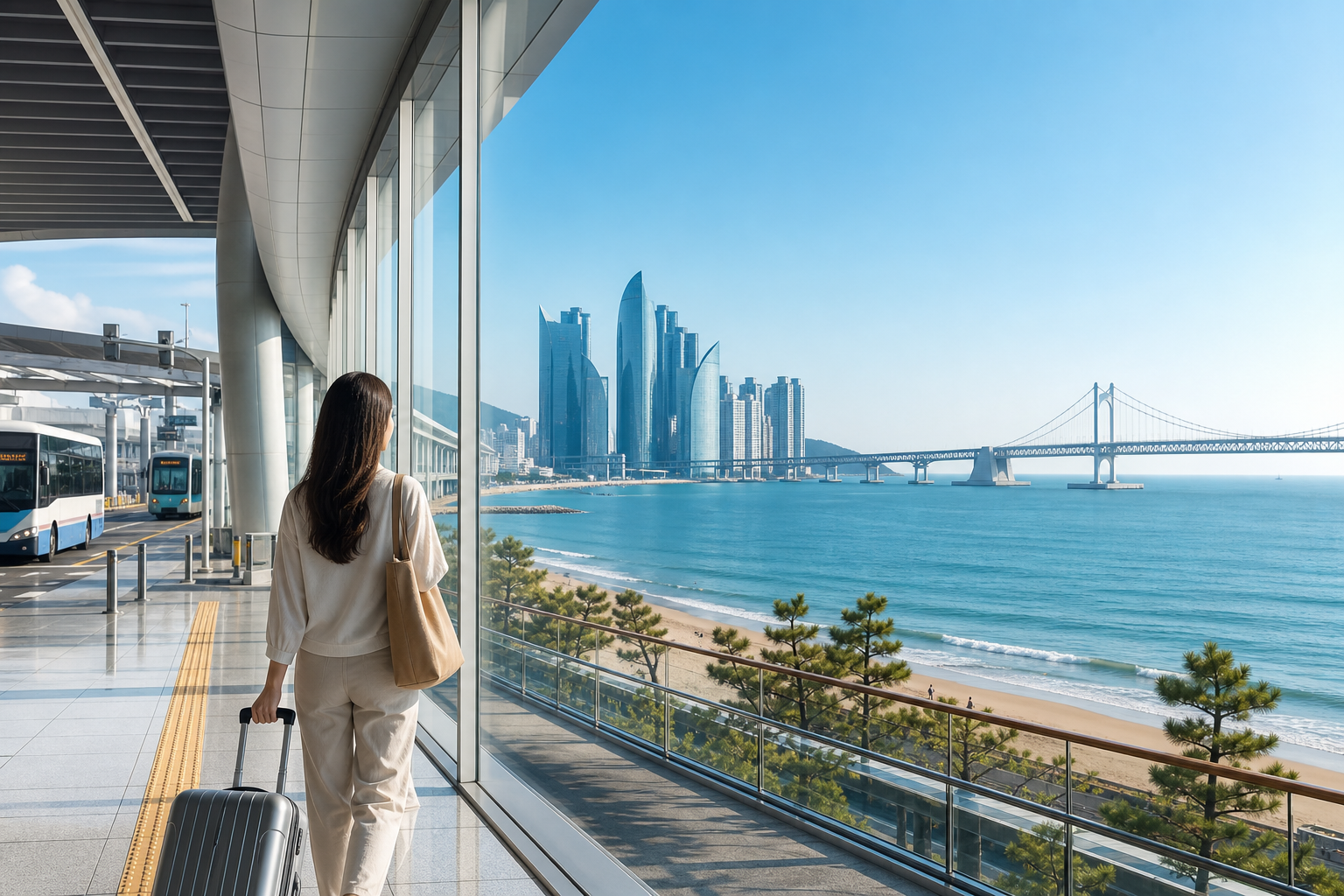
Getting from Gimhae Airport to Gwangalli is not difficult, but it is not quite as simple as going to a district that sits more directly on one obvious airport route.
That is why many first-time visitors hesitate here. They know Gwangalli is one of the best places to stay in Busan, especially if they want sea views, cafés, and a more atmospheric evening base. But once they land, the real question becomes practical: what is the easiest and smartest way to actually get there?
In most cases, you have three realistic choices:
- the Busan-Gimhae Light Rail Transit plus the subway
- a bus-based route
- a taxi
The best answer depends less on raw map distance and more on arrival friction. How much luggage do you have? Are you arriving during the day or late at night? Do you want the cheapest route, or do you want the easiest hotel arrival?
This guide is designed to answer that district-specific question so you can choose quickly.
Quick Answer: Best Way from Gimhae Airport to Gwangalli
For most first-time visitors, the smartest default is this:
- Use light rail and subway if you are arriving in normal daytime hours and traveling with manageable luggage.
- Use taxi if you are arriving late, carrying heavy bags, traveling with family, or simply want the easiest hotel-door arrival.
- Use a bus-based option only if it clearly reduces your transfers or your hotel is more convenient from that route.
This is not exactly the same logic as going to Seomyeon, where the transit answer feels more straightforward, and it is also not identical to Haeundae.
Gwangalli is a last-mile district. The city entry is easy enough, but the final segment matters more than many first-time visitors expect.
Why Gwangalli Is a Slightly Different Airport Transfer Case
According to Visit Busan, the Busan Metro includes subway lines 1 to 4, the Busan-Gimhae Light Rail Transit, and the Donghae Line, which together connect major areas across Busan and Gimhae. That broad system makes public transport a viable option from the airport.
But Gwangalli is not simply a “get on one obvious airport train and arrive directly at your hotel” district.
Visit Busan also notes that Gwangalli Beach is reached by walking about 13 minutes from Exit 5 of Gwangan Station on Busan Metro Line 2. That detail matters. Even after you get onto the right transit backbone, you still need to think about:
- one transfer between systems
- how far your hotel actually is from Gwangan Station
- whether a seaside-area walk with luggage sounds easy or annoying after a flight
That is why Gwangalli sits in a middle zone.
It is not a bad public-transport destination. But it is also not the cleanest low-friction rail arrival in Busan.
Option 1: Light Rail and Subway
For many travelers, this is the best value answer.
The broad logic is simple:
1. start on the Busan-Gimhae Light Rail Transit from the airport side 2. transfer into the Busan subway network 3. continue toward Gwangan Station on Line 2 4. walk or take a very short final ride to your hotel if needed
Why this option works well
This route is usually the best choice if you want:
- a predictable cost
- a reliable public-transport backbone
- no dependence on road traffic
- a practical daytime arrival plan
It also works well if you are the kind of traveler who does not mind one transfer and a short walk at the end.
If you have a carry-on suitcase, a backpack, or otherwise light luggage, the train-and-subway route is often the most efficient balance of cost and control.
Where this option becomes less attractive
The weakness is not the city-entry part. The weakness is the last stretch.
If your hotel is not especially close to Gwangan Station, or if you are arriving tired after a long flight, the final segment may feel more annoying than the map suggests. A seaside district can be pleasant once you are settled, but less pleasant when you are dragging luggage across sidewalks and crossings.
This option becomes less attractive if:
- you are landing late at night
- you have large suitcases
- you are traveling with children
- you want the simplest possible hotel arrival
- your hotel is meaningfully far from the station
Who should choose light rail and subway
Choose this if you are:
- a solo traveler or couple with manageable baggage
- arriving in normal daytime or early evening hours
- comfortable with one transfer
- trying to keep transport costs reasonable
For these travelers, rail-plus-subway is usually the best default public-transport answer.
Option 2: Bus or Airport Limousine Logic
Bus options can make sense, but this is where first-time travelers need to think carefully instead of assuming all bus routes are equally useful.
Visit Busan notes that Busan’s airport limousine to Haeundae follows a route that also stops in Gwangan-dong and Suyeong Junction, and that it takes about an hour, roughly similar to the metro in overall time. It also explicitly notes that this kind of route can be the better choice if dragging luggage and transferring between subway lines feels difficult.
That is the key lesson for Gwangalli.
Why bus can be useful for Gwangalli
A bus-based route can be a smart compromise when:
- you want fewer stair-heavy transfers
- your hotel is easier to reach from a surface-road stop
- you are willing to trade some predictability for simpler baggage handling
For some travelers, the best bus route is not about being faster. It is about being less annoying.
If you can get meaningfully closer to your hotel with less transfer pain, bus may beat subway even when the total travel time looks similar.
The downside of bus
Bus is usually less predictable than rail. Traffic conditions matter. Exact stop location matters. Luggage rules also matter.
Visit Busan notes practical limits for luggage on ordinary city buses and recommends using the subway, airport limousine bus, or taxi when your luggage is too bulky.
That means the bus option is not automatically the best “luggage solution” unless you are using the right type of route and it actually reduces friction for your exact hotel.
Who should choose bus
Choose bus when:
- you have enough luggage that multiple rail transfers sound annoying
- your arrival is not too late
- your hotel is easier from a Gwangalli-side or Suyeong-side stop
- you have checked the route and it clearly saves effort
For most first-time visitors, bus is the situational challenger, not the universal default.
Option 3: Taxi
Taxi is the easiest answer, and for many travelers it is the correct one.
If your priority is comfort, hotel-door simplicity, or low mental load after arrival, taxi often wins immediately.
Why taxi works so well here
Gwangalli is a scenic area, but the hotel-arrival experience can vary more than people expect. Some properties are close to the beach, some are tucked into side streets, and some are simply easier to reach by road than by dragging bags from a station.
Taxi removes:
- transfer decisions
- station-to-hotel walking burden
- uncertainty about which exit to use
- weather discomfort if it is hot, rainy, or humid
This is especially valuable after a long flight.
When taxi is the best choice
Taxi is usually the best choice if:
- you arrive late at night
- you are traveling with family
- you have heavy or bulky luggage
- you are staying only a short time and want to save energy
- you value convenience more than transport savings
When taxi is not necessary
If you are arriving in daylight, traveling light, and comfortable with public transit, taxi may simply be an unnecessary extra cost. Gwangalli is not so inaccessible that everyone needs a car ride from the airport.
Taxi is the comfort override, not the only realistic option.
Best Option by Traveler Type
Solo traveler or couple with light luggage
Start with light rail and subway.
This is usually the best balance of predictability, cost, and practicality.
Family with children or multiple large suitcases
Start with taxi.
The easier hotel arrival matters more than squeezing out a cheaper transit route.
Traveler who dislikes transfers but still wants to avoid taxi if possible
Check a bus or airport-limousine-style route first.
If it gets you significantly closer with less carrying, it can be the smartest middle option.
Late-night arrival
Default to taxi unless you already know the public route well and your hotel arrival is simple.
Late arrivals make last-mile friction feel worse, not better.
Best Option by Priority
Cheapest practical option
Light rail and subway
Most predictable route
Light rail and subway
Easiest arrival with heavy luggage
Taxi
Best compromise between convenience and cost
Bus, if it clearly reduces transfer burden for your hotel
Lowest-stress option after a long flight
Taxi
Common Mistakes First-Time Visitors Make
1. Assuming Gwangalli is a direct airport-rail district
It is very reachable, but the final segment matters more than it would in a cleaner rail-default district.
2. Looking only at travel time
A route that is only a little cheaper or a little faster may still be worse if it adds awkward transfers and a luggage-heavy walk.
3. Ignoring hotel micro-location
“Gwangalli” on a booking site does not always mean “easy from the station with bags.” Check the actual map.
4. Treating bus as automatically easier
Sometimes it is. Sometimes it is not. The value of the bus option depends on where you get off and how much last-mile effort it removes.
5. Over-saving on arrival day
Saving money is good. Starting the trip exhausted and irritated is not.
Final Recommendation
For most first-time visitors, the practical ranking is this:
1. Light rail and subway if you are traveling light and arriving in normal hours 2. Taxi if convenience, late arrival, or luggage burden matters most 3. Bus when it clearly reduces transfer pain for your exact hotel location
That is the real Gwangalli answer.
The district is absolutely worth staying in, especially if you want sea views, evening walks, cafés, and a more atmospheric Busan base. But it is best approached with rail-backbone vs last-mile friction logic, not with a vague “public transport is always best” mindset.
If you want the cheapest sensible route, start with light rail and subway. If you want the easiest hotel arrival, take a taxi. If you want a middle option, check whether a bus-based route meaningfully reduces the final carry.
Related Guides
- Best Areas to Stay in Busan: Haeundae vs Seomyeon vs Nampo for Different Travel Styles
- Gimhae Airport to Busan: Subway, Bus, or Taxi for First-Time Visitors
- Haeundae vs Gwangalli: Which Area Is Better for Your First Busan Trip?
- Best Area to Stay in Busan for Families: Haeundae vs Gwangalli vs Seomyeon
FAQ
What is the best way to get from Gimhae Airport to Gwangalli?
For most travelers, light rail and subway are the best default if luggage is manageable. Taxi is better for late arrivals, families, or heavy bags.
Is Gwangalli easy to reach by subway from Gimhae Airport?
Yes, but it is not a pure one-step airport-rail district. The transfer and final walk still matter.
Is taxi from Gimhae Airport to Gwangalli worth it?
Yes, especially if you arrive tired, late, or with bulky luggage. The value is convenience rather than raw speed alone.
Is bus or subway better for Gwangalli?
Subway/light rail is usually the more predictable default. Bus can be better when it reduces transfer burden and gets you closer to your hotel.
Which station is closest to Gwangalli Beach?
Visit Busan notes that Gwangalli Beach is about a 13-minute walk from Exit 5 of Gwangan Station on Busan Metro Line 2.