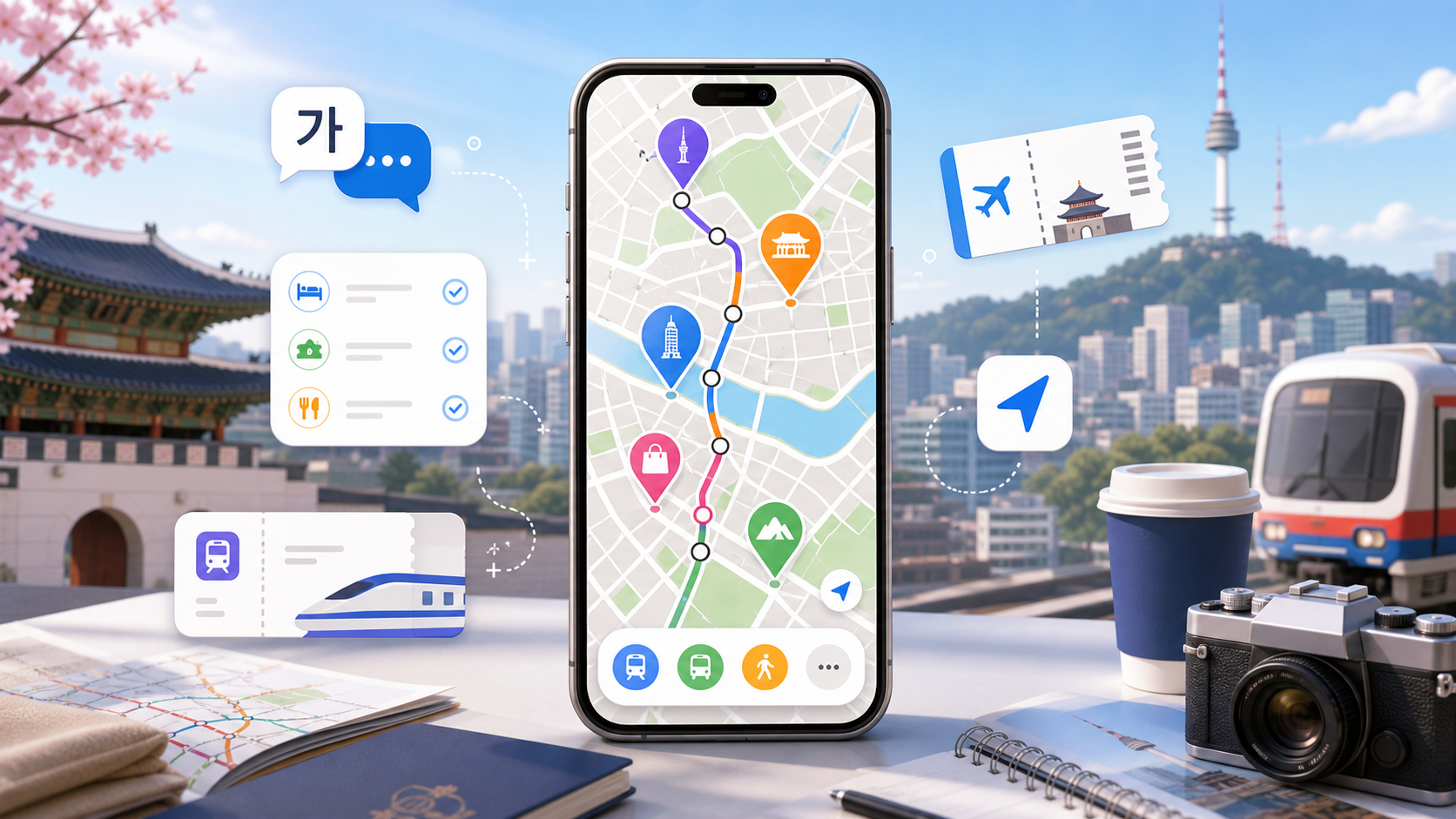
Korea is highly connected, but first-time visitors often discover one thing quickly: the app stack that works at home may not be the best tool stack in Korea. Search, maps, transit routing, restaurant names, and station exits can behave differently from what you expect, especially if you rely on one familiar global app for everything.
The good news is that you do not need dozens of downloads. For a first trip, the goal is to build a small, reliable app setup that helps you answer four daily questions:
- Where am I going?
- How do I get there by subway, bus, train, or taxi?
- How do I understand signs, menus, and messages?
- How do I keep bookings, timing, and backup plans organized?
Use this guide as a practical pre-arrival checklist rather than a ranking of every app available.
Quick Answer: App Categories First-Time Visitors Need
For most first trips to Korea, install and test apps in these categories before you fly:
- Map and place search app: for walking routes, place names, reviews, station exits, and nearby restaurants or cafes.
- Subway and bus navigation app: for route options, transfers, platform direction, and arrival estimates.
- Intercity rail or bus planning tools: useful if your route includes Busan, Gyeongju, Jeonju, or another city beyond Seoul.
- Translation app: for menus, signs, product labels, taxi conversations, and hotel messages.
- Booking apps: for flights, hotels, activities, and reservation records.
- Airline and accommodation apps: for check-in notices, address details, and arrival instructions.
- Payment and connectivity support: not always a single app, but you should prepare mobile data, card readiness, and any payment tools you plan to use.
- Cloud notes or itinerary app: for offline copies of addresses, booking numbers, and backup plans.
If you want only the shortest version: prepare one Korea-friendly map app, one transit app, one translation app, your booking apps, and offline copies of all key addresses. Then test them while still at home.
For broader arrival and transport planning, pair this app setup with the Korea transport and arrival guide and the site’s essential transportation apps guide.
Recommended Korea travel app stack for first-time visitors
| Need | Common app options | Use for | Foreigner caveat / backup |
|---|---|---|---|
| Map and local search | Naver Map, KakaoMap | Walking routes, subway exits, Korean place names, local search | Save Korean names/addresses because English spellings can vary |
| Subway and bus planning | Naver Map, KakaoMap, Subway Korea-style subway apps | Transit routes, station exits, transfer timing | Keep screenshots for key routes in case data drops underground |
| Taxi | Kakao T and hotel/concierge taxi help as backup | Taxi requests, destination communication | Foreign phone numbers, local accounts, and payment methods may not work for every user |
| Translation | Papago, Google Translate | Menus, signs, messages, camera translation | Save essential phrases and hotel addresses offline |
| Rail / intercity movement | Korail/KTX tools, station counters, intercity booking tools | Train or bus planning between cities | Card acceptance, seat availability, and interface language can vary |
| Booking and itinerary | Your hotel/airline apps, calendar, notes, offline PDFs | Reservations, addresses, confirmation numbers | Do not depend on one app; keep offline copies |
| Connectivity | eSIM provider app, pocket WiFi instructions, roaming app | Activation, troubleshooting, support details | Test setup before departure when possible |
App caveat: app availability, features, language support, foreign-card acceptance, phone-number verification, account requirements, and payment options can change. Treat the apps above as common options, not guaranteed solutions, and test critical tools before departure.
Map and Navigation Apps
Why Korea Map Apps Matter
In Korea, maps are not just for finding streets. They help you identify building entrances, subway exits, bus stops, cafe locations inside larger buildings, and the Korean name of a place. This matters because many addresses and business names may appear differently in English, romanized Korean, and Hangul.
A good map setup should help you:
- Search by English name, Korean name, or address.
- See walking routes from station exits.
- Check nearby bus stops and subway stations.
- Save places before the trip.
- Show your destination to a taxi driver or hotel staff member.
- Confirm whether a place is inside a mall, station, basement level, or upper floor.
Do not assume one familiar map app will handle every local search perfectly. It may still be useful for general orientation, but Korea-specific map apps often perform better for local business search and transit details.
What to Save Before Arrival
Before you land, save these places in your map app:
- Your first hotel or guesthouse.
- The nearest subway station to your accommodation.
- A backup airport transfer destination, such as a major station or airport bus stop near your hotel.
- Your first meal option near the hotel.
- A convenience store or pharmacy near the hotel.
- Major sights you already know you want to visit.
- The departure station for any intercity train or bus.
For each important place, save both the English name and the Korean name when possible. If your hotel confirmation includes a Korean address, keep it in your notes as well.
Map App Tips for Walking Routes
Walking navigation is where small details make a big difference. When checking a route, look for:
- Station exit number: Large subway stations can have many exits, and choosing the wrong one can add unnecessary walking.
- Road crossings: Some intersections require underpasses, overpasses, or specific crosswalks.
- Building level: Restaurants, clinics, cafes, and shops may be above street level or underground.
- Landmarks: Department stores, station names, and hotel signs are often easier to recognize than small street names.
- Last train or bus timing: If you will be out late, do not rely only on the route that works during the afternoon.
A practical habit: when you are leaving your hotel, take a screenshot of the map route and the destination name. If mobile data drops or the app refreshes slowly underground, you still have a reference.
Subway, Bus, and Rail Planning Apps
Subway Apps
For first-time visitors, subway apps are especially useful in Seoul and Busan. They help you understand not only which line to take, but also transfer stations, estimated travel time, and direction of travel.
Look for features such as:
- Route search between stations.
- Transfer count and expected time.
- Last train information or late-night cautions.
- Station exit information.
- Line color and station number display.
- Offline or low-data subway map access.
Subway systems in Korea are efficient, but large transfer stations can be confusing on a first day. If the app suggests a route with several transfers, compare it with a slightly longer but simpler route. For tired arrival days, fewer transfers can be better than the theoretically fastest route.
Bus Navigation Apps
Buses can be very useful in Korea, but they are less beginner-proof than the subway if you do not prepare. Bus stops can be on opposite sides of the road, routes may have similar numbers, and getting off at the correct stop requires attention.
Use bus navigation when it clearly improves your route, especially for:
- Short trips between neighborhoods not directly connected by subway.
- Destinations on hills or away from metro stations.
- Routes in cities where buses are more convenient than rail.
- Late-evening trips when a direct bus avoids a long transfer.
Before boarding, check:
- The bus number.
- The stop name and direction.
- The number of stops before you get off.
- Whether your app shows live or estimated arrival information.
- A nearby landmark at your destination stop.
If you are anxious about missing your stop, sit or stand where you can see the onboard display, follow your location on the map, and press the stop button when your destination is next.
Airport Transfer Planning
Your first app test should be your airport-to-hotel route. Search it before departure, not after landing when you may be tired and carrying luggage.
For the first arrival route, compare:
- Airport railroad or metro connections.
- Airport limousine bus routes.
- Taxi or ride-hailing options where suitable.
- Walking distance from the final station or stop to your hotel.
- Transfer count with luggage.
- Whether the route still works at your arrival time.
If you are arriving through Incheon or Gimpo and want to understand the main transfer choices before you open navigation apps, use the Incheon and Gimpo airport transportation guide.
Intercity Rail and Bus Tools
If your first trip includes more than Seoul, you may need apps or websites for train and intercity bus planning. This is especially relevant for routes involving Busan, Gyeongju, Jeonju, or other regional stops.
Use intercity planning tools to confirm:
- Departure station or terminal.
- Arrival station or terminal.
- Travel duration.
- Seat reservation status.
- Luggage practicality.
- Whether your hotel is near the arrival point.
- Backup departures if your preferred time is full or inconvenient.
Do not leave this planning until the morning of travel if you have a fixed hotel booking in another city. Even when tickets are available, a poorly timed departure can make the day feel rushed.
For a full trip structure beyond individual apps, start with Plan your Korea trip.
Translation and Communication Apps
Translation Apps for Menus, Signs, and Messages
A translation app is one of the most useful tools for a first trip to Korea. You may not need it constantly in major tourist areas, but it becomes very helpful for local restaurants, product labels, ticket machines, notices, and short conversations.
Prioritize translation features that support:
- Camera translation for menus and signs.
- Text translation between English and Korean.
- Voice translation for short exchanges.
- Copy-and-paste translation for hotel or booking messages.
- Offline language packs if available.
Camera translation is useful, but do not treat it as perfect. Menu names, allergens, opening notices, and instructions can translate awkwardly. If something is important, confirm with staff or use simple written phrases.
Phrases to Keep Ready
Save a few short phrases in your notes app so you can show them quickly:
- “Hello, I have a reservation under this name.”
- “Can I leave my luggage here until check-in?”
- “Does this contain meat, seafood, nuts, or dairy?”
- “Please take me to this address.”
- “Where is the nearest subway entrance?”
- “Can I pay by card?”
- “Could you please help me call a taxi?”
Keep sentences simple. Translation apps usually handle direct, short wording better than long explanations.
Using Translation Without Slowing Everything Down
Translation apps are helpful, but overusing them can make simple moments feel more complicated than necessary. Use visual clues first when the situation is obvious, such as subway line colors, elevator icons, toilet signs, and platform numbers.
Use translation actively when:
- You are ordering from a menu with no pictures or English.
- You need to understand a notice about closure, waiting, or queueing.
- You are checking product ingredients.
- You are confirming hotel instructions.
- You are asking for help with luggage, directions, or reservations.
A good travel rhythm is to translate before you reach the counter when possible. For example, review the menu while waiting rather than starting only when staff are ready for your order.
Payment, Connectivity, and Readiness
Mobile Data Comes Before Apps
Apps are only useful if you can connect. Before arrival, decide how you will get mobile data through roaming, eSIM, SIM card, pocket Wi-Fi, or another option that fits your phone and travel style.
For a first trip, prioritize reliability over chasing the most complicated setup. You need enough connectivity for:
- Map searches.
- Transit routing.
- Translation.
- Messaging your accommodation.
- Accessing booking confirmations.
- Emergency contact and backup navigation.
Even with mobile data, keep offline backups. Screenshots and downloaded documents can save time when you are underground, in a station, or dealing with a weak signal.
Payment Readiness
Korea is card-friendly in many everyday travel situations, but payment experiences can vary by business, card type, app, and whether a service supports foreign users. Avoid building your whole trip around one payment method.
Before you travel:
- Notify your bank or card issuer if needed.
- Bring more than one card if possible.
- Keep a small cash backup for situations where a card is not accepted or a machine is difficult to use.
- Check whether your transit card plan requires cash top-ups or can be handled another way.
- Do not assume every local payment or ordering app will accept foreign cards or foreign phone numbers.
For transport specifically, read the essential transportation apps for Korea guide alongside this article.
Account Verification and Phone Numbers
Some apps or services may require account verification, a phone number, email confirmation, or identity checks. This can become frustrating if you first discover it at an airport, station, or restaurant.
Before arrival, open each important app and check:
- Can you create an account from your country?
- Does it accept your phone number format?
- Does it send verification messages correctly?
- Can you add a payment card if required?
- Can you search and save places without a local number?
- Can you receive booking notifications by email as a backup?
If an app does not work fully for you, keep it as a reference tool but prepare an alternative.
Booking and Itinerary Support
Hotel and Flight Apps
Install the apps or save mobile web logins for your airline and accommodation booking platform. You do not need to use them constantly, but they are useful when timing changes or you need to show details quickly.
Keep easy access to:
- Flight number and terminal details.
- Hotel name in English and Korean if available.
- Hotel address and phone number.
- Check-in and checkout times.
- Reservation number.
- Message thread with the accommodation.
- Cancellation or change terms, if relevant.
Also save a screenshot or PDF of the hotel address. If you take a taxi, the Korean address and phone number can be more useful than an English hotel name.
Activity and Restaurant Booking Tools
Depending on your travel style, you may use apps or websites for tours, attractions, performances, beauty services, restaurants, or experiences. For a first trip, the key is not to book everything; it is to know which items truly need advance planning.
Consider booking ahead when:
- The experience has limited time slots.
- You are traveling during a busy holiday or peak season.
- It is a special meal or event you would be disappointed to miss.
- The location is far from your hotel and requires coordination.
- You need English-language support or clear instructions.
Leave flexibility for everyday cafes, casual restaurants, shopping, and neighborhood exploring. Korea rewards wandering, and an overbooked itinerary can make transit delays feel stressful.
Notes, Calendar, and Offline Files
A simple notes app can be more valuable than another specialized travel app. Create one Korea trip note with:
- Daily outline.
- Hotel addresses.
- Airport transfer plan.
- Intercity travel details.
- Booking reference numbers.
- Important Korean names and addresses.
- Backup rainy-day ideas.
- Emergency contacts.
- Passport and insurance reference details, stored securely.
Add key timed items to your calendar, especially flights, train departures, hotel check-in, tours, and restaurant reservations. Set alerts with enough margin for transit.
What to Set Up Before Arrival
One Week Before Travel
Use the week before departure to install, test, and simplify your app setup.
Do this before you fly:
- Install your map, transit, translation, airline, hotel, and booking apps.
- Create accounts where needed.
- Confirm you can log in without SMS problems.
- Save your hotel and first-day destinations.
- Screenshot your airport transfer route.
- Download or screenshot booking confirmations.
- Prepare a mobile data plan.
- Add important reservations to your calendar.
- Save a note with Korean addresses and phone numbers.
This is also the best time to remove unnecessary apps. Too many tools can create confusion when you are tired, jet-lagged, or trying to move quickly through a station.
The Day Before Departure
The day before you travel, check that the setup still works:
- Open each essential app once.
- Make sure your passwords or password manager are accessible.
- Save offline copies of hotel and flight details.
- Charge your phone and power bank.
- Turn on roaming settings only as appropriate for your plan.
- Confirm your first transport route from the airport.
- Write down your hotel address somewhere outside your phone if possible.
If you are traveling with another person, make sure more than one phone has the key information. Do not let the entire trip depend on one battery.
Arrival-Day App Routine
When you land, keep the first hour simple:
- Connect to mobile data or airport Wi-Fi.
- Check messages from your airline or accommodation.
- Open your saved airport transfer route.
- Confirm your hotel address.
- Use translation only when needed for signs, machines, or staff help.
- Avoid making major itinerary changes while tired unless necessary.
Your goal on arrival day is not to master every app. It is to reach your accommodation smoothly, eat something manageable, and prepare for the first full day.
App Mistakes to Avoid
Relying on Only One Map App
One app may be enough on some trips, but Korea is easier when you have a backup. If a search result looks wrong, compare the Korean name, address, or nearby station in another tool before walking across town.
Not Saving Korean Names and Addresses
English names can vary. A hotel, restaurant, or attraction may appear under a slightly different spelling in different apps. Saving the Korean name or address reduces confusion, especially for taxis and local search.
Testing Apps Only After Landing
Airport arrivals are the worst time to discover login issues, missing passwords, verification problems, or incompatible payment methods. Test essential apps before departure.
Forgetting Battery Management
Navigation, translation, and camera use drain battery quickly. Carry a power bank if you will be out all day, and keep charging cables accessible rather than buried in luggage.
Ignoring Station Exits
A route that simply says “arrive at the station” is incomplete. Large stations can place you far from your destination if you choose the wrong exit. Check exit numbers and walking routes before leaving the platform area.
Assuming Every App Accepts Foreign Cards
Some local services may not work smoothly with foreign cards, foreign phone numbers, or overseas app accounts. If an app is important to your plan, test payment or booking functionality before you depend on it.
Overloading Your Phone With Too Many Tools
More apps do not always mean better travel. A small set of tested tools is better than a crowded screen of apps you do not understand. Put your Korea essentials in one folder and keep the first screen simple.
Final Advice: Build a Small, Tested App Stack
For a first trip to Korea, the best app setup is not the longest list. It is the smallest set of tools that reliably answers your daily travel questions.
Before departure, make sure you have:
- One dependable map and local search tool.
- One transit planner you understand.
- One translation app with camera translation.
- Booking apps or saved mobile confirmations.
- A mobile data plan and battery backup.
- Offline copies of your hotel address, airport route, and reservations.
Then use apps to support the trip, not control it. Korea is easy to explore once you understand the basics: save your destinations, check station exits, keep Korean addresses handy, and leave enough time for transfers. A little setup before arrival can make your first few days feel much calmer.
Related Guides
- Plan your Korea trip — Use this for the bigger route, timing, and itinerary structure behind your app choices.
- Korea transport and arrival guide — Helpful for understanding how airports, trains, subways, buses, and local transfers fit together.
- Essential transportation apps for navigating Korea — A focused companion guide for transport-specific app planning.
- Incheon and Gimpo airport transportation guide — Useful when comparing airport transfer options before your first arrival day.