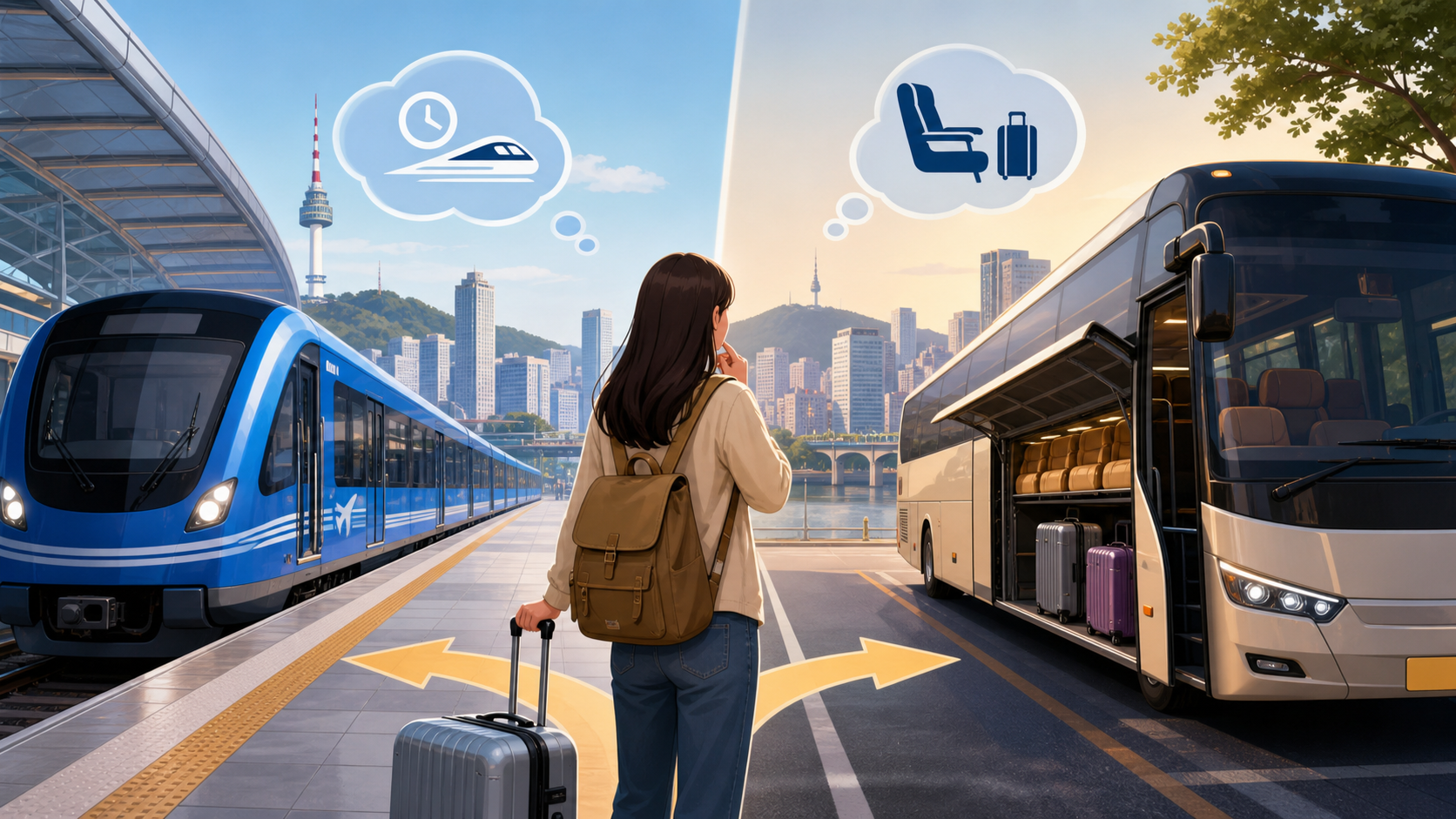
For many first-time visitors, the first real decision in Korea happens at the airport: should you take AREX or the airport limousine bus into Seoul?
Both can be good choices. The better transfer depends less on which one is “best” overall and more on your hotel location, luggage, arrival time, comfort with stations, and tolerance for traffic or transfers.
If you want the full airport overview before comparing specific modes, read the Incheon and Gimpo airport transportation guide and the broader Korea transport and arrival guide. This article focuses on the practical first-trip choice: AREX train or airport limousine bus.
Quick answer by traveler type
Choose AREX if your hotel is convenient from Seoul Station, Hongik University Station, or another easy rail connection, your luggage is manageable, and you prefer a predictable train-based transfer.
Choose the airport limousine bus if a bus stop is close to your hotel, you have larger luggage, you want fewer transfers, or you would rather sit through the ride than navigate stations after a long flight.
Here is the simple decision guide:
- Staying near Hongdae/Hongik University: AREX can be very convenient if your hotel is close to the right station exit.
- Staying in Myeongdong: airport limousine bus may be easier if it stops near your hotel, but AREX plus a connection can work for some locations.
- Staying near Seoul Station: AREX is often the most logical option if the final walk is manageable.
- Traveling with large luggage or children: airport limousine bus or taxi may feel easier than train transfers.
- Arriving during heavy road traffic: AREX may feel more predictable.
- Arriving late or tired: choose the option with the fewest steps from airport to hotel door, not the one that looks fastest in theory.
The best transfer is the one that gets you from the arrivals hall to your accommodation with the least friction.
AREX vs airport bus: quick comparison
| Decision point | AREX is usually better when… | Airport limousine bus is usually better when… |
|---|---|---|
| Hotel location | Your hotel is close to Seoul Station or an easy subway transfer | Your hotel is near a direct airport-bus stop |
| Luggage | You pack light and can handle station transfers | You have large suitcases, family luggage, or low energy |
| Traffic risk | You want a rail-based route with less road-traffic exposure | You prefer fewer stairs/transfers even if road traffic varies |
| Late arrival | Current train times still fit your landing and immigration timing | A bus/taxi option is operating closer to your final hotel timing |
Late-arrival caveat: AREX, subway, airport bus, and taxi options vary by date and time. Check official airport, AREX, and airport-bus schedules for your exact arrival day before choosing a late-night transfer plan.
How AREX and airport limousine buses differ
AREX and airport limousine buses solve the same problem in different ways.
AREX in simple terms
AREX is the airport rail system connecting Incheon Airport with key rail points in Seoul, including Seoul Station and Hongik University Station. It is useful when your accommodation connects well to the rail network.
AREX is usually appealing because:
- train travel is not affected by road traffic in the same way buses are
- the route is easy to understand if you are comfortable with stations
- it connects well with Seoul Station and Hongdae
- it can be efficient for travelers with light or moderate luggage
- it fits naturally with onward subway or rail connections
The tradeoff is that the train may not take you close to your hotel door. You may still need a subway transfer, walk, taxi, or station exit navigation.
Airport limousine bus in simple terms
Airport limousine buses connect the airport with major hotel districts, neighborhoods, and transport points. They can be especially useful when a stop is close to your hotel.
Airport buses are appealing because:
- they often reduce the number of transfers
- luggage is usually handled more easily than on subway stairs or platforms
- you can sit for the journey
- they may stop close to hotels or tourist districts
- they are less mentally demanding after a long flight
The tradeoff is traffic. Travel time can vary depending on road conditions, time of day, and your exact destination.
When AREX is better
AREX is often the better choice when your destination lines up naturally with the rail route.
Choose AREX when your hotel is close to a useful station
AREX works best if your accommodation is near:
- Seoul Station
- Hongik University Station
- a simple subway connection from AREX
- a station with an easy exit and manageable final walk
The final walk matters. A hotel that is “near the station” may still be awkward if the exit is far, the route has stairs, or the sidewalk is crowded. Check your exact hotel location, not just the neighborhood name.
Choose AREX when traffic risk matters
If you arrive at a time when road traffic may be heavy, the train can feel more predictable. You still need to account for walking, ticketing, platforms, and transfers, but the main rail segment is not delayed by city traffic in the same way a bus can be.
This matters most when:
- you have a tight evening plan
- you are connecting to a train from Seoul Station
- you dislike uncertain road travel
- your hotel is genuinely convenient from an AREX-connected stop
Do not choose AREX only because it sounds faster. Choose it when the whole route is faster or easier, including the last part to your hotel.
Choose AREX when you pack light
AREX is easier with:
- one suitcase per person
- bags you can lift if needed
- travelers who can walk through stations comfortably
- a group that can move together without slowing down
It becomes less pleasant with multiple large suitcases, young children, mobility limitations, or a hotel that requires a difficult transfer after the train.
Choose AREX for Seoul Station connections
If you are staying near Seoul Station or connecting to a train, AREX can be very logical. Seoul Station is a major hub, but it is also large. Build in time for walking, signs, elevators, and orientation if this is your first time in Korea.
AREX to Seoul Station is not the same as “arrive at hotel.” Make sure you know what happens after you reach the station.
When limousine bus is better
Airport limousine buses are often better when you want a simpler door-to-district journey.
Choose the bus when the stop is near your hotel
The airport limousine bus can be the easiest option if it stops close to your accommodation. This is especially helpful in areas with many hotels, major roads, and recognizable stops.
Before choosing the bus, check:
- the nearest airport bus stop to your hotel
- whether the stop serves your airport terminal and direction
- how far you must walk from the stop
- whether the walk is manageable with luggage
- whether your arrival time matches reasonable service availability
A bus stop five minutes from your hotel can be easier than a train route that requires multiple transfers.
Choose the bus when you have heavier luggage
The bus can be more comfortable if you have:
- large suitcases
- multiple bags
- a stroller
- shopping or sports equipment
- a family group that moves slowly
You still need to manage your bags at the airport and at the bus stop, but you may avoid stairs, station corridors, crowded subway cars, and complex transfers.
Choose the bus when you are tired
After a long flight, the easiest route is often the one with fewer decisions. A bus can be less stressful because you board once, sit down, and get off near your district.
This is useful if:
- it is your first time in Korea
- you are arriving after a long-haul flight
- you do not want to navigate the subway immediately
- your group includes tired travelers
- you value comfort over theoretical speed
Choose the bus for hotel-district convenience
Many first-time visitors stay in central hotel areas where airport buses may be practical. If a bus stop is near your hotel, it can be a strong arrival-day choice even if the train looks faster on a map.
The main risk is road traffic. If your schedule is tight, avoid assuming the bus will arrive at the fastest possible time.
Myeongdong/Hongdae/Seoul Station decision logic
Your neighborhood is the biggest factor in the AREX vs airport bus decision. Do not choose your transfer in isolation. Choose it based on the exact hotel address.
Myeongdong
Myeongdong is a popular first-time base because it is central, practical, and full of hotels, restaurants, shopping streets, and transit access. The best airport transfer depends on where in Myeongdong your hotel is located.
The airport limousine bus may be better if:
- there is a stop close to your hotel
- you have large luggage
- you want fewer transfers
- you arrive tired and want a simple route
AREX may be better if:
- you are comfortable transferring from Seoul Station
- your hotel is easy to reach by subway or taxi after AREX
- traffic risk is a concern
- you are packing light
For a detailed area-specific comparison, use the Incheon Airport to Myeongdong guide. The right answer can change from one hotel to another.
Hongdae
Hongdae is one of the clearest cases where AREX can work very well, especially if your accommodation is close to Hongik University Station. The airport rail connection is one reason Hongdae is attractive for some first-time visitors.
AREX may be better if:
- your hotel is near Hongik University Station
- you have manageable luggage
- you arrive during normal operating hours
- you want a direct rail-based route from the airport area
The airport limousine bus may be better if:
- your hotel is far from the station exit
- your luggage is heavy
- your group would struggle with station navigation
- a bus stop is closer to your actual accommodation
Hongdae is lively and spread out, so do not assume every “Hongdae” hotel is equally convenient. Check the Incheon Airport to Hongdae guide before deciding.
Seoul Station
If you are staying near Seoul Station, AREX is often the most logical choice because the rail route aligns with your destination. It can also be useful if you are connecting to intercity rail.
However, Seoul Station is large and can feel busy on a first arrival. Think through:
- which exit you need
- whether your hotel is on an easy walking route
- whether elevators or escalators are available where needed
- whether a short taxi from the station would reduce stress
- how your group handles large stations with luggage
The airport bus may still make sense if it stops closer to your hotel than the train platform does in practical terms.
Other Seoul areas
For areas outside Myeongdong, Hongdae, and Seoul Station, use the same logic:
- Find the nearest airport bus stop.
- Find the nearest useful AREX or subway connection.
- Compare the full route to your hotel door.
- Consider luggage, time of day, and energy level.
- Choose the route with fewer failure points.
A transfer with one simple bus ride can beat a faster train route with two confusing transfers. A direct rail route can beat a bus route during heavy traffic. Context matters.
Luggage and late arrival considerations
Luggage and arrival time can change the best answer quickly.
If you have only carry-on luggage
With carry-on luggage, AREX becomes easier. You can move through stations more comfortably, handle stairs or escalators if needed, and adjust if your route changes.
You still need to check the final walk. Carry-on luggage does not make a distant hotel close.
If you have large suitcases
With large suitcases, the airport limousine bus often becomes more appealing, especially if the stop is near your hotel. Reducing transfers can matter more than saving a small amount of time.
Large luggage makes these things harder:
- crowded subway platforms
- station corridors
- stairs
- narrow sidewalks
- finding the correct exit
- moving as a group
If the bus gets you close, it may be the calmer first-trip choice.
If you arrive late at night
Late arrivals require extra caution. Service frequency, operating hours, hotel reception, and tiredness all matter. Do not rely on a transfer plan without checking that it works for your actual landing time and terminal.
For late arrivals, ask:
- Will this option still be operating after immigration and baggage claim?
- How long will it take to reach the platform or bus stop?
- Is my hotel check-in available late?
- Would a taxi or private transfer be simpler for this specific night?
- Is the final walk safe and easy with luggage?
Late at night, the best route is often the most direct and least confusing, even if it is not the cheapest.
If you travel with children or older relatives
For families or multi-generation groups, prioritize comfort and simplicity. A route that is fine for one adult with a backpack may be frustrating for a group with suitcases, strollers, or tired travelers.
Airport buses, taxis, or private transfers may be worth considering if they reduce walking and transfers. AREX can still work if your hotel is genuinely convenient from the station.
If you are changing cities soon after arrival
If you plan to go from the airport to Seoul Station for an onward train, AREX may make sense. If you are staying one night in Seoul before continuing to Busan, Gyeongju, Jeonju, or another city, choose a hotel and transfer that make the next day easy too.
Do not optimize only the airport-to-hotel leg. Think about the next morning with luggage.
Common mistakes
Mistake 1: choosing by headline travel time only
A route can look fast but still be stressful if it requires long walks, transfers, stairs, or a confusing final step. Compare the whole journey from airport terminal to hotel door.
Mistake 2: assuming AREX is always best for Seoul
AREX is excellent for some routes, especially station-connected hotels. But if your hotel is not convenient from the rail route, an airport bus may be easier.
Mistake 3: assuming the bus is always easier
The bus is not automatically better. Traffic can delay the journey, and the nearest stop may still require an awkward walk. Check the exact stop and walking route.
Mistake 4: ignoring the final 500 meters
The last part of the journey often causes the most stress. A hotel can be “close” on a map but difficult with luggage if you choose the wrong station exit or bus stop.
Mistake 5: making the decision after landing
Do not wait until you are tired in the arrivals hall. Decide your likely transfer before flying, then adjust only if there is a delay or service issue.
Mistake 6: not having a backup plan
Your backup does not need to be complicated. It can be as simple as: “If the bus timing does not work, we will take AREX to Seoul Station and then a taxi,” or “If we are too tired for train transfers, we will use a taxi from the airport.”
Final recommendation
For first-time visitors, the best airport transfer is the one with the fewest stressful steps after a long flight.
Choose AREX if your hotel is close to Seoul Station, Hongik University Station, or a simple rail connection, and your luggage is manageable. It is especially strong when you want predictable train movement and your final route from the station is clear.
Choose the airport limousine bus if it stops near your hotel, you have heavier luggage, or you want a more relaxed ride with fewer transfers. It is especially useful when the bus gets you close to the door and you are not on a tight schedule.
If you are still unsure, map both routes from the airport terminal to your exact hotel entrance. Count transfers, walking time, luggage difficulty, and backup options. The calmer route is usually the right route for your first arrival in Korea.
FAQ
Is AREX better than the airport limousine bus?
AREX is often better if your hotel is close to Seoul Station or an easy subway transfer. The airport limousine bus is often easier if it stops near your hotel and you have luggage.
Which is easier with luggage?
The airport bus or taxi is usually easier with large suitcases, family luggage, or low energy. AREX can still work if your transfer path is simple.
What should I choose for Myeongdong or Hongdae?
Choose the option with the simplest final walk from the stop or station to your hotel. For first-timers, the final 500 meters often matters more than the headline airport-to-city travel time.