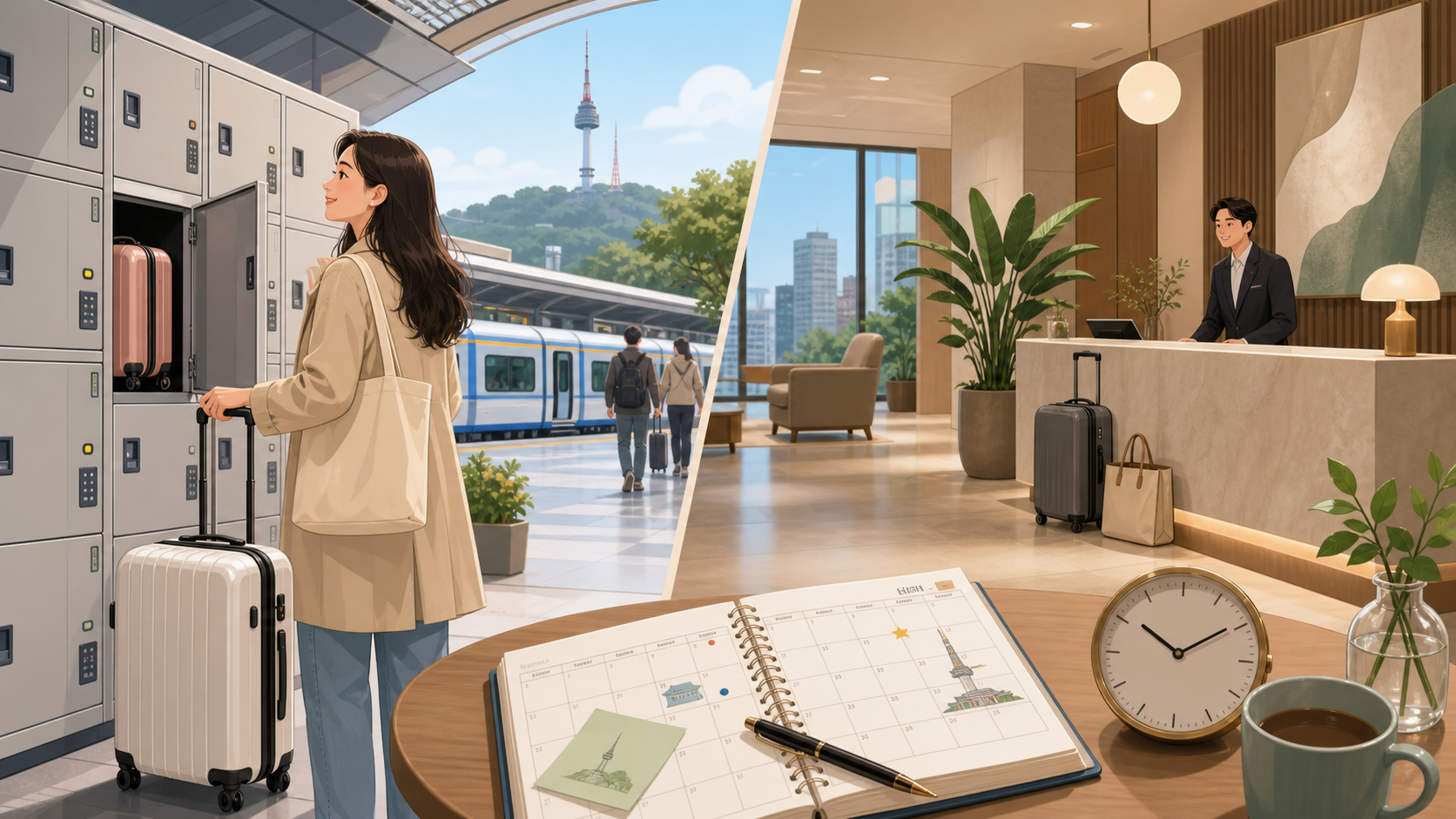
For most first-time Korea trips, ask your hotel to hold your bags before check-in or after checkout. Use a station locker or staffed storage only when going to the hotel would create a major detour. Use luggage delivery only when its cutoff, pickup point, and arrival time fit your route with a safe margin.
This is the broad arrival-and-departure luggage guide: it helps you choose between hotel storage, station storage, and delivery. For current Seoul Station T-Luggage location, hours, size-based fees, and station-versus-airport delivery decisions, use the Seoul Station T-Luggage guide. Keeping those changing service details on one page avoids conflicting advice.
Decide before travel where the bags will go, keep passports, medicine, electronics, and valuables with you, and leave a pickup buffer before any train or flight. For the wider arrival route, see the Korea transport and arrival guide and the Incheon and Gimpo airport transportation guide.
Best luggage option by situation
| Situation | Best first option | Avoid when |
|---|---|---|
| Arriving before hotel check-in | Confirm before departure that your hotel will hold bags on arrival | Your hotel is far from the first area you want to visit |
| Short stop near a major station | Station locker, with a backup plan | You have large suitcases or arrive during a busy period |
| Late departure after checkout | Hotel storage, then return before airport transfer | The hotel is not on the way to your airport route |
| Heavy luggage or family trip | Taxi-direct or hotel-first plan | You would need multiple station transfers |
| Multi-city transfer day | Store bags near the train/bus departure point | You cannot confirm locker or counter availability |
Large-suitcase warning: station lockers can be limited and large lockers may not be available when you arrive, so always keep a hotel, airport, or taxi-direct backup plan.
Arrival day luggage plan
Your arrival-day luggage plan should be built around four questions:
- What time do you land?
- Where is your hotel?
- How many bags do you have?
- How much energy will you realistically have after the flight?
Best default plan for first-time visitors
For most first-time visitors, the best default is:
- Land in Korea.
- Clear immigration and collect luggage.
- Set up mobile data if needed.
- Take your chosen airport transfer to your hotel area.
- Go to the hotel and ask to store luggage if your room is not ready.
- Eat or walk nearby until check-in.
- Return to the hotel, check in, shower, and reset.
This keeps the bags connected to the place where you will sleep and avoids adding another pickup deadline.
When you should not go to the hotel first
Going to the hotel first is not always the best move. It may be inefficient if:
- your hotel is far from the airport transfer route
- you land early and your first planned activity is near a major station
- you are changing cities immediately after arrival
- your accommodation has limited reception hours
- you are staying in a rental-style property that does not offer bag storage
- your group has large luggage and the hotel is difficult to reach by transit
In those cases, compare your options before arrival. It may be better to store luggage near a major station, use a luggage service, or choose a more direct transfer. The key is to decide before you are standing in the arrivals hall with tired travelers and multiple suitcases.
Before hotel check-in
Ask your hotel before you fly
Hotel message template: “Hello, I have a reservation under [name] on [date]. I will arrive before check-in time. Could you please confirm whether you can store my luggage before check-in and after checkout?”
Before leaving for Korea, send your hotel or accommodation a short message:
- Can we leave luggage before check-in on arrival day?
- Is there a staffed front desk or reception area?
- Are there any time limits for luggage storage?
- Can we leave luggage after checkout on departure day?
- Is early check-in possible if the room is ready?
Do not assume early check-in
Early check-in can happen, but it should be treated as a bonus, not the plan. Rooms may not be ready, housekeeping may still be working, and policies vary by property.
A better mindset is:
- Plan to store luggage.
- Hope for early check-in.
- Keep the first activity close to the hotel.
That way, your day still works even if the room is not ready.
Choose low-effort activities before check-in
Before check-in, avoid anything that requires perfect timing or high energy. Good options include:
- lunch near your hotel
- a cafe break
- a short walk in the neighborhood
- a convenience-store stop for water and basics
- a simple indoor attraction nearby
- browsing a shopping street without committing to a long route
Avoid a timed reservation or a cross-city route before check-in. A delay at immigration, baggage claim, or the storage desk should not ruin the rest of the day.
After checkout / departure day
Departure day has the same luggage problem in reverse. Checkout is often earlier than your flight, train, or evening plans. If you do not plan this gap, you can end up wasting the day or dragging bags around Seoul.
Best default departure-day plan
For most visitors, the simplest departure-day plan is:
- Pack the night before.
- Check out in the morning.
- Ask the hotel to hold luggage if allowed.
- Do one easy final activity near the hotel or on the way to the airport transfer.
- Return for bags with plenty of buffer time.
- Travel to the airport without rushing.
This works especially well if your hotel is in a convenient first-time area. If you are still choosing a base, the where to stay in Seoul for first-time visitors guide can help you understand why location matters beyond sightseeing.
When to store bags away from the hotel
Sometimes it makes more sense to store luggage somewhere else. Consider a station locker or luggage storage option if:
- your final sightseeing area is far from your hotel
- your airport transfer leaves from a different district
- you are taking a train to another Korean city after checkout
- your hotel does not offer luggage storage
- returning to the hotel would create a long backtrack
For example, if your final route is built around Seoul Station, Hongdae, or a major transfer point, storage near that area may reduce backtracking. If you are heading from Seoul to the airport after a final meal or walk, choose the storage location based on the transfer you will actually use.
Build a larger buffer than you think you need
Departure day is not the time for a tight schedule. Leave extra time for:
- returning to the hotel or locker
- collecting luggage
- walking with bags
- elevators or station navigation
- traffic if using a bus or taxi
- airport check-in, security, and terminal movement
A final cafe stop is better than a final panic sprint.
Station, hotel, and locker logic without overclaiming exact availability
Korea has many practical storage options, but availability depends on the exact location, date, time, luggage size, and local facilities. First-time visitors should avoid building a plan that depends on one specific locker being empty.
Scope note: the T-Locker and T-Luggage hours, fees, locations, and rules below are Seoul-specific examples checked on 2026-09-16 KST. They are not nationwide rules for every station or private storage provider in Korea.
Hotel luggage storage
Hotel storage is usually the easiest option when available because it keeps your bags connected to your accommodation.
It is best when:
- you are staying in a staffed hotel
- your sightseeing plan is near the hotel
- you are arriving before check-in or leaving after checkout
- you want the lowest-friction solution
Possible limitations:
- smaller guesthouses may have limited space
- rental-style stays may not have reception
- some properties may restrict storage hours
- policies can vary, so you should confirm directly
Station lockers and staffed storage
Station storage is useful only when the station is already part of your route. Seoul’s official storage system separates T-Locker hourly lockers from staffed T-Luggage storage and same-day delivery. The Seoul Metropolitan Government currently lists T-Locker hours as 05:00–24:00 and says storage and retrieval are unavailable outside those hours. Its general offline T-Luggage guidance shows 09:00–22:00, but individual center hours can differ; the official operator currently lists Gangnam opening at 10:00. Verify the selected center before travel because locations, fees, and service rules can change.
They are best when:
- your luggage is not oversized
- the station is already part of your route
- you can handle your bags through station corridors
- you have a backup plan if lockers are full or unsuitable
Potential issues:
- large lockers may be limited
- availability can change during busy periods
- some stations are large and confusing with luggage
- finding the locker area can take time
- payment and instructions may require patience
Do not plan a complicated sightseeing day around station lockers unless you are comfortable with a backup option.
Airport storage and transfer-point storage
Airport storage or storage near a major transfer point can make sense if you are not going straight to your hotel, have a long layover-style gap, or are returning to the airport later. It can also be useful for travelers with awkward timing.
However, storing luggage at the airport and then sightseeing in Seoul can create extra travel time. It is only helpful if the total route still makes sense.
Luggage delivery services
Delivery is useful when it removes a difficult transfer, not merely because carrying a bag is inconvenient. Seoul’s official T-Luggage page separates same-day station-to-station delivery from station-to-airport delivery and prices both by luggage size and weekday/weekend. The official table currently starts at ₩17,000 for weekday station-to-station delivery and ₩20,000 for weekday station-to-airport delivery for bags up to 23 inches; larger bags and weekends cost more. Confirm the live table, exact airport terminal support, and cutoff before paying.
If you consider luggage delivery, check:
- accepted luggage sizes
- pickup and drop-off locations
- cutoff times
- delivery timing
- language support
- what happens if your flight or train is delayed
For a first trip, luggage delivery is most useful when it clearly removes a difficult transfer. If it adds uncertainty, keep the plan simpler.
Official Seoul service sources checked
- Seoul Metropolitan Government: Subway Storage Facilities — T-Luggage/T-Locker locations, hours, fees, dimensions, and access caveats; checked 2026-09-16 KST.
- T-Luggage official English site — current storage/delivery fee tables, service locations, and hours; checked 2026-09-16 KST.
How luggage affects area choice
Where you stay matters more when you have luggage. A hotel that looks only slightly farther on a map can feel much harder if you are carrying bags through station exits, uneven sidewalks, stairs, or crowded areas.
When choosing a Seoul base, think beyond the neighborhood name. Ask:
- Is the hotel close to an airport bus stop, AREX connection, subway station, or taxi-friendly road?
- Is the final walk manageable with suitcases?
- Does the route require multiple transfers?
- Are there elevators or escalators where you need them?
- Is the area easy to navigate at night?
- Will the hotel store luggage before check-in and after checkout?
The best first-time area is not always the trendiest area. It is often the area that makes arrival, checkout, food, and transport easy.
Myeongdong luggage logic
Myeongdong can work well for first-time visitors because it is central and has many hotels, food options, and transport connections. If your hotel is near a convenient airport bus stop or manageable subway route, arrival can be straightforward.
Before choosing a transfer, compare your exact hotel location with the options in the Incheon Airport to Myeongdong guide. The right choice depends on whether the bus, train, or taxi gets you closest with the least luggage stress.
Hongdae luggage logic
Hongdae can be convenient for visitors who want a lively area and useful airport rail access. It can be especially practical if your accommodation is close to a station exit that works with luggage.
However, Hongdae is a large, busy area. A hotel that is technically in Hongdae may still be a tiring walk from the station with suitcases. Use the Incheon Airport to Hongdae guide to think through the transfer before committing.
Seoul Station luggage logic
Seoul Station is practical when you will return for AREX, KTX, Line 1, or Line 4. If you will not return, storing a bag there can create the backtracking you were trying to avoid.
Use the dedicated Seoul Station T-Luggage guide for current location, hours, fees, and delivery details. For the broader choice between hotel storage, lockers, and delivery before check-in or after checkout, keep using this guide.
Mistakes to avoid
Mistake 1: assuming all hotels store bags
Many hotels can help, but not all accommodations operate the same way. Confirm storage with your specific property, especially for guesthouses, apartments, late arrivals, or self-check-in stays.
Mistake 2: depending on one locker
Lockers are useful, but availability and size can vary. Always have a backup plan, especially if your luggage is large or your timing is tight.
Mistake 3: underestimating station walking
A transfer that looks simple online may involve long corridors, stairs, exits, and crowds. With luggage, fewer transfers often matter more than the shortest theoretical route.
Related Guides
- Korea transport and arrival guide
- Getting from the airport to the city: Incheon and Gimpo airport transportation
- Where to stay in Seoul for first-time visitors
- Incheon Airport to Myeongdong
- Incheon Airport to Hongdae
- Seoul Station T-Luggage: storage, delivery, hours, and hotel-base decisions
FAQ
Can a hotel hold luggage before check-in or after checkout?
Many staffed hotels do, but it is a property policy rather than a universal rule. Ask your accommodation directly before travel, especially for guesthouses, apartments, or self-check-in stays.
Should I use a locker or staffed luggage storage?
Use a locker for a short stop when your bag fits and you can return during station access hours. Use staffed storage when you need help with a larger bag, clearer pickup support, or delivery. Keep a backup because capacity is not guaranteed.
Is luggage delivery better than taking bags to the hotel?
Only when it removes meaningful backtracking. Delivery adds cutoffs, size rules, pickup points, and timing risk. If your hotel is already on the route, hotel storage is usually simpler.
Can I store valuables in a station locker or luggage center?
Keep passports, cash, payment cards, medicine, electronics, keys, and irreplaceable items with you. Check the operator’s prohibited-items and compensation rules before storing anything important.
Final advice
Use the hotel when it is already on your route. Use a station locker or staffed counter when the station is your natural return point. Pay for delivery only when it removes a real detour and the current cutoff leaves a safe train or flight margin.