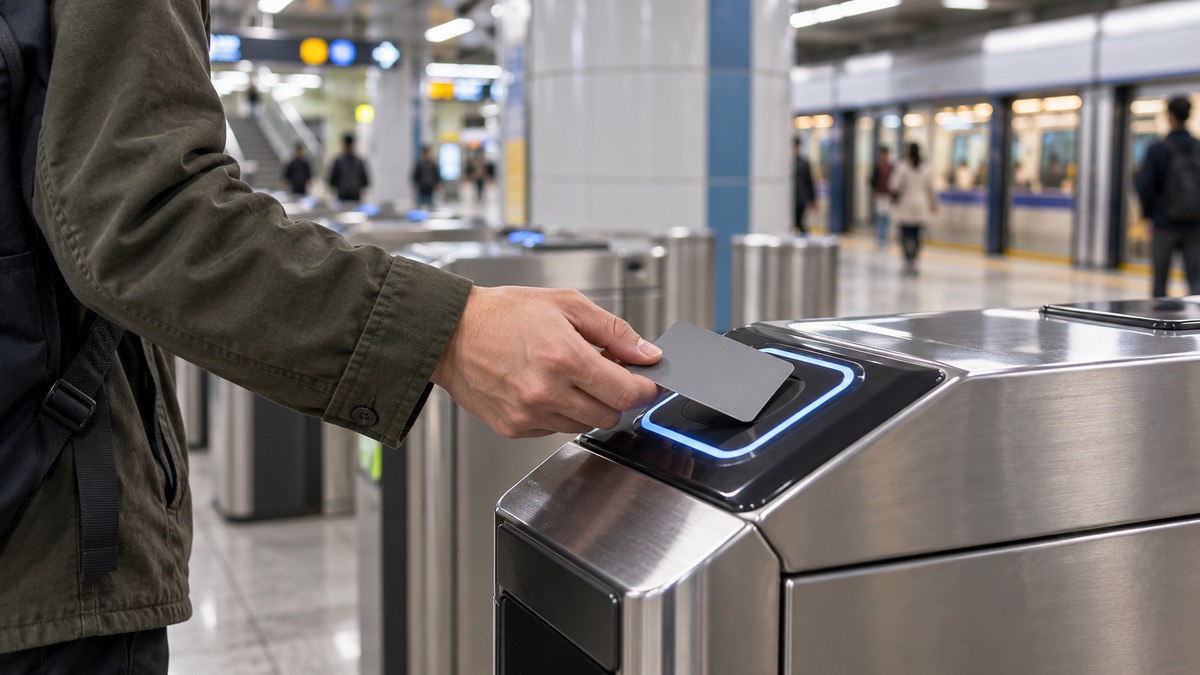
Most visitors should buy a standard T-money card if it is easy to find. It has the broadest tourist-facing guidance and the largest affiliated-store network, according to VISITKOREA. But you do not need to search several shops for it: an EZL card works on public transportation nationwide and is a practical substitute for ordinary bus and subway trips. Cashbee is the older brand name that was folded into EZL’s integrated brand.
The important choice is often not T-money versus EZL. It is whether you need a stored-value card at all. A short Seoul-only trip with heavy subway and bus use may fit a Climate Card short-term pass; a multi-city trip usually fits T-money or EZL better. Buy a small initial balance, keep some Korean won available, and check the logo at the point of sale rather than assuming every card design or retailer follows identical rules.
Fast decision
– Choose T-money if both cards are available and you want the simplest default with the widest tourist information and affiliated-store network.
– Choose EZL/Cashbee if it is the card in stock or you prefer its design; it is suitable for normal public transportation and affiliated purchases.
– Consider a Climate Card instead only for a Seoul-focused itinerary where the included network and number of rides make the fixed pass worthwhile.
– Do not rely on a phone app without checking compatibility. Mobile transit setup depends on the device, NFC support, app, payment method, and account configuration.
Who should use this guide?
Use this comparison if you are arriving in Korea without a local transit card and expect to take city buses or subways. It is especially useful for a multi-city trip because both T-money and EZL are reloadable stored-value cards rather than Seoul-only passes.
Who can skip it?
Skip a general stored-value card comparison if you will use only airport transfers and taxis, or if a Seoul short-term Climate Card clearly covers nearly all of your planned rides. Also skip the mobile setup unless your phone and payment method are explicitly supported; a physical card is the lower-friction backup for most short-term visitors.
T-money vs Cashbee/EZL at a glance
| Decision point | T-money | EZL / older Cashbee branding |
|---|---|---|
| Best default | Most first-time visitors | Travelers who find it first or prefer its design |
| Purchase locations | Convenience stores nationwide; Seoul subway information centers on Lines 1–8 | Convenience stores nationwide |
| Typical card price | KRW 3,000–5,000 for a general card | From KRW 4,000 |
| Transport use | Public transportation nationwide; look for the T-money logo at the operator or terminal | Public transportation nationwide; look for the EZL or supported legacy-card logo |
| Other payments | Affiliated stores displaying T-money acceptance | Affiliated stores and credit-card merchants within EZL’s stated exclusions |
| Convenience-store refund headline | Small balances may be refundable; more than KRW 50,000 requires Tmoney Town near Seoul Station | Official EZL guidance: under KRW 30,000 at CU; under KRW 20,000 at GS25, 7-ELEVEN, and E-Mart24, with a KRW 500 fee |
| Tourist advantage | Largest affiliated-store network and several traveler-specific products | Character and K-pop designs; selected EZL benefits may apply |
Source note: the figures and rules above were checked against VISITKOREA’s transportation-card page, last updated in August 2026. Card stock, designs, retailer participation, app compatibility, and refund handling can change. Confirm the latest rule on the official T-money or EZL site before loading a large balance.
What happened to Cashbee?
Travelers still search for “Cashbee,” and older physical cards may carry that name. EZL Corp.’s official history records the April 2024 launch of the integrated EZL brand and identifies earlier services such as Mobile Cashbee as current EZL services. The company’s official Cashbee site also states that Cashbee and LOCA Mobility were renewed under the integrated EZL brand. Current Korea Tourism Organization guidance therefore compares T-money and EZL, not T-money and a newly issued Cashbee product.
That does not guarantee that every older Cashbee card follows every current EZL product rule. Use the EZL comparison for a new purchase, but follow the instructions for the exact legacy card if you already own one.
Where to buy and how much to load
VISITKOREA lists GS25, CU, 7-ELEVEN, and other convenience stores as nationwide purchase points for both T-money and EZL. T-money is also sold through information centers in Seoul subway stations on Lines 1–8. Stock varies, so ask for the available general transportation card rather than walking between stores for a specific design.
A cautious first load is better than putting a large trip budget on an anonymous card. Start with enough for the first day or two, watch the balance shown on station machines and readers, then top up as needed. This reduces refund friction at the end of the trip.
In Seoul, do not assume one payment rule applies to every machine. Seoul introduced international-card and mobile-payment support on new machines for Climate Cards and single-journey tickets in March 2026. That does not mean every standard T-money or EZL reload point accepts an overseas card. Carry a small amount of Korean won until you confirm the machine or cashier’s accepted method.
How to use the card correctly
Subway
Tap once when entering and again when exiting. The reader normally displays the remaining balance. A single-journey subway ticket is a different product and cannot replace a stored-value card for bus transfers.
Bus
Tap when boarding and tap again before getting off. Seoul’s official guidance says the exit tap is required for transfer discounts. In Seoul, eligible transfers generally need to occur within 30 minutes, extended to one hour between 9 p.m. and 7 a.m.; the same numbered bus is not treated as an eligible transfer.
Taxi and retail
Many taxis and affiliated stores accept transit-card payment, but acceptance should be confirmed at the terminal or by the displayed card logo. Do not describe this as universal. Keep a regular payment card or cash backup.
Topping up: physical card first, mobile only after a compatibility check
For a physical card, the simplest top-up route is a convenience-store cashier or an eligible subway machine. Use the exact card name or show the card, state the amount, and confirm the updated balance.
Mobile functions exist, but they are not a universal replacement for a physical card. T-money’s official English page says its foreigner-focused mobile service requires the app, NFC, and Android 5.0.1 or later. Current EZL guidance describes two Android options: a USIM-stored card on an NFC-capable phone with a physical USIM, and an app-stored HCE card on an activated NFC-capable phone running Android 12 or later; the HCE option can work with eSIM. Mobile EZL still requires app setup and identity verification. Most short-term visitors will find a physical card simpler, especially if they have not confirmed device, account, identity, and payment compatibility before arrival.
Refunds and the low-balance rule
Refund rules differ by card, store, and balance. VISITKOREA states that a T-money balance above KRW 50,000 must be handled at Tmoney Town near Seoul Station. EZL’s current foreign-visitor page gives a store-specific rule: CU handles balances under KRW 30,000, while GS25, 7-ELEVEN, and E-Mart24 handle balances under KRW 20,000, each after a KRW 500 fee. A separate EZL summary uses the more conservative under-KRW-20,000 headline, so travelers near a threshold should use the detailed official table and allow time for a refusal or alternate location. The card purchase price is separate from the stored balance.
The practical strategy is simpler than memorizing every refund table:
- Load smaller amounts.
- Check the balance the day before departure.
- Spend or ride down most of the balance.
- Use the official T-money or EZL instructions for the exact remaining amount.
- Keep the physical card until the refund is complete; an anonymous lost card may not be recoverable.
When another card is the better choice
Climate Card for Seoul-only heavy use
A Climate Card short-term pass may be better if most of your travel stays inside its covered Seoul network and you will ride frequently. It is not the automatic winner for airport transfers, GTX, the Sinbundang Line, or trips outside the coverage area. Compare your actual route before buying. Read our Seoul Climate Card vs T-money guide before deciding.
WOWPASS for shopping and currency management
WOWPASS combines a prepaid payment function, currency exchange, and a transit function. That can help travelers who want app-based spending records or currency-loading features, but it is more setup than a basic transit card. If your only goal is tapping onto buses and subways, T-money or EZL is simpler.
Single-journey ticket for very light subway use
A single-journey ticket can make sense for one or two subway rides. Seoul’s official page notes that it carries a KRW 500 deposit, refunded after the ride, and costs KRW 100 more than the standard transit-card fare. It cannot be used on buses.
Common mistakes foreign visitors make
- Loading too much on arrival. Large balances create avoidable refund work.
- Skipping the bus exit tap. This can prevent the expected transfer discount and affect distance-based fare calculation.
- Assuming taxi transfers count. Seoul’s transfer guidance covers bus-to-bus, subway-to-bus, and bus-to-subway combinations, not taxi rides.
- Expecting every machine to accept an overseas card. Seoul’s international-card rollout covers specified machines and products, not every reload situation.
- Treating Cashbee as a separate current system without checking EZL. Current official tourist guidance uses the EZL name.
- Depending on a mobile app without a fallback. Device, NFC, account, and payment compatibility can block setup.
- Buying an unlimited pass before checking coverage. A pass is poor value if your routes fall outside its network.
Related Guides
- Seoul Climate Card vs T-money for Tourists
- Korea Transport and Arrival Guide
- Incheon Airport to Seoul Transport
- Essential Transportation Apps for Korea
- Korea Money Guide for Travelers
- Best eSIM and SIM Card Options for Korea
- Plan Your Korea Trip
FAQ
Is T-money better than Cashbee or EZL for tourists?
T-money is the safer default when both are available because VISITKOREA says it has the largest affiliated-store network and several traveler-specific card options. EZL is still suitable for ordinary nationwide public transportation, so availability and convenience can matter more than the brand.
Can I use one transit card in Seoul, Busan, and other cities?
T-money and EZL are designed for public transportation nationwide, but individual routes, operators, and merchant terminals can have exceptions. Check the displayed logo and keep a backup payment method.
Can two people share one card?
On a Seoul bus, the official guide says a passenger can ask the driver to charge multiple people to one card before tapping. That exception is poor for independent sightseeing and transfer planning: each traveler should normally carry a separate card so entry, exit, distance, and transfer records stay with the right person. Never try to pass one card back through a subway gate.
Can I recharge a physical T-money or EZL card with a foreign credit card?
Do not assume so. Some new Seoul machines accept international cards for specified products, including Climate Cards and single-journey tickets, but standard stored-value-card top-ups can still require cash or a supported local payment method. Confirm at the exact machine or retailer.
How much should I load first?
Load only enough for the first day or two, then adjust after seeing your actual fare use. This is an editorial recommendation, not an official fixed amount; it is designed to minimize refund friction.
Should I buy the card at Incheon Airport?
Buy it at the airport only if the available card and payment method suit you and your first transfer accepts it. Airport buses, AREX products, and rail tickets do not all follow the same payment flow. Confirm your airport-to-hotel route first in the Incheon Airport transport guide.
Final verdict
For most first-time visitors, buy a standard T-money card if it is readily available. If the shop has EZL instead, take it rather than losing time hunting for a different logo. Keep the initial balance modest, tap on and off correctly, and choose a Climate Card only after checking that your Seoul routes fall inside its coverage.
Sources and update note
Facts were checked on October 26, 2026 against:
- VISITKOREA: Transportation Cards — current comparison of T-money, EZL, WOWPASS, and Climate Card; page states it was last updated in August 2026.
- Seoul Metropolitan Government: Public Transportation — bus taps, transfer timing, single-journey tickets, and current card guidance.
- Seoul Metropolitan Government: international-card ticket-machine rollout — scope of overseas-card support introduced in March 2026.
- T-money official English mobile-service page — NFC/mobile service capabilities and compatibility framing.
- EZL Corp. official history and official Cashbee/EZL site — the 2024 integrated-brand launch and the Cashbee-to-EZL relationship.
- EZL official foreign-visitor page — current card, top-up, and store-specific refund guidance.
- EZL official Mobile EZL FAQ — current USIM and HCE setup requirements, including Android 12-or-later HCE support.
Transportation-card prices, top-up methods, pass coverage, and refund rules can change. Recheck the linked official pages before travel, especially if you plan to load a large balance.