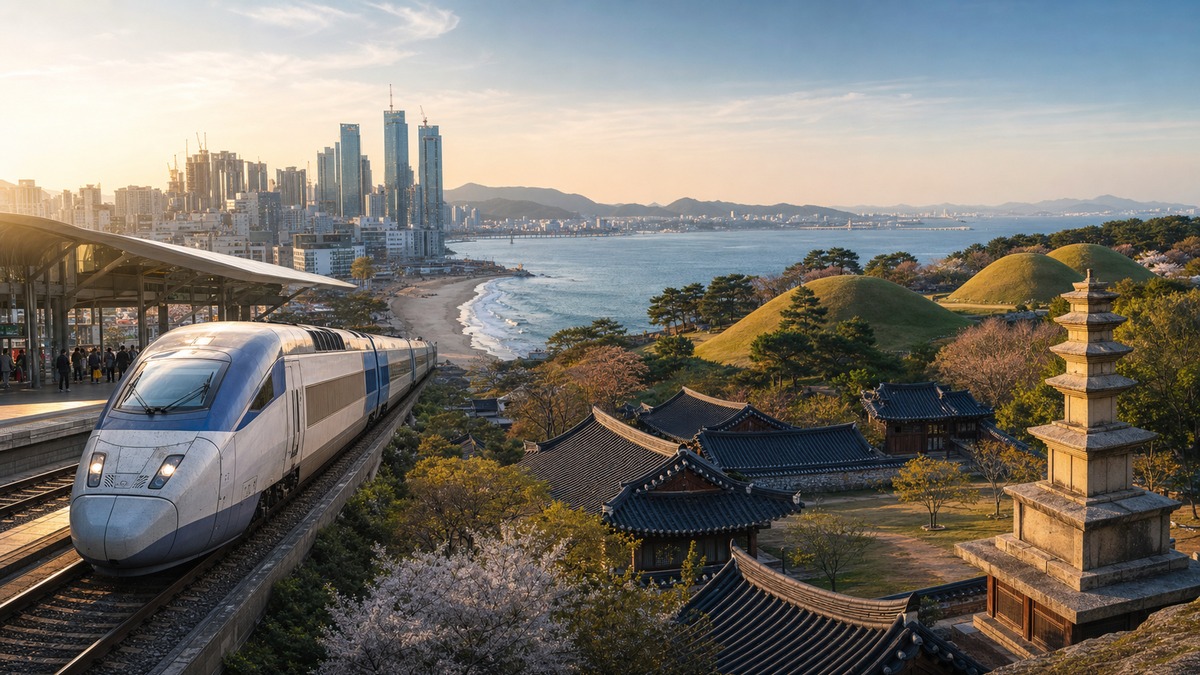
The best Seoul to Busan to Gyeongju route for a first Korea trip is usually Seoul first, Busan second, Gyeongju third, then either return to Seoul or continue onward. This order keeps the trip logical: land in the main arrival city, jump south to the coast, then use Gyeongju as a compact heritage stop after Busan.
The route works because each city has a different role. Seoul gives you palaces, food streets, museums, shopping, and dense subway travel. Busan changes the mood with beaches, markets, harbor views, and hillside neighborhoods. Gyeongju slows everything down with royal tombs, temples, and historic landscapes.
Quick route answer
For most first-time visitors, choose this order:
- Seoul: 3-4 nights for arrival, major neighborhoods, and trip setup.
- Busan: 2-3 nights for coastal scenery, markets, and a different city rhythm.
- Gyeongju: 1-2 nights for ancient-capital atmosphere and calmer walking.
- Return to Seoul: 1 night or a generous same-day buffer if your international flight departs from the Seoul area.
If you are still shaping the wider trip, start with the Korea trip planning guide and use this page to decide how the southern route should fit.
Why Seoul should usually come first
Seoul is the easiest place to land, adjust, and make mistakes. If you arrive tired, you can keep the first evening small. If you forgot something, the city has the best range of shops and services. If weather disrupts your plan, there are indoor alternatives everywhere.
Starting in Seoul also helps you learn the basics before moving faster: transit cards, meal ordering, subway exits, convenience stores, and neighborhood navigation.
Why Busan fits before Gyeongju
Busan is the natural second stop because it is a major destination with strong connections from Seoul. It also gives the itinerary a clear contrast. After Seoul’s intensity, Busan feels more open and coastal, even though it is still a large city.
Putting Busan before Gyeongju makes the heritage stop easier. Gyeongju is close enough to Busan to visit next without feeling like a random detour. You can finish the beach-and-market chapter, then shift into tomb parks, temples, museums, and slower walking.
Before booking, decide whether you care more about beaches, nightlife, markets, or onward transport. The guide to the best areas to stay in Busan can help you avoid a hotel that looks convenient but adds long crossings every day.
How many nights should you spend?
A balanced first-trip version is 3 nights Seoul, 2 nights Busan, 1 night Gyeongju, and 1 final night Seoul. That fits many weeklong trips without turning every second day into a transfer day.
If you have more time, upgrade the route like this:
- Add a fourth night in Seoul for museums, shopping, cafes, or a day trip.
- Add a third night in Busan if you want both beach time and markets.
- Add a second night in Gyeongju if you want Bulguksa, museums, cycling, or relaxed evening walks.
Sample 7-day Seoul-Busan-Gyeongju route
- Day 1: Arrive in Seoul — choose one easy neighborhood dinner and sleep early.
- Day 2: Historic Seoul — palace area, Bukchon or Insadong, and a relaxed evening district.
- Day 3: Modern Seoul — Hongdae, Seongsu, Gangnam, a museum, or shopping depending on your style.
- Day 4: Seoul to Busan — travel early enough to enjoy the afternoon and evening.
- Day 5: Busan full day — choose either a coastal route or a market-and-harbor route.
- Day 6: Busan to Gyeongju — transfer, check in, and explore the central heritage zone.
- Day 7: Gyeongju morning, return toward Seoul — use the morning for one priority sight, then move back with a buffer.
For a more detailed structure, compare this with the 8-day Korea itinerary for Seoul, Busan, and Gyeongju.
Getting from Busan to Gyeongju
The Busan to Gyeongju leg is where you should check current transport options before travel. Depending on your Busan base and Gyeongju accommodation, the best choice may involve a train, bus, or local transit connection.
Think door to door, not station to station. A faster intercity segment may be less useful if it requires long transfers at both ends. A slightly slower option can be easier if it leaves from a convenient terminal or arrives closer to your stay. For route logic and transfer choices, use the guide to how to get to Gyeongju from Busan.
Where to slow down
Slow down in Seoul if this is your first time in Korea and you want the least stressful arrival. Slow down in Busan if you care about beaches, markets, and views more than heritage sights. Slow down in Gyeongju if you like walking, history, photography, and quieter evenings.
Do not assume Gyeongju needs only a few hours. The central sights are easy to see quickly, but the city feels better when you are not watching the clock. If your trip has room, an overnight stay is a major upgrade.
Where to stay in Gyeongju
For a short first visit, stay somewhere that makes the central heritage area easy to reach. You will save energy and reduce reliance on taxis or awkward late-day transfers. If you only have one night, convenience matters more than finding the most unusual guesthouse.
With two nights, you can be more flexible, but first-timers usually benefit from being near restaurants, evening walks, and the main historic core. See the guide to where to stay in Gyeongju for a first visit before booking.
Should you return to Seoul after Gyeongju?
If your flight leaves from Incheon or Gimpo, plan the return carefully. The safest version is to spend the final night in Seoul or near your departure corridor. Same-day long-distance travel before an international flight can work, but it leaves less room for missed connections, weather, heavy luggage, or simple fatigue.
If your trip continues elsewhere, Gyeongju can also be a transition point. Some travelers extend toward Jeonju for food and hanok atmosphere, while others return to Seoul to keep the trip simpler. If you want the fuller loop, the 10-day Korea itinerary with Seoul, Busan, Gyeongju, and Jeonju explains how to add the extra stop.
Common mistakes to avoid
- Changing hotels too often: one-night stays are fine when they have a purpose, but several in a row can drain the trip.
- Booking Busan far from your priorities: beach travelers and market travelers often need different bases.
- Making Gyeongju a leftover stop: decide your must-see sights before arrival.
- Ignoring the final airport buffer: the route is only relaxing if your last transfer is not too tight.
Choose Seoul → Busan → Gyeongju → Seoul if you want the clearest first-trip route. The order is popular because it is logical, varied, and easy to manage: capital first, coast second, ancient capital third, then back to your departure point.