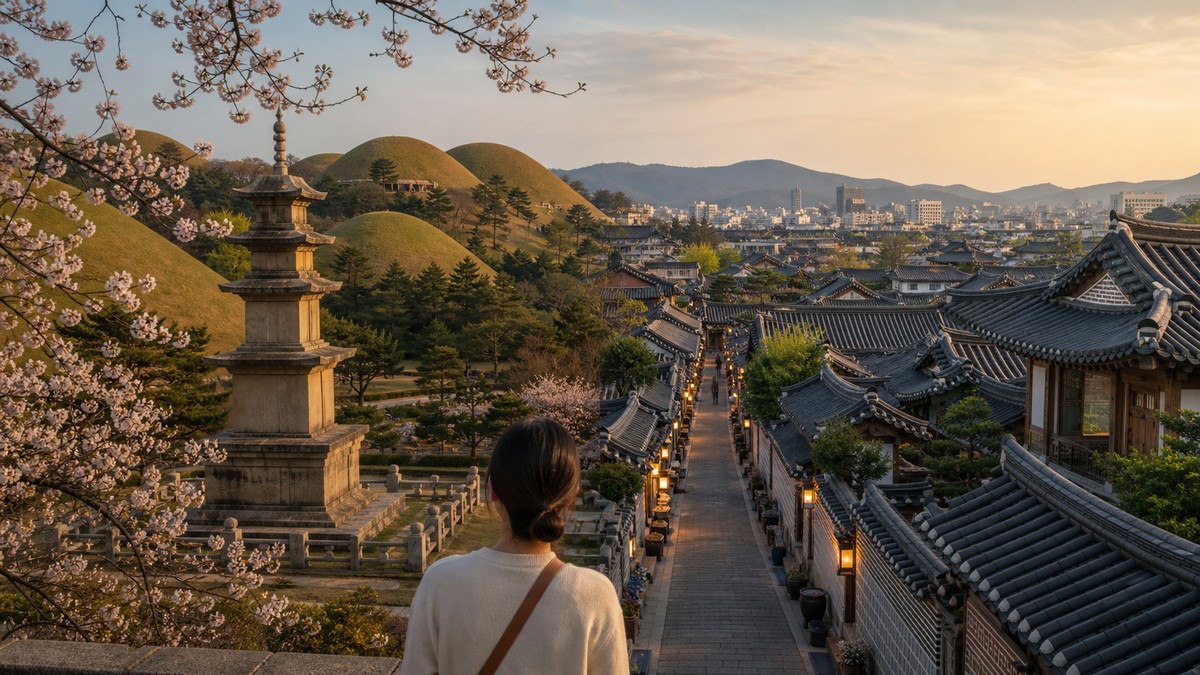
Gyeongju and Jeonju are often grouped together because both feel more traditional than Seoul or Busan. But they are not interchangeable stops. Gyeongju is the stronger choice for ancient history, royal tombs, temples, and a quieter break between major cities. Jeonju is stronger for hanok-lane atmosphere, food, guesthouse stays, cafés, and a slower cultural overnight.
So should you visit both on a first Korea trip? Yes, if your route has enough time for each city to play a different role. No, if adding both turns the middle of your itinerary into a chain of transfers. The decision is less about which city is “better” and more about whether your trip needs two different versions of traditional Korea.
Quick decision: both, Gyeongju, or Jeonju?
Choose both Gyeongju and Jeonju if:
- You have around 10 days or more in Korea.
- You want one history-heavy stop and one food-and-hanok stop.
- You are already planning Seoul plus Busan or another southeast stop.
- You do not mind changing bases more than twice.
- You prefer smaller cultural cities to adding extra big-city neighborhoods.
Choose Gyeongju only if:
- Your route already connects Seoul and Busan.
- Silla history, temples, tombs, and museum time matter most.
- You want a traditional-feeling stop that fits naturally near Busan.
- You have limited time and want simpler transport.
Choose Jeonju only if:
- Your priority is hanok atmosphere, food, cafés, and easy wandering.
- You are building a Seoul-centered trip and may not go southeast.
- You want a relaxed overnight rather than a full historic-site circuit.
- You care more about street-level culture than archaeological landscapes.
What Gyeongju adds
Gyeongju gives a first Korea trip historical depth. Instead of only seeing modern districts, markets, and palace areas, you spend time around royal tomb mounds, Buddhist sites, old observatory landmarks, and museum collections. It helps explain why Korea’s past is not limited to Seoul’s Joseon-era palaces.
The biggest practical advantage is route logic. Gyeongju pairs well with Busan, so it can sit naturally in a Seoul–Busan itinerary. It is also calmer than both big cities. The main drawback is that the sights are spread out, so you should expect a mix of walking, local transport, and selective planning.
Pick Gyeongju when you want your traditional stop to feel substantial and site-driven.
What Jeonju adds
Jeonju gives a different kind of tradition. Its appeal is less about moving between major monuments and more about spending time in and around Hanok Village: walking lanes, trying regional food, visiting small shops, stopping at cafés, and sleeping somewhere more atmospheric than a standard hotel.
That makes Jeonju useful when your itinerary needs texture rather than another sightseeing push. It is easy to enjoy at a slower pace, especially overnight, when the day-trip crowds thin. The tradeoff is that Jeonju may feel less essential if you have already planned several hanok areas, palace neighborhoods, markets, and food streets in Seoul.
Pick Jeonju when you want a softer cultural stop.
When visiting both is worth it
Visiting both cities makes sense when each has a clear job. A strong first-trip route might use Seoul for palaces, neighborhoods, shopping, and contemporary Korea; Gyeongju for ancient history and quieter sightseeing; Busan for coast, markets, and city energy; and Jeonju for hanok atmosphere and food before returning to Seoul.
In that version, the stops do not compete. Gyeongju answers, “Where can I understand older Korean history?” Jeonju answers, “Where can I enjoy a traditional-feeling overnight with food and lanes?” Together they broaden the trip.
The key is pacing. If visiting both means one tired evening in each place, choose one. If you can give each city at least a meaningful half day plus an overnight, both can work. The route should feel like a sequence of distinct chapters, not a scavenger hunt of famous names.
When one is enough
One city is enough if your total Korea trip is around a week or less. First-time visitors often underestimate how much time Seoul deserves and how much energy transfers consume. A route can look efficient on a map but feel fragmented once you include station time, luggage, check-in windows, and local transit.
If your trip is mainly Seoul and Busan, choose Gyeongju. It connects more naturally with the southeast and adds a historic layer Busan does not provide in the same way. If your trip is mostly Seoul plus one traditional overnight, choose Jeonju. It gives you a compact cultural change of pace without committing to a full southeast route.
Also choose one if you are traveling with heavy luggage, children, older relatives, or anyone who prefers settling in over maximizing destinations. Korea’s transport network is good, but every move still costs time and attention.
The transport reality
The awkward part of visiting both is the connection between them. Gyeongju and Jeonju sit in different regions, and the trip between them is not like moving between nearby attractions. Depending on your exact route, you may use a mix of train, bus, or transfers through larger hubs.
That does not make the pairing a bad idea. It means you should treat the move as a real travel segment. Do not plan to leave one city late, transfer casually, and still explore the other properly the same day. For most first-timers, the cleanest approach is to sleep in both places or place a larger city buffer between them.
Recommended choices by itinerary length
For 6–7 days, do not visit both unless the whole trip is built around smaller cultural cities. Most first-timers will be happier with Seoul plus either Busan and Gyeongju, or Seoul plus Jeonju.
For 8–9 days, both can work only at a quicker pace. A better default is Seoul, Busan, and Gyeongju if history and route efficiency matter, or Seoul, Busan, and Jeonju if food and hanok atmosphere matter more.
For 10–12 days, visiting both becomes much more reasonable. You can give Seoul enough time, include Busan, and still let both smaller cities feel distinct.
For two weeks or more, both are easy to justify if they match your interests.
Best recommendation
For most first-time Korea travelers, visit both only if you have at least ten days and genuinely want both historical sites and hanok-food atmosphere. Otherwise, choose the city that fits your route.
Choose Gyeongju for a Seoul–Busan trip, a history-focused route, or a stronger sightseeing anchor. Choose Jeonju for a Seoul-centered trip, food-focused travel, or a slower traditional overnight. Visit both when each city earns its place; skip one when it only adds another hotel change.
The best first Korea itinerary is not the one with the longest city list. It is the one where every stop solves a different travel problem.