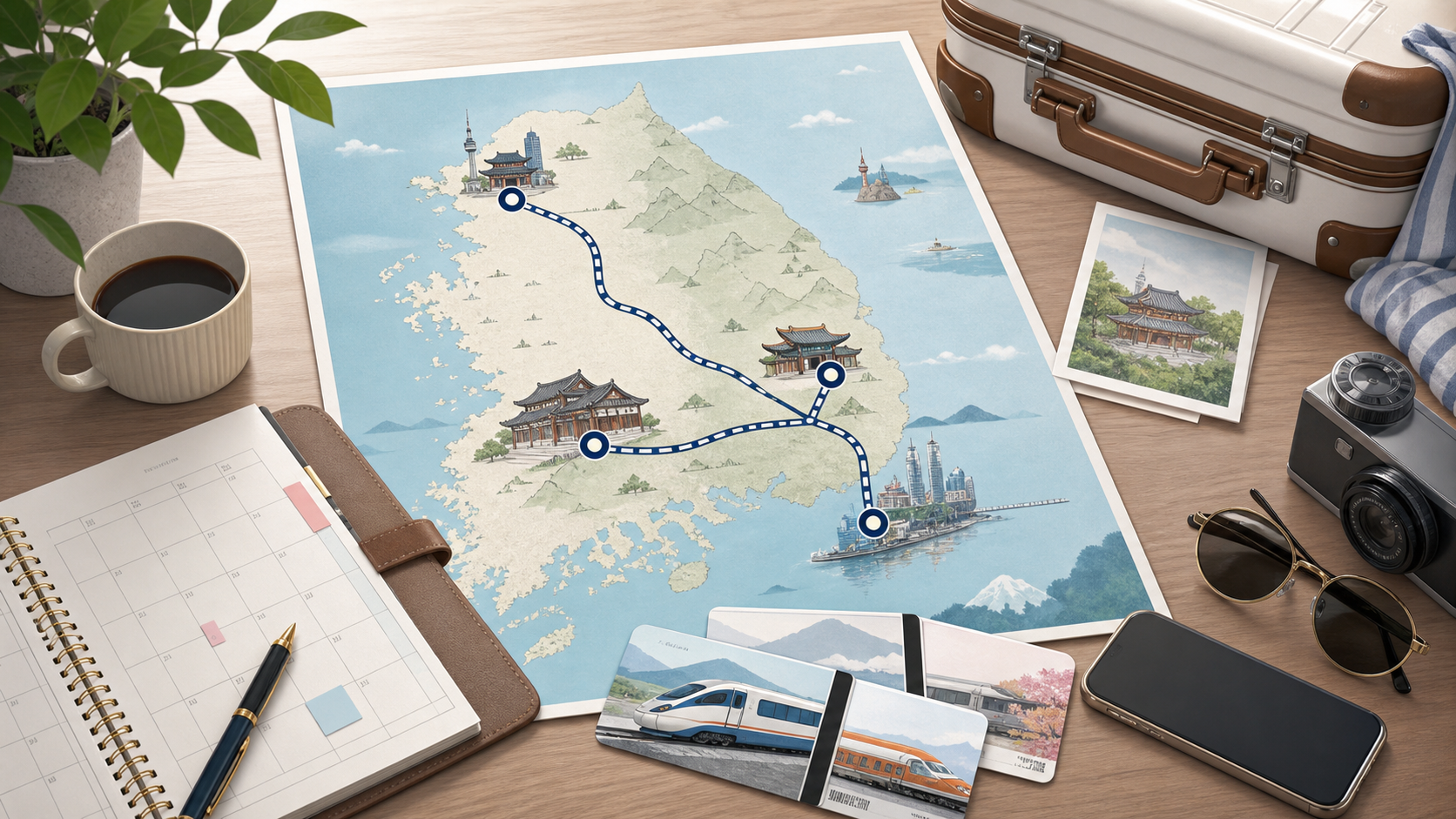
A first Korea trip can look simple on a map: fly into Seoul, take the train to Busan, add a historic city, maybe include a hanok stay, and fly home. The problem is not that these places are hard to visit. The problem is that first-time itineraries often count travel days as full days, add too many hotel changes, or place cities in an order that creates unnecessary backtracking.
The best Korea itinerary is not the one with the longest list of stops. It is the one where each stop has a clear purpose and enough time to be useful. Seoul usually anchors the trip. Busan gives coastal contrast. Gyeongju adds ancient history. Jeonju adds food, hanok atmosphere, and a slower traditional finish. If you are still shaping the whole route, start with the broader Korea trip planning guide and then use this mistake list to pressure-test your draft.
Quick answer: the biggest first Korea itinerary mistakes
Avoid these before you book trains and hotels:
- Treating arrival day as a full sightseeing day.
- Trying to visit Seoul, Busan, Gyeongju, and Jeonju in one short week.
- Changing hotels too often to chase small time savings.
- Adding day trips before the core city plan is stable.
- Choosing areas to stay based only on price, not movement.
- Forgetting that Korea trips work better by route order than by wish list.
- Leaving no buffer for weather, jet lag, shopping, laundry, or missed trains.
A strong first trip usually chooses fewer bases and makes them count. If you only have five or six nights, keep the route simple. If you have ten to fourteen days, you can build a more complete Seoul, Busan, Gyeongju, and Jeonju route without turning every day into transit.
Mistake 1: counting arrival day as a real day
The first itinerary error happens before the trip even begins: counting the arrival day as if it were a normal sightseeing day. Long-haul flights, immigration, airport transfers, SIM or eSIM setup, luggage, and hotel check-in can consume more energy than expected. Even if you land in the afternoon, your useful evening may be limited to dinner and a short walk.
Build arrival day as a soft landing. Stay in Seoul, choose an easy neighborhood, and avoid prepaid evening plans. If you do anything, make it simple: food, convenience store basics, a short market walk, or a nearby cafe. This protects the rest of the trip because you are not starting tired and behind schedule.
The same rule applies to departure day. Unless your flight leaves late at night, it is not a full day. Many first-time visitors create a final-day plan that looks efficient on paper but becomes stressful once luggage storage, airport rail timing, and last-minute shopping are involved.
Mistake 2: adding too many cities for the trip length
Korea has excellent transport, but good trains do not make every route sensible. The most common first-trip mistake is trying to fit four major stops into seven days. Seoul, Busan, Gyeongju, and Jeonju can work beautifully together, but not if each stop becomes one rushed night and a morning checkout.
Use trip length as the filter:
- 5 days: Seoul-focused is usually best.
- 7 days: Seoul plus Busan, or Seoul plus one smaller cultural stop.
- 10 days: Seoul, Busan, and Gyeongju is a strong first-trip structure.
- 14 days: Seoul, Busan, Gyeongju, and Jeonju can breathe.
If Seoul is your main interest, use the how many days in Seoul guide before adding distant stops. A deeper Seoul trip is usually better than a route where every city gets only a rushed introduction.
Mistake 3: treating every transfer as just the train time
A train ride may take two or three hours, but a transfer day is not only the train ride. You also need to pack, check out, reach the station, wait, ride, exit, reach the next hotel, store bags or check in, and reset mentally. A clean two-hour train can become a half-day of practical movement.
This matters most when comparing day trips and overnight stays. Gyeongju, Jeonju, and Busan-area routes can be simple if you respect the real door-to-door time. They become tiring when the itinerary assumes the station-to-station number is the full cost.
Before you add a new overnight, ask: what does this hotel change replace? If it removes a meaningful evening, creates a rushed morning, or forces you to carry luggage through sightseeing, it may not be worth it.
Mistake 4: staying in the wrong area for the route
The cheapest hotel area is not always the cheapest trip decision. A poor base can add repeated subway transfers, awkward taxi rides, and late-night friction. For a first Korea trip, the right area is usually the one that makes your daily movement simple.
In Seoul, choose based on your actual priorities: palaces and traditional streets, shopping, nightlife, food, or transport convenience. In Busan, the difference between Seomyeon, Nampo, Haeundae, and Gwangalli can change the whole feel of the trip. Compare the best areas to stay in Busan before booking, because a beach base and a central transport base solve different problems.
For smaller cities, location matters even more because you may be walking more and using fewer subway options. If Gyeongju is in your plan, check where to stay in Gyeongju for first-time visitors so the temples, tombs, and evening walks fit naturally.
Mistake 5: forcing Gyeongju and Jeonju to do the same job
Gyeongju and Jeonju are both valuable, but they are not interchangeable. Gyeongju is stronger for ancient history, royal tombs, temple visits, and a quiet heritage-city rhythm. Jeonju is stronger for hanok atmosphere, food, strolling, and a traditional-feeling overnight.
Many first-time itineraries add both without deciding why. That can work on a longer trip, but on a shorter trip it creates a squeezed middle. If you only have time for one, compare the Gyeongju vs Jeonju first Korea trip guide and choose the city that serves the trip better.
If you choose Gyeongju, give it enough time to be more than a transfer stop. The how many days in Gyeongju guide can help you decide whether one night is enough or whether two nights will make the visit calmer.
Mistake 6: planning every day at maximum density
A first Korea trip often starts with excitement and becomes an overfilled spreadsheet. Palaces, cafes, markets, museums, shopping streets, viewpoints, temples, beaches, and food alleys all compete for space. The result is a plan where every day depends on perfect energy, perfect weather, and perfect transport.
Build each day with one anchor, one flexible add-on, and one easy evening idea. The anchor is the thing you would regret missing. The add-on is optional. The evening idea should be close to where you already are or near your hotel. This structure keeps the trip productive without making it brittle.
Leave at least one flexible half-day in Seoul or Busan. Use it for weather changes, shopping, rest, a museum swap, laundry, or a neighborhood you discover during the trip. A buffer is not wasted time; it is what keeps the itinerary from collapsing when reality appears.
Mistake 7: booking transport before the route order is final
Do not book every train the moment you sketch the route. First decide the city order, the number of nights in each place, and whether your departure airport requires a final Seoul or airport-area night. Then book transport around that structure.
A common route is Seoul first, Busan next, then Gyeongju, with a return toward Seoul if the international flight departs from Incheon. This works because Busan and Gyeongju pair naturally. If Jeonju is added, the order needs more care so you are not zigzagging across the country.
If you are moving between Busan and Gyeongju, review how to get to Gyeongju from Busan before locking hotel nights. The easiest route on paper may not match your preferred station, luggage situation, or arrival time.
Mistake 8: adding day trips because they sound efficient
Day trips can be excellent, but they are not automatically efficient. A day trip saves a hotel move, but it can also create an early start, a late return, and limited time in the destination. An overnight adds packing friction, but it gives you evening atmosphere and a calmer morning.
For first-time travelers, day trips work best when they are close, simple, and optional. They work poorly when they are used to squeeze in a city that actually deserves a night. Jeonju is a good example: some travelers can sample it in a long day, but many will enjoy it more as an overnight if food and hanok atmosphere are the point. Use how many days in Jeonju before deciding whether it belongs as a quick visit or a real stop.
A safer first Korea itinerary framework
If your draft feels crowded, rebuild it from this framework:
- Choose the trip length honestly, excluding weak arrival and departure days.
- Pick one primary anchor: Seoul only, Seoul plus Busan, or Seoul-Busan-Gyeongju.
- Add Jeonju only if the trip length can support it.
- Choose hotel areas for movement, not only for nightly price.
- Keep one flexible half-day for recovery or weather.
- Book transport only after the order and night count are stable.
This approach may look less ambitious, but it usually creates a better trip. You will remember the neighborhoods, meals, walks, and views more clearly because the itinerary gives them room.