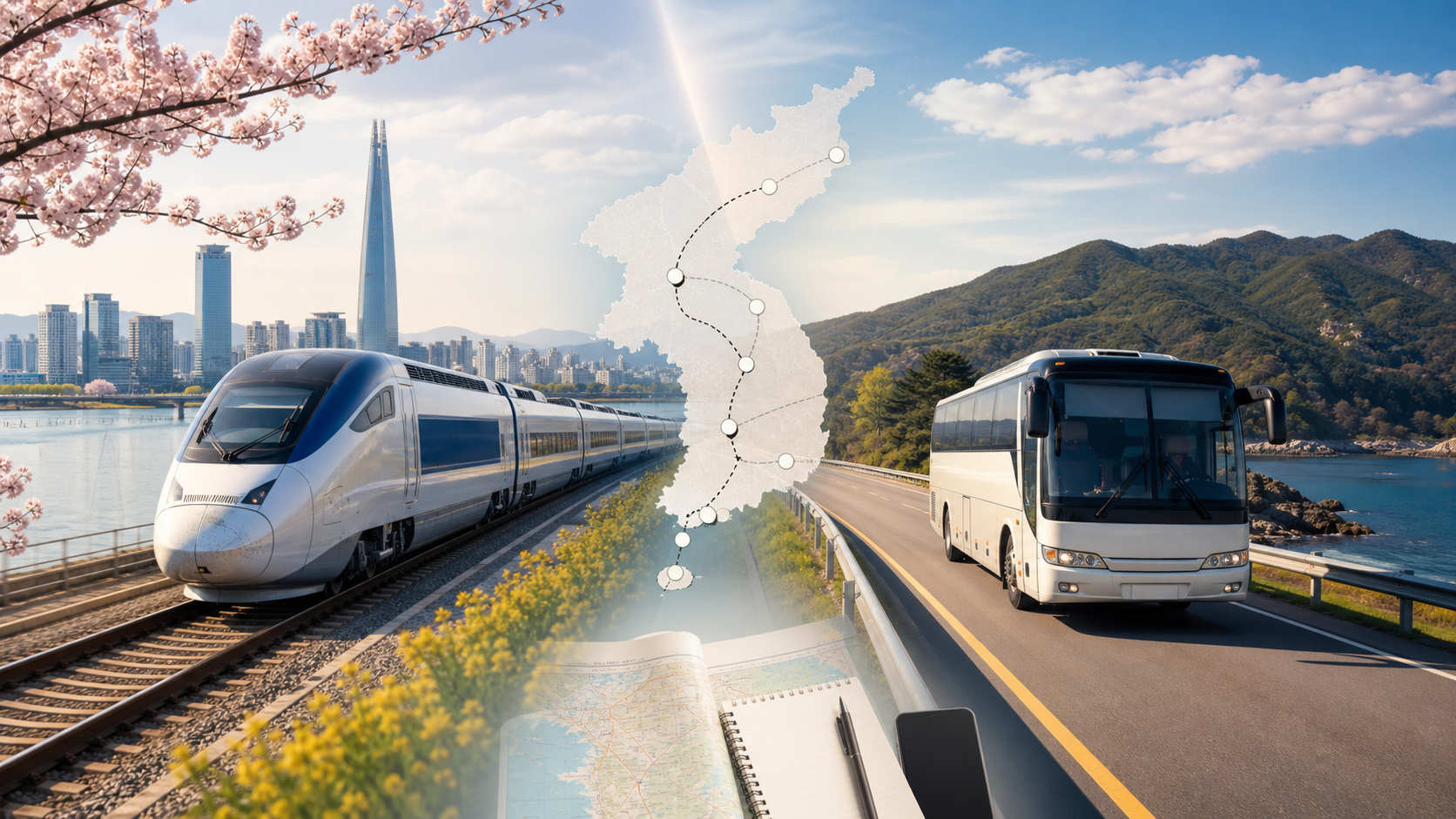
Korea is one of the easiest countries in Asia to travel without renting a car, but first-time visitors still face an important route decision: should you use trains or buses?
The short answer is simple: use trains for the major fast corridors and buses for cities or routes where the bus is more direct. Do not choose one system for the whole trip just because it feels simpler. Korea works best when you match the transport mode to the specific leg.
For many first trips, that means KTX or other trains between Seoul and Busan, then a practical mix of buses, local transit, and occasional taxis for places such as Gyeongju or Jeonju. If you are still learning the basics, start with the Korea transport and arrival guide.
Quick answer: train or bus?
Use this decision list:
- Choose the train for Seoul to Busan, airport-linked plans, long-distance speed, and travelers who want the most predictable major-city transfer.
- Choose the bus for direct city-to-city routes that are awkward by rail, budget-friendly travel, and destinations where the bus terminal is more useful than the train station.
- Use both if your route includes Seoul, Busan, Gyeongju, and Jeonju.
- Do not rent a car by default unless your itinerary is intentionally rural or you strongly want driving flexibility.
For first-time visitors, the best mindset is not “train versus bus.” It is which leg is easiest by train, and which leg is cleaner by bus?
When trains are the better choice
Trains are usually the best choice when speed and predictability matter most. Korea’s high-speed rail system makes the Seoul-Busan corridor especially convenient, and this is the route where many first-time visitors feel the train advantage immediately.
Choose trains when:
- you are traveling between major cities on a well-served rail corridor
- you want a faster long-distance transfer
- you prefer station-centered travel over terminal navigation
- you are carrying luggage and want a more straightforward boarding experience
- you are connecting Seoul and Busan on a first itinerary
The train is especially useful when your trip has limited days. A 7-day or 10-day Korea itinerary does not have room for avoidable transfer fatigue. Saving an hour or two on the longest leg can protect the rest of the route.
When buses are the better choice
Buses are not a backup option in Korea. They are a major part of the transport system and can be the cleaner choice for many intercity routes.
Choose buses when:
- the bus route is more direct than the train route
- the train option requires an awkward transfer
- the bus terminal is closer to where you actually need to go
- you are visiting smaller cities or regional stops
- you want a practical, affordable route without forcing everything through rail
For a broader bus overview, use your guide to intercity and express buses in Korea. For both city and intercity bus basics, read a complete guide to using buses in Korea.
The first-time Korea route where the decision matters most
A common first-time route is:
- Seoul
- Busan
- Gyeongju
- Jeonju
- Seoul or airport return
This route is attractive because each stop has a different role. Seoul gives you the biggest city experience. Busan adds coast, seafood, markets, and a different urban mood. Gyeongju adds ancient history and a slower heritage stop. Jeonju adds hanok atmosphere and food.
But the route only works if the transport choices stay practical. If you force trains everywhere, some legs may become indirect. If you force buses everywhere, you may give up speed where rail is clearly stronger.
Seoul to Busan: train is usually the cleanest choice
For most first-time visitors, Seoul to Busan is the clearest train leg. It is long enough for speed to matter, common enough to plan around easily, and important enough that you do not want the transfer to drain your travel day.
Choose the train for Seoul to Busan if:
- this is your first major intercity transfer in Korea
- you want a simple city-to-city move
- you are traveling with luggage
- you want more time left for Busan on arrival day
- your route is already packed
A bus can still work if price or departure timing is your priority, but most first-time itineraries benefit from making Seoul to Busan as smooth as possible.
Busan to Gyeongju: decide by your exact base and arrival point
Busan to Gyeongju is where the train-versus-bus question becomes more practical. The best choice depends on where you are staying in Busan, where you want to arrive around Gyeongju, and how you plan to move after arrival.
Do not judge this leg only by map distance. A route can look short but still feel awkward if station access, waiting time, luggage, or onward local transport does not line up.
Before choosing, read how to get to Gyeongju from Busan. That guide is more useful than a generic train-versus-bus rule because this leg depends heavily on your actual route.
Gyeongju without a car: transport choice affects the whole stay
Gyeongju is not difficult without a car, but it rewards better planning than Seoul or Busan. The train or bus only gets you to the area. Your stay then depends on where you sleep, how selective your sightseeing is, and whether you are willing to use local buses or occasional taxis.
For most first-time visitors, the key is to stay central and avoid scattering the day across too many distant sights. A no-car Gyeongju plan works best when walking, buses, and taxis each have a job.
Use how to get around Gyeongju without a car before deciding whether your arrival mode supports the itinerary you actually want.
Busan to Jeonju: bus may be more useful than forcing rail
Busan to Jeonju is a good example of why Korea travelers should not be train-only by habit. Depending on schedules and route details, the bus can be the more direct and practical choice.
This leg also raises a bigger question: should Jeonju be a day trip, an overnight stop, or part of a longer route? The answer matters more than the vehicle type. If you try to squeeze Jeonju into an already full Busan stay, the transfer can feel heavier than expected.
Before adding this leg, read Busan to Jeonju: day trip or overnight?. For many travelers, Jeonju works better as an overnight or route stop than as a rushed side trip.
How to choose by travel style
If you want the easiest first trip
Use trains for major long-distance moves and keep buses for shorter or more direct regional legs. This gives you the least mental load while still avoiding inefficient rail detours.
Best fit:
- Seoul to Busan by train
- Busan to Gyeongju based on the easiest arrival point
- regional legs by bus when direct
- local taxis only when they prevent fatigue
If you are traveling on a tighter budget
Buses deserve more attention. Express and intercity buses can be comfortable, frequent, and cost-effective. The tradeoff is that some long-distance legs may take longer, and arrival terminals may not always match your hotel area.
Budget travelers should compare total convenience, not only ticket price. A cheaper bus that creates an expensive taxi ride or a tiring hotel transfer may not actually be the better choice.
If you are traveling with kids or heavy luggage
Choose the option with the fewest stressful transitions. That is often the train for major routes, but not always. A direct bus that avoids an awkward transfer can be better than a theoretically faster train.
The right question is: Which option gets us from hotel area to next hotel area with the least friction?
If you are a solo traveler
Solo travelers can be more flexible. Buses are often easy to use, and trains are comfortable for longer hops. If you are comfortable navigating terminals and using map apps, mixing both modes gives you the best route control.
Common mistakes to avoid
The biggest Korea transport mistakes are not technical. They are planning mistakes.
Avoid these:
- choosing only trains because trains feel more familiar
- choosing only buses because they may be cheaper
- ignoring where the station or terminal is compared with your hotel
- counting travel days as full sightseeing days
- adding Gyeongju and Jeonju without giving either stop enough time
- refusing occasional taxis even when they save the day
- booking transport before deciding the route role of each city
A good first Korea trip does not need perfect optimization. It needs sensible decisions that protect your energy.
Train vs bus by route type
Use this practical summary:
- Major city to major city: train usually wins if speed matters.
- Regional city to regional city: bus often deserves the first look.
- Routes involving Gyeongju: compare arrival point, hotel area, and local movement.
- Routes involving Jeonju: buses can be very practical, especially when the rail route is indirect.
- Short first trip: choose the simplest transfer, not the most theoretically interesting one.
- Longer first trip: mixing trains and buses is usually the best approach.
Final recommendation
For a first Korea trip, do not treat trains and buses as competitors. Treat them as tools.
Use the train where Korea’s rail network is clearly strong, especially on major long-distance corridors. Use buses where they are more direct, more convenient, or better matched to the city you are visiting. If your route includes Seoul, Busan, Gyeongju, and Jeonju, the best plan will almost certainly use both.
The goal is not to prove you picked the fastest transport every time. The goal is to arrive with enough energy to enjoy the next city.