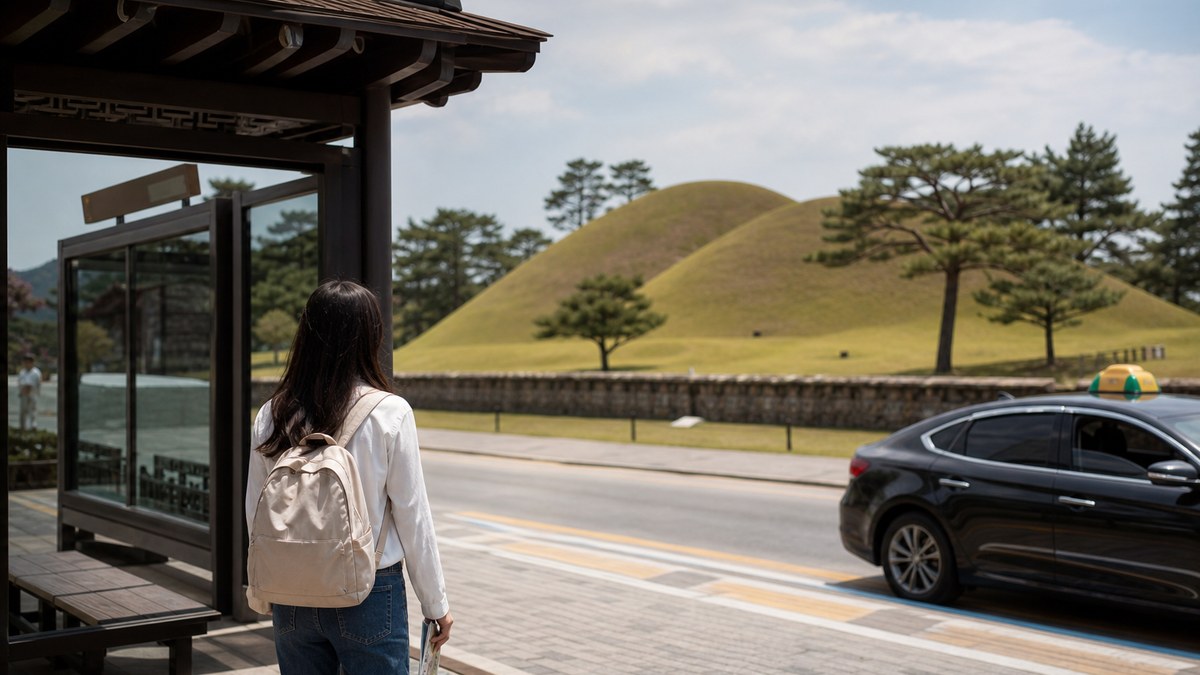
A lot of first-time travelers hesitate over Gyeongju for one reason:
“Do I need a car?”
For most visitors, the answer is no.
You can do Gyeongju without a car.
But you cannot do it well with careless planning.
Gyeongju works best without a car when you:
- stay in the right area
- keep the itinerary selective
- understand that buses, walking, and occasional taxis each have a role
If you expect the city to behave like a dense Seoul neighborhood, the plan will feel awkward.
If you treat it as a slower heritage stop and build the trip around that reality, Gyeongju can work very well without driving.
Quick Answer: Can You Get Around Gyeongju Without a Car?
Yes — Gyeongju is workable without a car for most first-time visitors.
The cleanest no-car version usually looks like this:
- stay in central Gyeongju or near Hwangnidan-gil
- keep the trip selective
- use walking where the city naturally rewards it
- use buses and taxis as support, not as proof that every distant stop belongs in the plan
If you are still choosing your base, start with Where to Stay in Gyeongju for First-Time Visitors.
Why Gyeongju Feels Harder Than Seoul or Busan Without a Car
The problem is not that Gyeongju is impossible.
The problem is that the city spreads your decisions differently.
Seoul and Busan often let travelers improvise more aggressively.
Gyeongju rewards a calmer, more deliberate route.
That means the no-car question is really about three things:
- where you stay
- how ambitious your itinerary is
- whether you are comfortable using taxis strategically instead of treating them as failure
Best Areas to Stay if You Are Not Driving
For most first-time visitors, central Gyeongju / Hwangnidan-gil is the strongest no-car base.
Why:
- easier access to the city’s atmosphere
- better walking rhythm
- less dependence on repeated long transfers
- stronger fit for both short and moderate-length itineraries
Bomun can still work, but it is usually better for travelers who already know they want a more resort-style stay. If you are comparing those options directly, read Hwangnidan-gil vs Bomun: Which Area Is Better for Your First Gyeongju Trip?.
When Walking Is Enough
Walking is enough for the parts of Gyeongju where the city’s identity is most naturally felt.
That matters because a first-time trip should not only function.
It should also feel coherent.
If your stay is centered properly, walking can carry:
- parts of the historic core
- atmosphere-heavy exploration
- flexible meal and café pacing
- evening movement that would feel overplanned by vehicle
When Buses Are Enough
Buses are enough when:
- the day stays selective
- your target sights are not scattered too widely
- you are willing to trade some convenience for practicality
The mistake is thinking buses should support an overloaded route.
They work much better when the itinerary has already been simplified.
When Taxis Make the Trip Better
Many travelers mentally resist taxis because they think a good no-car plan should avoid them completely.
That is the wrong standard.
A smart no-car Gyeongju trip often uses taxis selectively to:
- reduce fatigue
- prevent one awkward leg from distorting the whole day
- keep the itinerary realistic without giving up key parts of the city
Using taxis occasionally does not mean the plan failed.
It often means the plan is being managed intelligently.
What Makes a No-Car Plan Fail
The usual failure pattern is not “no car.”
It is bad scope control.
A no-car Gyeongju trip fails when you:
- choose the wrong base
- stretch the day across too many disconnected stops
- refuse to use taxis even when they would fix the schedule
- mistake theoretical possibility for practical comfort
That is especially risky in a one-day plan. If your trip is short, read 1-Day Gyeongju Itinerary for First-Time Visitors.
If your trip is more balanced, read 2-Day Gyeongju Itinerary for First-Time Visitors.
Who Should Consider a Car Anyway
A car may still be worth considering if:
- you want maximum flexibility more than simplicity
- you are intentionally building a broader regional route
- your stop pattern is more scattered than a typical first-time city-base plan
But for the average first-time traveler who mainly wants a practical Gyeongju experience, a car is usually optional rather than necessary.
Best Fit by Traveler Type
Best for first-timers who want a clean and atmospheric visit
No car is fine — stay central and plan selectively.
Best for travelers who want a resort-style base with less walking logic
No car can still work, but your stay and transfer choices matter more.
Best for travelers trying to do too much in too little time
A car may feel tempting, but often the better fix is reducing the itinerary, not upgrading the vehicle layer.
Final Recommendation
You do not need a car in Gyeongju for a good first-time trip.
The better answer is usually:
- stay in the right area
- keep the trip selective
- walk where Gyeongju is strongest
- use buses and taxis strategically instead of ideologically
If you build the trip around that logic, Gyeongju can feel calm, practical, and highly worthwhile without driving.
Related Guides
- Where to Stay in Gyeongju for First-Time Visitors: Hwangnidan-gil vs Bomun vs Central Gyeongju
- Hwangnidan-gil vs Bomun: Which Area Is Better for Your First Gyeongju Trip?
- 1-Day Gyeongju Itinerary for First-Time Visitors: What to Prioritize and What to Skip
- 2-Day Gyeongju Itinerary for First-Time Visitors: A Practical Plan Without Overpacking
- How to Get to Gyeongju from Busan: Train vs Bus vs Car for First-Time Visitors
FAQ
Can you visit Gyeongju without a car?
Yes. Most first-time visitors can explore Gyeongju without a car if they stay centrally and keep the plan selective.
Is Gyeongju easy without a car?
It is workable, but not in the same way as Seoul. Gyeongju rewards better base choice and more deliberate planning.
Where should I stay in Gyeongju without a car?
For most first-time visitors, central Gyeongju or the Hwangnidan-gil area is the best no-car base.
Do I need taxis in Gyeongju if I do not drive?
Often yes, at least selectively. Occasional taxis can make a no-car trip far smoother without meaning the plan failed.