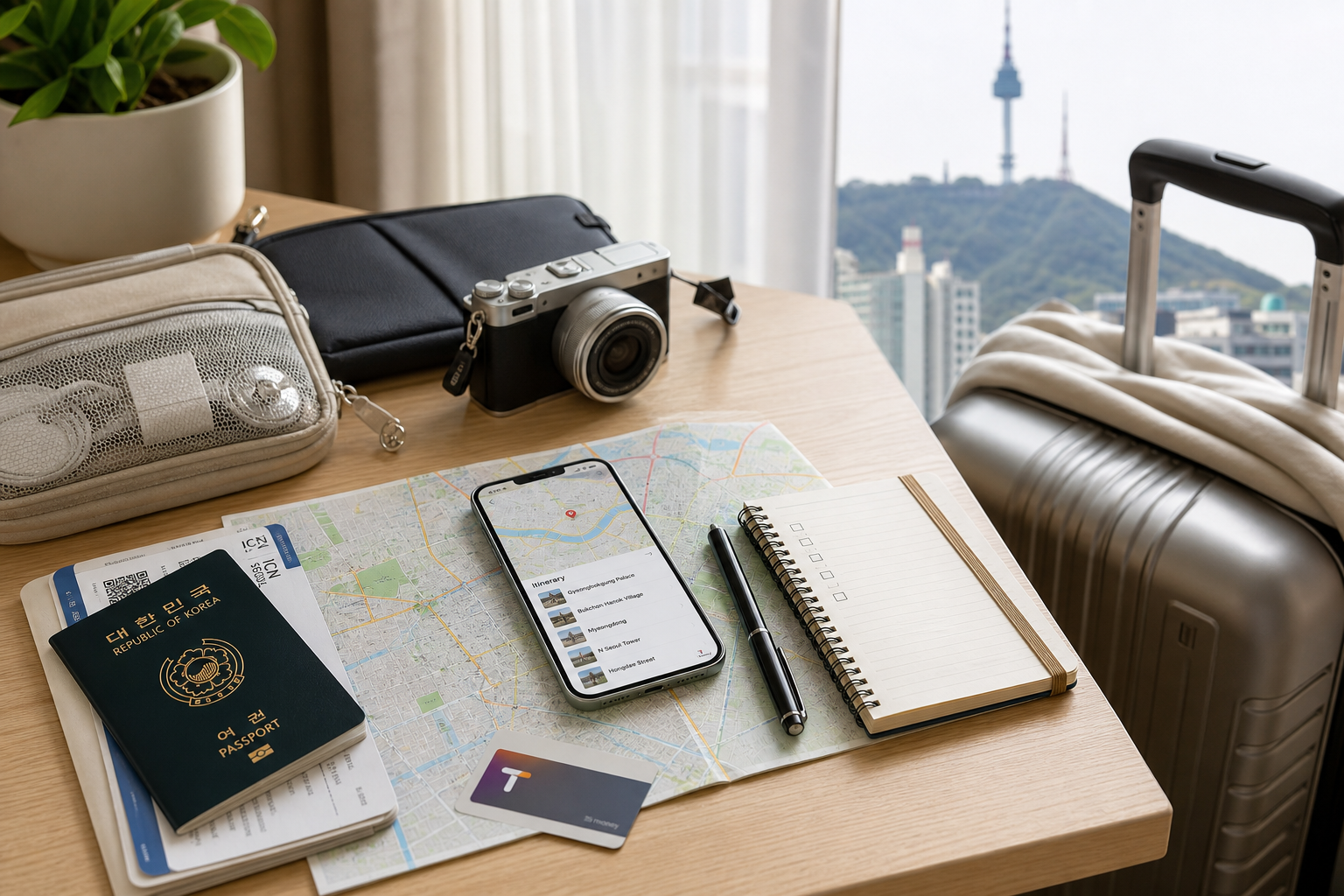
A first trip to Korea usually does not go wrong because the country is too difficult.
It goes wrong because travelers make a few small but high-impact mistakes before the trip even begins.
They:
- assume entry rules are simple
- land without a clear airport plan
- overthink money in the wrong way
- choose the wrong transport setup
- ignore mobile data until arrival
- pack for pretty photos instead of real weather
- book a hotel in the wrong area for their trip style
The good news is that these problems are avoidable.
Korea is often easier than first-time visitors expect if the core planning decisions are handled before departure.
This guide focuses on the mistakes that actually create stress, wasted time, and unnecessary friction.
The short answer
If you want the fastest version, here it is:
Most first-time travelers make mistakes in seven places:
- entry requirements
- airport arrival planning
- payment setup
- transport-card choice
- mobile connectivity
- season and packing expectations
- hotel-area selection
If you fix those seven things before your flight, your Korea trip becomes dramatically easier.
Mistake 1: Assuming K-ETA or entry rules are the same for everyone
This is one of the most expensive mistakes because it affects whether you are actually ready to board.
Many first-time travelers hear one simplified version of the rule and assume it applies to everybody:
- “You always need K-ETA.”
- “Nobody needs K-ETA anymore.”
- “My friend went without it, so I’m probably fine too.”
That is not a reliable way to handle entry planning.
VISITKOREA makes it clear that Korea entry rules depend on your nationality and travel status. Some travelers still need a visa or K-ETA, while designated countries and regions are temporarily exempt from K-ETA through December 31, 2026.
The mistake is not just “forgetting K-ETA.”
The real mistake is assuming another traveler’s rule is your rule.
How to avoid it
- check your own passport nationality on the official source
- verify whether you are visa-free, K-ETA-required, or temporarily exempt
- recheck close to departure in case rules change
- use official sites, not random third-party summary pages
If you get this wrong, the rest of your itinerary does not matter.
Mistake 2: Landing without a clear airport-to-city plan
After a long flight, even simple decisions feel harder.
That is why “I’ll decide at the airport” is a bad arrival strategy.
Many first-time travelers know that Korea has good transport, but they do not decide in advance which arrival option actually fits them best:
- AREX
- airport limousine bus
- taxi
- late-night fallback option
That creates predictable problems:
- decision fatigue after landing
- confusion if you arrive with luggage, family, or at a late hour
- unnecessary spending because you default to the easiest visible option
- wasted time trying to compare choices while tired
This matters even more because your ideal airport transfer depends on where you are staying, when you arrive, and how comfortable you are with transfers.
How to avoid it
Before you fly, decide:
- your default airport-to-city route
- your backup option if timing changes
- whether your hotel area is better served by train, bus, or taxi
A good plan removes friction from the first two hours of the trip, which often shapes how confident the rest of the trip feels.
Mistake 3: Overcomplicating money or assuming one payment method solves everything
Money is where many travelers create extra stress for themselves.
Some arrive assuming Korea is basically cashless.
Others arrive carrying too much cash because they are worried cards will not work.
Others add too many layers—cash, multiple cards, prepaid tools, top-up systems—before understanding what they actually need.
The practical answer is simpler.
VISITKOREA indicates that cards are widely accepted in Korea, including in many common tourist situations. But it also notes that some stores may not provide card service, which means backup cash still matters.
That creates a much better planning rule:
- use cards as your main payment method
- keep some backup cash
- exchange gradually, not blindly
- treat tools like WOWPASS as optional convenience, not mandatory setup
How to avoid it
For most first-time travelers, the smartest setup is:
- one or two working international cards
- a reasonable amount of won as backup
- a simple exchange plan
- optional WOWPASS only if its features genuinely match your style
The mistake is not “using the wrong app.”
The mistake is turning payments into a complicated system before the trip starts.
Mistake 4: Choosing the wrong transport card for your actual itinerary
A lot of Korea travel advice talks about transport cards as if there is one best answer.
There is not.
Some travelers buy an unlimited pass because it sounds efficient, then realize their trip does not use it enough.
Others ignore transport-card planning completely and make everyday movement harder than it needs to be.
VISITKOREA recommends transportation cards because they simplify travel, and subway guidance also makes clear that using a transport card is usually more convenient and usually cheaper than relying on single-use tickets.
But the key first-time mistake is more specific:
- assuming Climate Card and T-money are interchangeable
They are not.
If your trip is heavily Seoul-based and you plan to ride public transit frequently over a fixed number of days, an unlimited-style option can make sense.
If your itinerary is mixed, flexible, airport-connected, or wider than central Seoul, T-money is often the safer and simpler fit.
How to avoid it
Ask these questions before buying:
- Is my trip mostly Seoul-only?
- Will I take multiple public transport rides every day?
- Do I need broad flexibility more than theoretical savings?
- Am I choosing based on my itinerary, or just because the pass sounds popular?
The right transport card is not the most hyped one.
It is the one that matches your real movement pattern.
Mistake 5: Arriving without reliable mobile data
This is one of the most preventable travel mistakes.
A lot of first-time visitors underestimate how much they need connectivity immediately after landing.
Without data, even basic actions become harder:
- checking directions
- contacting someone
- pulling up booking details
- navigating airport transport
- using maps or translation tools
- adjusting plans in real time
VISITKOREA confirms that travelers have several options in Korea, including prepaid SIM cards, eSIM, roaming, and airport pickup services. Public Wi‑Fi is available in many places, but that should be treated as backup, not your main arrival strategy.
The mistake is usually not “choosing the wrong telecom brand.”
It is reaching Korea without any dependable connection plan at all.
How to avoid it
For most travelers:
- eSIM is the easiest option if your phone supports it
- physical SIM is a good fallback if your phone does not support eSIM or you prefer a more traditional setup
- roaming can work for short trips if you value simplicity over cost
Whatever you choose, decide it before the flight.
Your first hours in Korea are much smoother when your phone is already useful.
Mistake 6: Choosing your travel season based on photos instead of real conditions
This mistake is subtle, but common.
People see cherry blossoms, fall foliage, snowy streets, or beach photos and choose dates emotionally without thinking through what the season actually feels like day to day.
VISITKOREA describes Korea as having four distinct seasons:
- spring and autumn are generally mild
- summer is hot and humid
- winter is cold and dry
It also warns that summer can bring rainy-season and typhoon-related disruption, while winter requires serious cold-weather preparation. Spring and autumn are generally the easiest seasons for walking-heavy travel.
That means beautiful seasonal images do not tell the whole planning story.
A season is not just scenery.
It is also:
- your walking comfort
- your energy level
- your packing load
- your weather risk
- the type of itinerary you can enjoy easily
How to avoid it
Use this rule:
- choose spring or autumn if you want the easiest first-trip conditions
- choose summer if beaches, green scenery, and warm-season energy matter more than comfort trade-offs
- choose winter if you actively want snow, ski culture, and winter atmosphere
And always check the live forecast close to departure.
The best-looking season is not always the best season for your actual travel style.
Mistake 7: Choosing where to stay based only on price or hype
This is one of the biggest first-trip errors because your hotel area affects almost everything:
- daily transit time
- how tired you feel
- what your evenings are like
- how easy it is to recover between activities
- whether your itinerary feels smooth or fragmented
Many first-time visitors book based on one factor only:
- cheapest room
- most famous district name
- trendiest social media area
- one attraction they want to be near
That often leads to a bad fit.
The better question is not:
- “Which area is the most famous?”
The better question is:
- “Which area matches my trip style?”
For example:
- a convenience-first traveler may prefer a central and easy base
- a nightlife-first traveler may want a livelier area
- a family may want a calmer area with more space
- a Busan trip may need a totally different base logic from Seoul
How to avoid it
Choose your stay area based on:
- your main itinerary zones
- your tolerance for nightlife or noise
- your transport style
- whether you want energy, convenience, or calm
The wrong hotel area can make a decent trip feel tiring.
The right area can make the exact same trip feel much easier.
The smarter first-time Korea setup
If you want the cleanest version of a first Korea travel plan, use this checklist:
Before booking
- confirm entry requirements for your passport
- choose the season that actually fits your travel style
- choose a stay area based on convenience, not hype alone
Before flying
- decide how you will get from the airport to your accommodation
- set up your mobile data plan
- choose the transport card logic that fits your itinerary
- prepare a simple card-plus-cash payment setup
After arrival
- follow your arrival plan instead of improvising while tired
- use your connectivity and transport setup immediately
- adjust only after you understand the city rhythm
That is the key operating principle.
A strong first trip is usually not built on complexity.
It is built on a few correct decisions made early.
Final takeaway
Korea is not a hard destination for first-time travelers.
But it is a destination where small planning mistakes can create outsized stress.
If you avoid these seven mistakes, you remove most of the preventable friction:
- not checking your real entry requirement
- arriving without an airport transfer plan
- overcomplicating payments
- choosing the wrong transport-card setup
- arriving without mobile data
- choosing the wrong season for your travel style
- staying in the wrong area
That is the real first-time Korea advantage.
You do not need a perfect trip plan.
You need a trip plan that gets the important basics right.
Official sources to verify before publishing
- VISITKOREA Visa & Travel Requirements page
- VISITKOREA Transportation Cards page
- VISITKOREA Subway page
- VISITKOREA Climate page
- previously checked official K-ETA, Seoul Climate Card, and eSIM/SIM guidance used in linked planning articles
Planned internal links
- Do You Need K-ETA for Korea in 2026? Countries, Exemptions, and What Travelers Should Check
- Incheon Airport to Seoul in 2026: AREX, Airport Bus, Taxi, and Late-Night Options
- Korea Money Guide for Travelers: Cash, Cards, WOWPASS, and Where to Exchange
- Seoul Climate Card for Tourists in 2026: Is It Better Than T-money?
- Best eSIM and SIM Card Options for Korea Travel: What Most Tourists Actually Need
- Best Time to Visit Korea by Season: Weather, Crowds, and What to Wear
- Where to Stay in Seoul for First-Time Visitors: Myeongdong vs Hongdae vs Gangnam vs Jamsil
- Where to Stay in Busan for First-Time Visitors: Haeundae vs Seomyeon vs Nampo