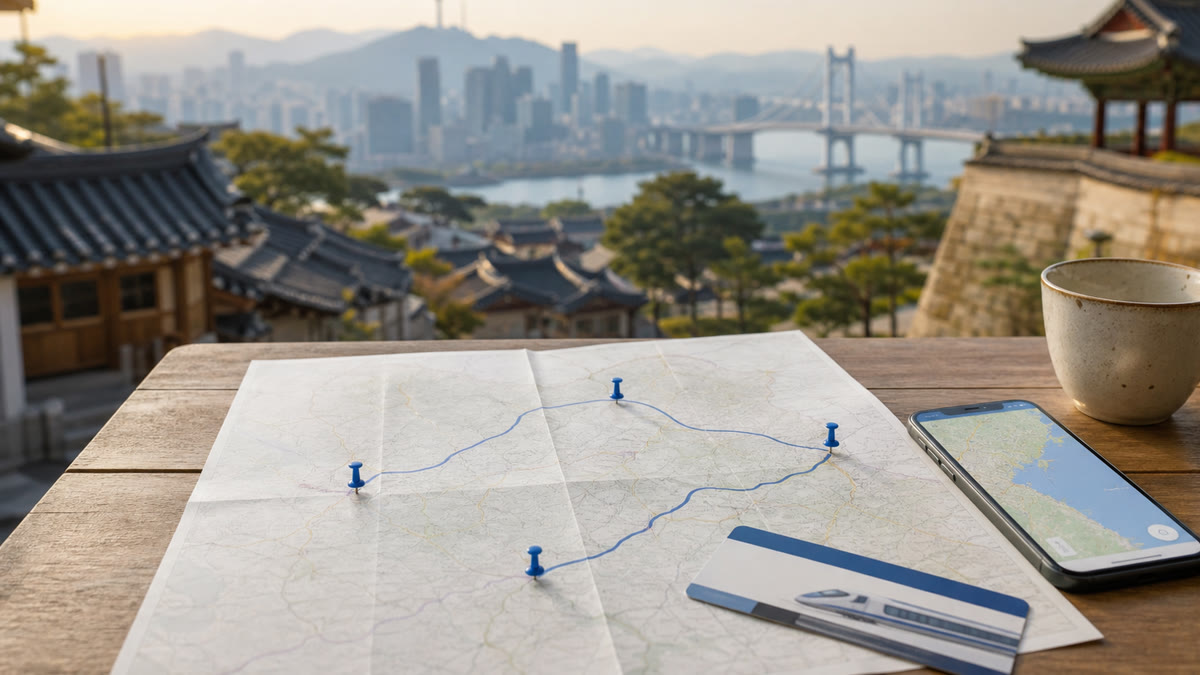
A Seoul, Busan, Gyeongju, and Jeonju itinerary works when each stop has a clear purpose. Seoul is the arrival anchor and biggest city base. Gyeongju adds ancient Silla history and open-air heritage. Busan gives you coast, markets, and a second major-city feel. Jeonju adds hanok streets, food culture, and a slower regional finish.
The best route for most first-time visitors is Seoul → Gyeongju → Busan → Jeonju → Seoul. This keeps the trip moving in a logical arc instead of bouncing around Korea with luggage. It also lets Jeonju act as a relaxed final stop before returning north for your flight.
Use this guide with these related planning pages:
- Plan Your Korea Trip
- best areas to stay in Busan
- Gyeongju vs Jeonju
- Gyeongju to Jeonju
- Busan to Jeonju
- how many days in Jeonju
Quick answer: the best order
For a smooth first Korea route, plan the cities in this order:
1. Seoul for arrival, neighborhoods, palaces, shopping, and trip setup 2. Gyeongju for tomb parks, temples, and historic atmosphere 3. Busan for coastal city energy, food markets, beaches, and viewpoints 4. Jeonju for hanok lanes, slower meals, and a compact final regional stop 5. Seoul for the last night if your international flight leaves from the capital area
This order is practical because it protects the two hardest moments of the trip: arrival and departure. Seoul is the easiest place to recover from jet lag, learn the transport rhythm, and fix small travel problems. A final Seoul night also reduces stress before an early flight.
How many nights you need
Best version: 10 nights
A comfortable split is:
- Seoul: 3 nights
- Gyeongju: 2 nights
- Busan: 3 nights
- Jeonju: 1 night
- Seoul: 1 final night
This is the version I would choose for most first-time travelers. It gives Busan enough time to feel like a real base, not a transit stop. It also gives Gyeongju a proper overnight and keeps Jeonju focused instead of overloaded.
Faster version: 8 nights
An 8-night route can work like this:
- Seoul: 3 nights
- Gyeongju: 1 night
- Busan: 2 nights
- Jeonju: 1 night
- Seoul: 1 final night
This is possible, but it rewards disciplined planning. You need to accept that Gyeongju and Jeonju will each have one main job. Do not add every temple, market, cafe, and viewpoint just because they appear online.
One week or less
With 7 nights or fewer, choose three bases instead of forcing four. Seoul and Busan are usually the anchors. Then choose either Gyeongju or Jeonju. Pick Gyeongju if ancient history, temples, and royal tombs matter most. Pick Jeonju if food, hanok streets, and an easier compact overnight sound more appealing. The Gyeongju vs Jeonju guide is the right comparison for that decision.
Why Gyeongju goes before Busan
Gyeongju fits naturally between Seoul and Busan. After several days in Seoul, it gives the trip a different texture: lower buildings, open heritage zones, and a slower sightseeing style. It also prevents Busan from becoming your first major transfer after Seoul, which can make the whole route feel rushed.
One night in Gyeongju is enough for a compact introduction if you arrive with usable daylight. Two nights are better if you want a less hurried visit or plan to include outer sights. Avoid treating Gyeongju as a quick same-day stop between trains unless you are comfortable with a very limited sample.
Why Busan needs real time
Busan is not a small beach add-on. It is a large, spread-out city, and your hotel area shapes the whole visit. A stay near the wrong area can turn simple plans into long cross-city rides. Before booking, compare the best areas to stay in Busan based on whether you want beach atmosphere, markets, nightlife, transport convenience, or a quieter base.
Give Busan at least two nights. Three is better. A good pattern is one arrival afternoon, one full coastal or city day, and one flexible day for markets, viewpoints, neighborhoods, or rest. If Busan gets only one night, the route often becomes Seoul-to-Gyeongju-to-Busan-to-Jeonju movement with too little actual Busan.
Why Jeonju works best near the end
Jeonju is strongest when you are ready to slow down. After Seoul’s scale, Gyeongju’s historic sights, and Busan’s coast, Jeonju feels different: smaller, more walkable, and more food-centered. That contrast is the reason to include it.
Plan Jeonju around a simple overnight. Arrive, reduce luggage friction, walk Hanok Village, keep dinner flexible, enjoy the evening atmosphere, and leave the next morning without rushing. If you are coming from Busan, use the Busan to Jeonju guide to decide whether the overnight is worth it. If you are linking the two heritage stops directly, check Gyeongju to Jeonju before assuming it is an easy hop. For pacing, how many days in Jeonju explains when one night is enough.
Sample 10-night itinerary
Use this as a route template rather than a strict timetable:
- Day 1: Arrive in Seoul, stay central, keep plans light
- Day 2: Seoul palaces, historic neighborhoods, or markets
- Day 3: Seoul modern districts, museums, shopping, or river time
- Day 4: Travel to Gyeongju, do an afternoon heritage walk
- Day 5: Gyeongju temples, tomb parks, or a slower historic day
- Day 6: Travel to Busan, explore near your hotel base
- Day 7: Busan coast, beach area, or viewpoints
- Day 8: Busan markets, neighborhoods, cafes, or flexible sightseeing
- Day 9: Travel to Jeonju, focus on Hanok Village and food
- Day 10: Easy Jeonju morning, return to Seoul for the final night
- Day 11: Depart from the Seoul area
The route works because every transfer changes the trip’s mood. You are not moving just to collect city names.
When to shorten or skip a stop
Skip Jeonju if you have less than eight nights, dislike hotel changes, or mainly care about beaches, nightlife, and shopping. Seoul and Busan cover those themes better.
Skip Gyeongju instead if ancient history is not a priority and you want the easier, more compact regional stop. Jeonju is less about major sites and more about atmosphere, food, and walking.
Shorten Busan only if you are not interested in the coast or city neighborhoods. Otherwise, Busan deserves more time than either Gyeongju or Jeonju on a first trip.
Common planning mistakes
Avoid these problems:
- Cramming all four cities into a 6- or 7-night trip
- Giving Busan only one night while expecting a full city experience
- Adding Jeonju without a clear reason beyond “it looks nice”
- Connecting Gyeongju and Jeonju without checking the travel day
- Forgetting a final Seoul night before an early international flight
- Booking hotels by photos only, not by station access and luggage convenience
Bottom line
A Seoul, Busan, Gyeongju, and Jeonju itinerary is excellent when it has enough time and a clean route. Use Seoul as the anchor, Gyeongju as the historic reset, Busan as the coastal city base, and Jeonju as the slower food-and-hanok finish. With 9 to 10 nights, the full route can feel balanced. With less time, choose three bases and enjoy them properly.