Choosing where to stay in Korea for a first trip is really a route decision. The best hotel area is not simply the most famous neighborhood or the prettiest street. It is the place that makes your first few days easier, keeps transfers manageable, and matches the role each city plays in your itinerary.
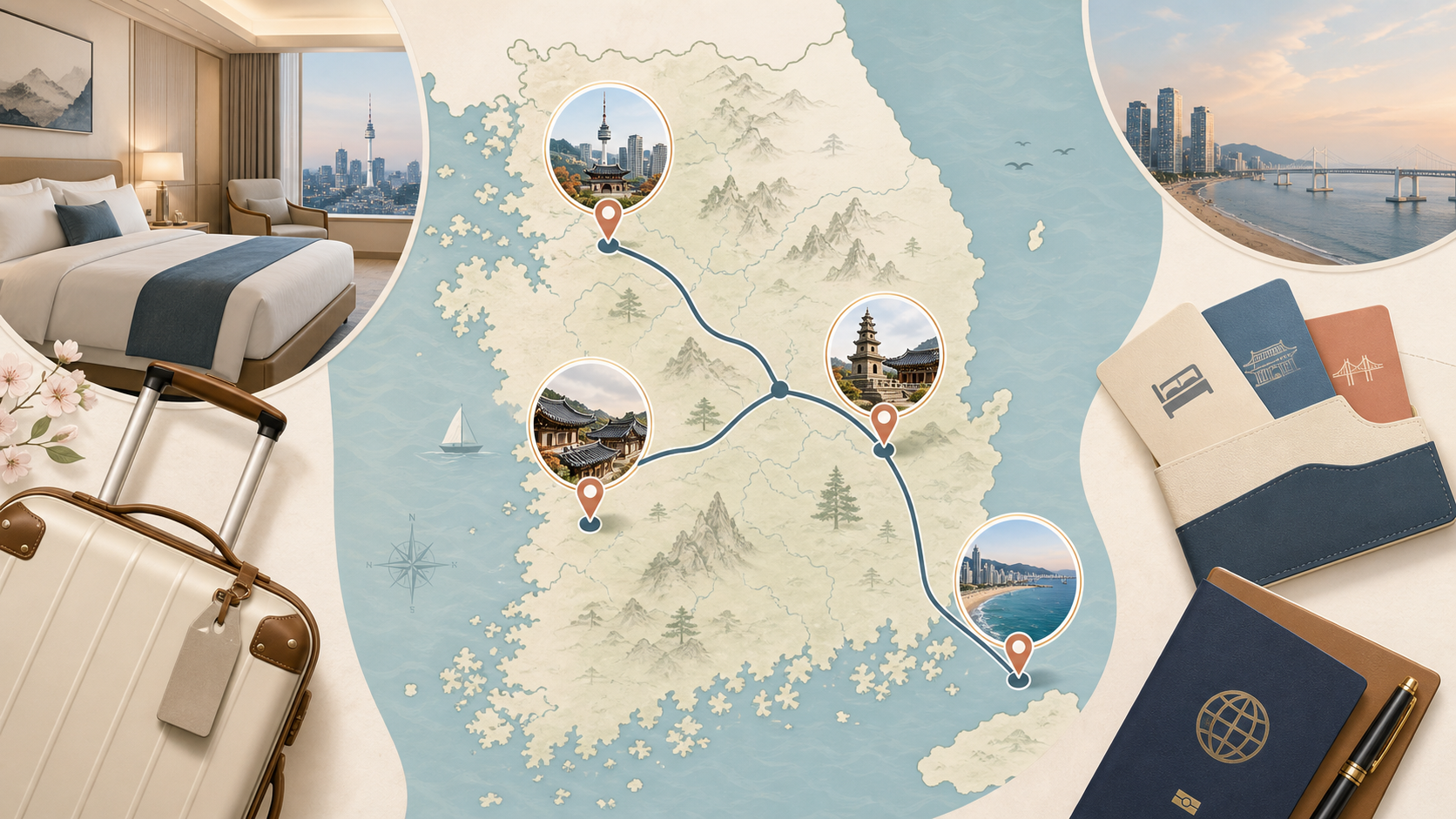
For most first-time visitors, Korea works best as a route built around Seoul, Busan, and optionally Gyeongju or Jeonju. Seoul is the arrival anchor. Busan gives coastal contrast. Gyeongju adds history and a slower heritage chapter. Jeonju adds food, hanok atmosphere, and a traditional small-city feel. Your accommodation choices should support that order instead of creating daily friction.
Use this guide to choose bases by trip length, travel style, and transfer logic. For the wider route framework, start with the Korea trip planning guide.
Quick answer: where should first-time visitors stay?
For a first Korea trip, choose accommodation like this:
- Seoul: stay somewhere transit-friendly and central enough for your actual plans. Prioritize convenience over novelty on the first stay.
- Busan: choose your base by trip style. Seomyeon is practical, Nampo is market-focused, Haeundae is beach-resort oriented, and Gwangalli is scenic and evening-friendly. Compare the best areas to stay in Busan before booking.
- Gyeongju: stay where sightseeing and evening walks are easy. The right base reduces taxi dependence and makes a short stay feel calmer. Use the where to stay in Gyeongju guide.
- Jeonju: stay close enough to the hanok and food areas if atmosphere is the reason you are going. Check the where to stay in Jeonju guide.
The most common first-time mistake is booking each hotel independently without thinking about the route. A hotel can look good in one city and still weaken the whole trip if it makes station transfers, luggage, evenings, or airport timing harder.
Start with your route before choosing hotels
Before comparing hotel areas, answer three questions:
- How many hotel changes are you willing to make?
- Which city is your arrival and departure anchor?
- Do you want a two-city trip or a three-to-four-stop route?
A first Korea trip usually fits one of these patterns:
- Seoul-only or Seoul-focused: best for short trips, long-haul jet lag, families, cautious first-timers, or travelers who dislike hotel changes.
- Seoul + Busan: best for 7 days when you want modern city life plus coast.
- Seoul + Busan + Gyeongju: best for around 10 days when you want the strongest first-time balance.
- Seoul + Busan + Gyeongju + Jeonju: best for longer trips or travelers who strongly value food, hanok stays, and slower heritage towns.
If you are still deciding the number of days in Seoul, use the how many days in Seoul guide before locking accommodation. If you only have one week, compare your plan with the 7-day Korea itinerary for first-time visitors.
The first Seoul stay: make arrival easy
Your first Seoul hotel has an important job: it needs to make the first 48 hours simple. This is not the moment to choose a beautiful but awkward area just because it looks interesting online. Jet lag, luggage, airport transfer timing, and unfamiliar transit can make a poor location feel more expensive than it looked.
For a first Seoul base, prioritize:
- Easy access from the airport or main rail connections.
- Subway convenience for palaces, markets, shopping areas, food neighborhoods, and evening plans.
- A surrounding area with food options within walking distance.
- A route back to the hotel that feels simple after a long day.
- Enough flexibility that bad weather does not ruin the day.
A central, transport-friendly Seoul stay is usually worth paying for, especially at the start of the trip. It reduces the number of small decisions you need to make while adjusting to Korea.
How many Seoul nights should you book first?
For a first trip, Seoul normally deserves at least three full sightseeing days if your schedule allows it. Arrival day is often only a partial day, especially after long-haul flights.
A practical pattern:
- Short trip: keep most or all nights in Seoul.
- 7-day trip: book 3 to 4 nights in Seoul, then move to Busan.
- 10-day trip: book 4 nights in Seoul, then continue to Busan and Gyeongju.
- Longer trip: consider a Seoul start and a final Seoul night or airport-area buffer.
Do not treat a two-night Seoul stay as two full days. In practice, it may be one real sightseeing day once arrival, check-in, and transfer time are included. If Seoul is a major reason for your trip, protect those nights early.
Busan base decisions: beach, market, nightlife, or logistics?
Busan is where many first-time visitors make the biggest accommodation mistake. They choose a beach hotel because Busan is coastal, then discover that their sightseeing list is spread across a long city. Busan is rewarding, but its areas create different trips.
Think of Busan bases by purpose:
- Seomyeon: best for practical movement, nightlife, eating, and transit convenience. Good if you want a balanced first Busan stay.
- Nampo: best for markets, seafood, harbor atmosphere, and classic central sightseeing.
- Haeundae: best if you want a beach-focused stay, a more resort-like feel, and do not mind being farther from some central areas.
- Gwangalli: best for views, evenings, cafes, beach atmosphere, and a scenic base with a relaxed feel.
There is no single best Busan area for everyone. The right choice depends on whether Busan is a quick contrast stop or a major part of the trip. Before booking, compare the best areas to stay in Busan and choose based on how you will actually spend your days.
Where to stay in Busan on a 7-day Korea route
On a 7-day Korea trip, Busan time is limited. Your base should reduce travel friction. If you have only two or three nights, think carefully before choosing a location that adds long cross-city rides every day.
Choose Seomyeon if:
- You want the easiest all-round base.
- You will use public transport often.
- You want food and nightlife nearby.
- You are unsure which Busan sights will become priorities.
Choose Nampo if:
- Markets, seafood, old Busan atmosphere, and harbor areas are priorities.
- You prefer a classic sightseeing base over a beach stay.
- You want a compact-feeling area with strong food access.
Choose Haeundae or Gwangalli if:
- The beach experience is a major reason for visiting Busan.
- You want scenic evenings more than maximum transit efficiency.
- You are comfortable spending more time crossing the city for certain sights.
For a first-time 7-day route, avoid splitting Busan hotels unless you have a strong reason. A two-night hotel split usually costs more energy than it saves.
Gyeongju base decisions: choose calm and access
Gyeongju works best when it feels slower than Seoul and Busan. If you add Gyeongju to a first Korea route, your accommodation should help you walk, rest, and enjoy the evening atmosphere rather than spend the stay coordinating taxis.
Stay in Gyeongju if:
- You want history, temples, royal tombs, hanok streets, and a calmer cultural chapter.
- You are doing a 10-day route and want more than Seoul plus Busan.
- You prefer evenings that feel different from big-city Korea.
- You want a short but meaningful heritage stop.
For most first-time visitors, Gyeongju is strongest after Busan. This makes the route feel natural and avoids unnecessary backtracking. Choose a base with sightseeing access and evening convenience; the where to stay in Gyeongju guide explains the area trade-offs in more detail.
Should Gyeongju be one night or two nights?
One night can work if you are using Gyeongju as a compact cultural stop, but two nights usually feels better. With one night, you arrive, sightsee, sleep, and leave. With two nights, you get one full day and can experience the city at a calmer pace.
Choose one night if:
- Your total trip is short.
- You only want the main highlights.
- You are comfortable with a faster pace.
- You have efficient transport timing.
Choose two nights if:
- You want the city to feel like a proper stop, not a transfer break.
- You care about temples, tombs, cafes, and evening walks.
- You are traveling with family or slower travelers.
- You want a buffer for weather.
Accommodation matters more on a one-night stay because there is no time to recover from a poor location.
Jeonju base decisions: go for food and atmosphere
Jeonju is not just another city to add because it appears on a map. It works best when food, hanok atmosphere, traditional streets, and a slower pace are part of your reason for visiting Korea. If your route is already short, adding Jeonju can weaken the trip unless you cut something else.
Stay in Jeonju if:
- You want a food-focused stop.
- You like hanok streets and traditional atmosphere.
- You want a softer contrast after Seoul and Busan.
- You are planning a longer route or are willing to move at a faster pace.
For a first-time stay, choose an area that supports the reason you are going. If hanok atmosphere and food are the focus, do not book so far away that every outing becomes a transport decision. Use the where to stay in Jeonju guide before locking the hotel.
Should you include both Gyeongju and Jeonju?
Gyeongju and Jeonju are not interchangeable. They both add heritage texture, but they serve different purposes.
Choose Gyeongju if:
- You want ancient history, temples, royal tombs, and a natural pairing with Busan.
- You are building a 10-day Seoul-Busan-Gyeongju route.
- You want a strong cultural stop without stretching the map too much.
Choose Jeonju if:
- You care more about food, hanok atmosphere, and a traditional town feeling.
- You have enough time to avoid rushing.
- You want a slower stop that feels distinct from Seoul and Busan.
Include both only if the trip length supports it. If you have around 7 days, both is usually too much. If you have around 10 days, both can be done only with compromises. If you have longer, both can make the route richer.
Best hotel pattern for a 7-day first Korea trip
For most 7-day first trips, use a two-base structure:
- Seoul: 3 to 4 nights.
- Busan: 2 to 3 nights.
- Final night: either remain in Busan if departure logistics work, or return toward Seoul if your flight requires it.
This route works because each hotel stay has a clear job. Seoul introduces Korea. Busan changes the scenery. You are not spending the trip checking in and out.
Avoid these 7-day hotel mistakes:
- Booking Seoul too far from useful transit.
- Choosing a Busan beach base when your plans are mostly central.
- Adding Gyeongju or Jeonju without accepting what must be cut.
- Changing hotels inside the same city for a short stay.
- Ignoring the final airport transfer until after hotels are booked.
If you are planning one week, use the 7-day Korea itinerary for first-time visitors to keep the accommodation plan aligned with the route.
Best hotel pattern for a 10-day first Korea trip
For a 10-day trip, the strongest hotel pattern is usually:
- Seoul: 4 nights.
- Busan: 3 nights.
- Gyeongju: 1 to 2 nights.
- Final buffer: return toward Seoul or your departure airport if needed.
This structure gives each stop a reason. Seoul is not rushed. Busan has enough time to justify the transfer. Gyeongju becomes a meaningful heritage chapter rather than a day-trip afterthought.
You can adjust the pattern if Jeonju is more important than Gyeongju. In that case, protect enough time for Jeonju instead of squeezing it in as an extra. A rushed hanok stay is rarely the best use of a first-trip budget.
Final-night strategy: do not ignore departure logistics
Many first-time visitors plan the exciting part of the route and leave the final night unresolved. This can create stress and extra cost near the end of the trip.
Before booking all hotels, check:
- Departure airport and flight time.
- Whether you need to return to Seoul before flying out.
- How early you need to leave your final city.
- Whether a final Seoul night makes the trip calmer.
- Whether an airport-area stay is useful for an early departure.
A final buffer night may look less exciting than another destination, but it can be the difference between a smooth trip and a stressful finish. This is especially true for families, long-haul flights, and travelers with expensive international connections.
How to choose between a better hotel and a better location
For first-time Korea travel, location usually wins. A beautiful hotel in an inconvenient area can quietly damage the trip by adding daily transfer time, taxi costs, and decision fatigue.
Choose the better location when:
- You have a short stay.
- You will be out sightseeing most of the day.
- You rely on public transport.
- You want easy food options at night.
- You are arriving late or leaving early.
Choose the better hotel when:
- You plan to rest more.
- You are traveling as a couple and hotel time is part of the trip.
- You have children and need space.
- You are staying several nights and can absorb slightly longer transport.
- The location is still connected enough for your plans.
The best value is usually a comfortable mid-range hotel in a practical area, not the cheapest room or the most luxurious property.
Booking order for first-time visitors
Book in this order:
- International flights: confirm arrival and departure cities and times.
- Route shape: decide Seoul-only, Seoul-Busan, Seoul-Busan-Gyeongju, or a longer route with Jeonju.
- First Seoul hotel: make arrival easy.
- Busan hotel: choose based on whether you want beach, markets, nightlife, or transit convenience.
- Gyeongju or Jeonju hotel: choose based on the purpose of the stop.
- Final-night logistics: protect the departure day.
- Activities and restaurants: add these only after the route is stable.
This order prevents the common problem of booking attractive hotels that do not fit together as a route.