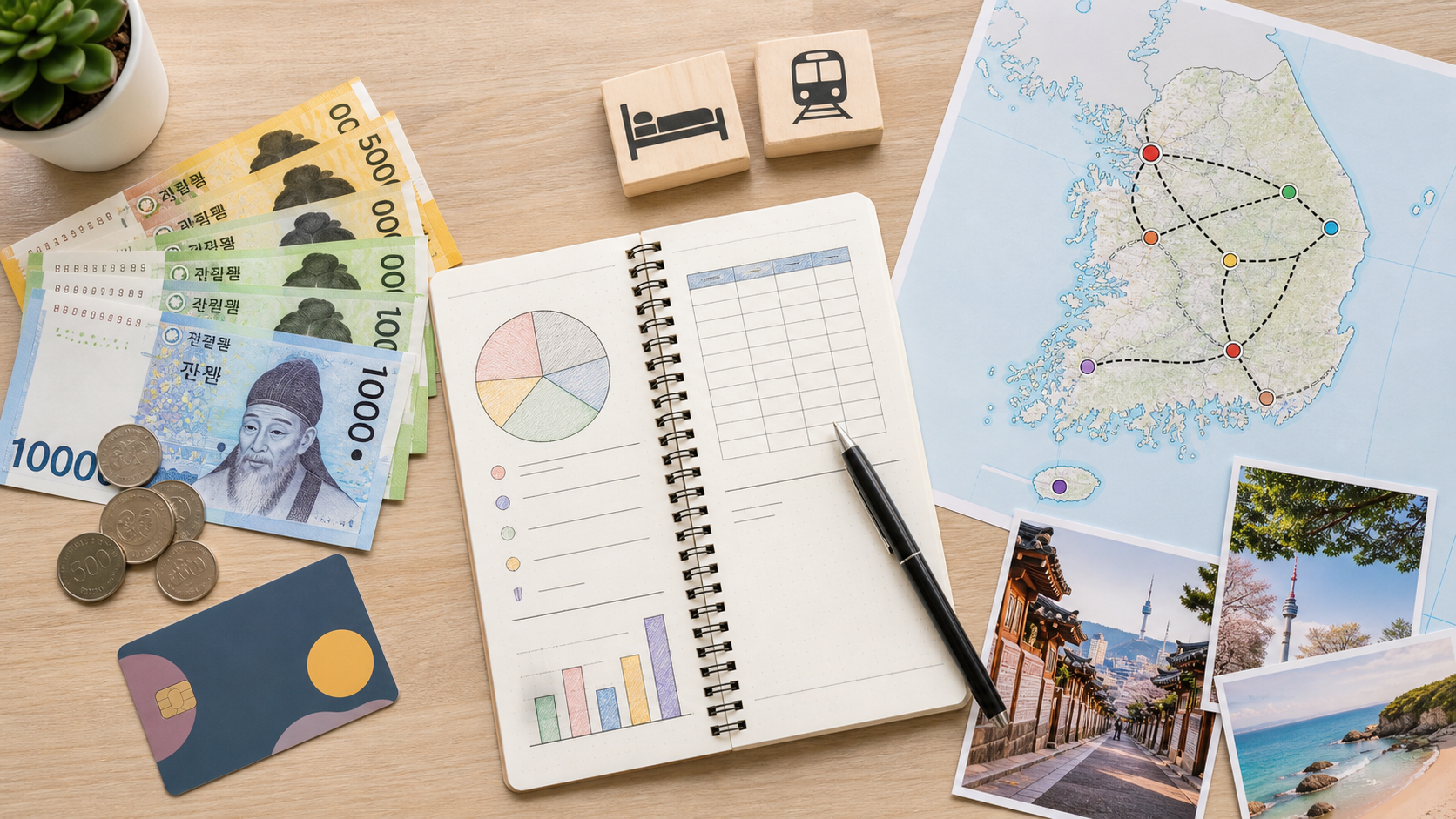
Planning a Korea first trip budget is not only about daily spending. The bigger decision is whether your money buys a smooth trip or an itinerary that feels expensive because it is too rushed. For first-time visitors, the main budget choice is usually 7 days versus 10 days: seven days keeps the route tighter, while ten days gives you enough time to add a stronger second or third stop without turning transfers into the main event.
This guide uses budget ranges and decision logic rather than fixed prices. Korea costs change by season, exchange rate, neighborhood, hotel quality, and how early you book. Use the ranges below to decide what kind of trip you are building, then check live hotel and transport prices before committing. For the broader planning framework, start with the Korea trip planning guide.
Quick answer: how much should you budget?
For a comfortable first Korea trip, a practical planning range is:
- Value-conscious trip: lower-cost hotels or guesthouses, casual food, public transport, limited paid attractions.
- Comfortable mid-range trip: good location hotels, a mix of casual and nicer meals, trains between cities, paid sights, cafes, and some taxis.
- Higher-comfort trip: better hotels, private rooms in prime areas, more taxis, guided activities, luggage convenience, and fewer compromises on location.
If your target is around $300 per day for two people excluding international flights, you can usually plan a comfortable first trip if you control hotel location, avoid unnecessary hotel moves, and keep the route efficient. If that $300 per day is for one person, you have more room for hotels, food experiences, and convenience spending.
The biggest cost driver is not one palace ticket or one train ride. It is the combination of:
- Hotel quality and neighborhood.
- Number of nights.
- Number of city transfers.
- Whether you need taxis because your hotel location is inconvenient.
- Whether you add destinations that require backtracking.
7 days vs 10 days: the budget difference that matters
A 7-day Korea trip is not automatically cheaper in a useful way. It has fewer hotel nights, but the fixed costs of arrival, departure, airport transfers, travel setup, and jet lag are spread across fewer days. A 10-day trip costs more overall, but often gives better value because each hotel move and train transfer supports more actual sightseeing time.
Choose 7 days if:
- Your flights are fixed and vacation time is limited.
- You want Seoul plus one clear contrast, usually Busan.
- You prefer fewer hotel moves.
- You would rather spend on better hotels and food than add another city.
- You do not want to feel tired on the final two days.
Choose 10 days if:
- You want the strongest first-time route without rushing.
- You want Seoul, Busan, and a cultural stop such as Gyeongju.
- You are comfortable with two hotel changes.
- You want more value from intercity train costs.
- You want enough buffer for weather, shopping, and slower mornings.
If Seoul is your main priority, first decide how much time the capital deserves with the how many days in Seoul guide. If you already know you want a classic one-week structure, compare it with the 7-day Korea itinerary for first-time visitors.
A realistic 7-day first Korea budget structure
A good 7-day route should normally use two bases. The cleanest version is Seoul plus Busan, because it gives a big contrast without too much routing complexity.
A practical 7-day structure:
- Days 1-4: Seoul for arrival, palaces, neighborhoods, markets, shopping, cafes, and food.
- Days 5-7: Busan for coastline, seafood, markets, beaches, and a different city rhythm.
Budget decisions for this route:
- Hotels: Spend more on location than room size. In Seoul, a central and transit-friendly base saves time. In Busan, your area choice changes the whole trip; compare beach, nightlife, and transport convenience before booking with the best areas to stay in Busan.
- Transport: The Seoul-Busan train is worth budgeting for because it makes the route simple. Do not choose a cheaper but awkward transfer if it costs half a day.
- Food: Korea is friendly to mixed spending. You can eat casual meals well, then choose a few higher-budget meals where they matter.
- Activities: Many first-time highlights are not expensive compared with hotels and trains. Keep a modest activity budget, but do not overpack paid tours just because you have only seven days.
- Taxis: Use taxis strategically for late nights, luggage, or awkward final legs. Do not build a route that requires taxis every day because the hotel is poorly located.
A 7-day trip works best when you keep the route decisive. Adding Gyeongju or Jeonju to a one-week trip can be done, but it usually means cutting meaningful time from Seoul or Busan. That may be acceptable if history or hanok atmosphere is the main reason for the trip, but it is not the best default for most first-time visitors.
A realistic 10-day first Korea budget structure
A 10-day trip gives the budget more breathing room because the route can do more without feeling like every day is a transfer day. The strongest first-time structure is Seoul, Busan, and Gyeongju.
A practical 10-day structure:
- Days 1-4: Seoul for arrival recovery and classic first-time sightseeing.
- Days 5-7: Busan for coast, markets, food, and city contrast.
- Days 8-9: Gyeongju for temples, tombs, hanok streets, and slower evenings.
- Day 10: return toward Seoul, the airport, or your departure city depending on flight timing.
Budget decisions for this route:
- Hotels: You pay for more nights than a 7-day trip, but you can choose accommodation by purpose. Seoul should be convenient. Busan should match your preferred style. Gyeongju should reduce friction around sightseeing; use the where to stay in Gyeongju guide before choosing.
- Transport: The extra city adds transfer costs, but Gyeongju pairs naturally with Busan. This is more efficient than forcing a long zigzag route.
- Food: Ten days lets you spread bigger food experiences across the trip instead of trying to fit everything into Seoul.
- Activities: You can balance paid attractions with self-guided walking days. This often keeps the budget healthier than booking a tour every day.
- Energy: The main financial benefit of ten days is not just more sightseeing. It is less wasted spending caused by fatigue, missed reservations, or last-minute convenience choices.
Ten days also lets you consider Jeonju, but be careful. Jeonju is excellent for food, hanok atmosphere, and a slower traditional stop, yet adding it to a 10-day first trip can make the route tight. If Jeonju is a priority, compare accommodation areas with the where to stay in Jeonju guide and decide what you are willing to cut.
Hotel budget: where to spend and where to save
Hotels are usually the largest controllable cost after flights. The cheapest room is not always the cheapest trip if it creates long daily transfers or forces more taxis.
Spend more when:
- You arrive late or leave early and need a simple transfer.
- You are staying only two or three nights and cannot waste time commuting.
- The neighborhood has direct transport to your main sightseeing areas.
- You are traveling with children, older parents, or heavy luggage.
- You want evenings to be easy without long rides back to the hotel.
Save when:
- You are staying longer and can absorb a slightly less central location.
- The hotel is still close to a useful subway or rail station.
- You do not need a large room because most days are spent outside.
- You are comfortable eating locally rather than staying in a nightlife or shopping district.
For a first trip, location is a budget tool. A well-placed mid-range hotel often creates a better trip than a nicer room far from the places you actually want to visit.
Food budget: use Korea’s range instead of choosing one style
Food budgeting in Korea works best when you mix categories. You do not need every meal to be a destination meal, and you do not need to eat cheaply every day to stay on budget.
A practical pattern:
- Breakfast: simple bakery, cafe, convenience store, hotel breakfast only if it genuinely saves time.
- Lunch: markets, casual restaurants, noodles, rice dishes, stews, or food halls.
- Dinner: choose the meals you care about most, such as barbecue, seafood in Busan, traditional meals, or a planned neighborhood food crawl.
- Snacks and cafes: budget for them intentionally; they are part of the Korea travel experience, not accidental extras.
The common mistake is underestimating drinks, cafes, desserts, and convenience snacks. They may not be expensive individually, but they add up over 7 to 10 days. Build a daily cushion rather than treating every small purchase as outside the budget.
Transport budget: trains, subways, taxis, and luggage
Transport spending should support route simplicity. Korea’s public transport is usually the default choice inside major cities, while intercity trains make the Seoul-Busan-Gyeongju route manageable.
Plan for:
- Airport transfers: arrival and departure are not normal sightseeing days. Budget for the option that reduces stress.
- City transport: subway and bus rides are usually efficient, but first-time visitors should allow a small margin for route mistakes.
- Intercity trains: book the route that protects time, not only the cheapest possible movement.
- Taxis: useful for luggage, late nights, bad weather, and final connections.
- Luggage storage or forwarding: sometimes worth it if it protects a full sightseeing day.
A lower transport budget can become a higher trip cost if it creates fatigue. If saving a small amount means losing half a day, it is usually not worth it on a short first trip.
Activity budget: what is worth paying for?
You do not need a paid activity every day in Korea. Many of the best first-time experiences are neighborhood-based: palace areas, markets, street food, shopping streets, waterfront walks, hanok lanes, and evening views.
Pay when the activity solves a problem:
- It gives context you would not get alone.
- It covers a hard-to-plan food or culture experience.
- It reduces transport complexity.
- It fits a short trip where time is more valuable than saving a little money.
- It helps a family or group move smoothly.
Skip or reduce paid activities when:
- The day is already full of free or low-cost neighborhoods.
- You would be paying for transport you can easily do yourself.
- The tour duplicates sights you already planned.
- You need a slower day after a hotel change.
For most first-time visitors, the best activity budget is selective. Choose a few paid experiences that improve the trip, then let the rest of the itinerary breathe.
Sample budget logic for a 7-day trip
Use this as a planning checklist rather than a fixed quote:
- Accommodation: six hotel nights, likely split between Seoul and Busan.
- Intercity transport: one major Seoul-Busan movement, plus airport transfers.
- Local transport: daily subway, bus, and occasional taxi costs.
- Food: seven days of mixed casual meals, cafes, snacks, and a few nicer dinners.
- Activities: palace or museum entries, viewpoints, possible food tour or cultural experience.
- Buffer: shopping, weather changes, luggage storage, small mistakes, and convenience spending.
The budget risk in seven days is compression. If you book hotels far from transport, add too many paid tours, or change cities too often, you may spend more while enjoying less.
Sample budget logic for a 10-day trip
Use this as a planning checklist:
- Accommodation: nine hotel nights, usually Seoul, Busan, and Gyeongju.
- Intercity transport: Seoul-Busan, Busan-Gyeongju, and final return or onward movement.
- Local transport: city transport plus taxis where they protect luggage or evenings.
- Food: more room for regional meals without forcing every meal to be special.
- Activities: a few paid experiences balanced with self-guided days.
- Buffer: stronger need for laundry, rest, weather alternatives, and flexible final logistics.
The budget risk in ten days is expansion. Because the trip feels longer, it is easy to add Jeonju, extra tours, shopping days, or upgraded hotels everywhere. Decide your priorities before the trip becomes a list of add-ons.
How to cut costs without weakening the trip
If the budget is getting too high, cut in this order:
- Reduce hotel moves. A simpler route saves money and energy.
- Choose better-located mid-range hotels instead of luxury rooms. Location matters more than extra amenities on a sightseeing trip.
- Use casual meals for breakfast and lunch. Save bigger spending for dinners that matter.
- Limit paid tours to the days where they add real value. Do not book activities just to fill time.
- Keep one flexible day. It prevents expensive last-minute fixes.
- Avoid backtracking. A neat route is often cheaper than a route that looks exciting on a map.
Do not cut the final airport buffer too aggressively. A stressful departure day can spoil the value of money saved earlier.
When to choose 7 days and spend more per day
Seven days can be the better budget decision if you want a sharper, more comfortable trip. Instead of stretching funds across more nights, you can spend on better hotel locations, stronger meals, and smoother transfers.
This is especially sensible if:
- You are flying long-haul and expect jet lag.
- You mainly want Seoul and Busan.
- You prefer fewer logistics.
- You are traveling as a couple and want better evenings.
- You would rather return for a second Korea trip than rush everything now.
In this case, build the route around Seoul and Busan, then resist the urge to add a third city.
When to choose 10 days and spend more overall
Ten days is the better decision if you want a fuller first Korea route and can afford the extra hotel nights. It usually gives a better travel experience than forcing the same ambitions into a week.
Choose 10 days if:
- You want Seoul, Busan, and Gyeongju.
- You care about both modern cities and heritage stops.
- You want a less rushed pace.
- You are comfortable with two hotel changes.
- You want each transfer to support multiple meaningful days.
This is often the best value version for first-time visitors because it balances contrast, pace, and cost.