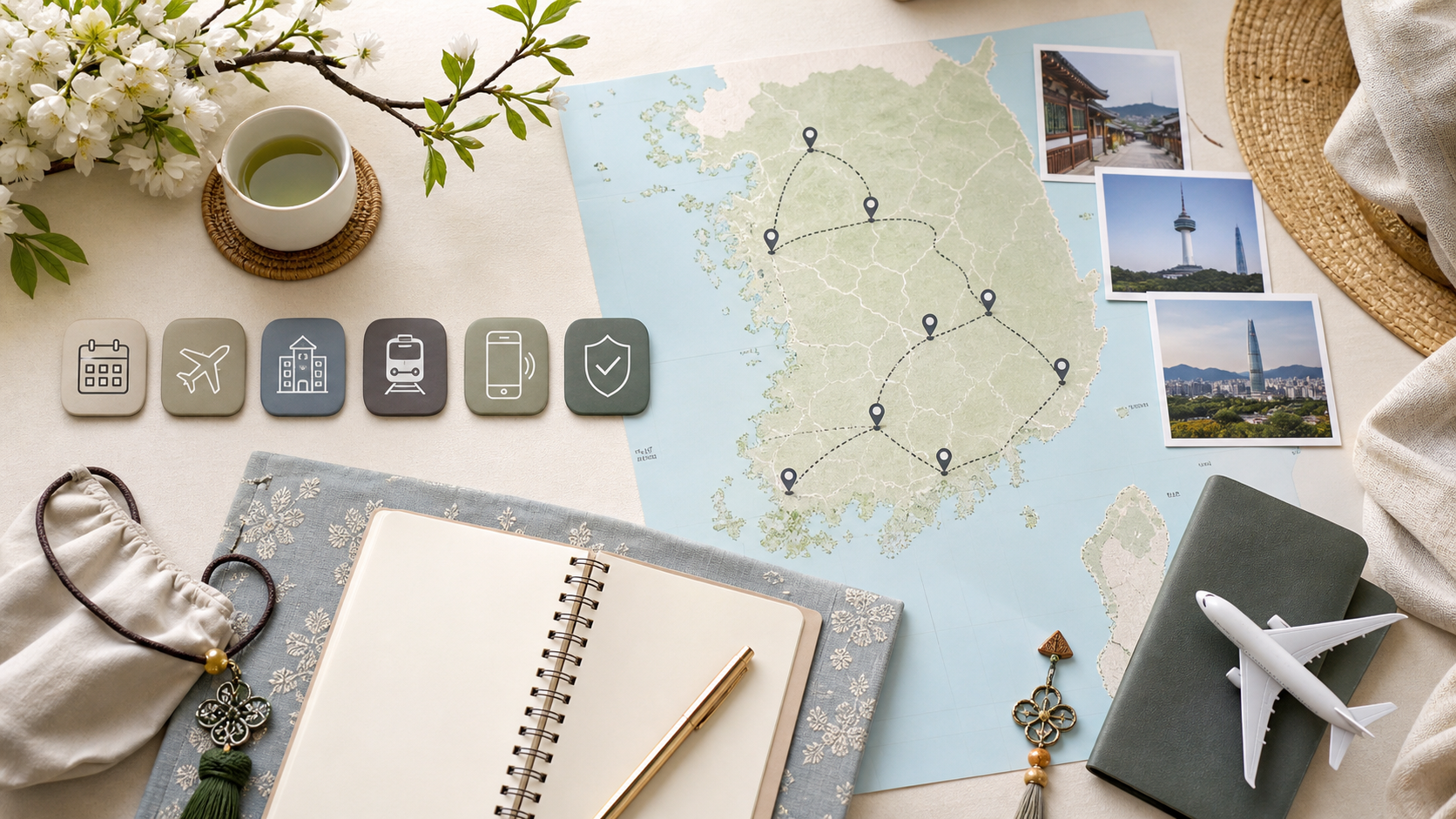
Planning a first Korea trip is not only about choosing places to visit. The bigger risk is booking things in the wrong order. If you reserve hotels before you understand your route, choose train days before checking your arrival time, or commit to activities before your neighborhoods make sense, the trip can become more expensive and harder to fix.
The best Korea trip booking sequence is simple: decide the route shape first, then lock the immovable pieces, then book flexible details around them. This guide gives a practical order for first-time visitors so you can avoid unnecessary hotel moves, awkward airport transfers, and last-minute spending.
If you are still deciding the overall route, start with the Korea trip planning guide before using this booking checklist.
Quick answer: the best Korea trip booking order
For most first-time visitors, use this order:
- Confirm travel dates and trip length. Decide how many nights you really have after arrival and before departure.
- Choose your route shape. For example: Seoul only, Seoul plus Busan, or Seoul plus Busan plus Gyeongju.
- Book international flights. Do this once the route shape and airport logic are clear.
- Choose hotel areas before choosing hotels. The neighborhood matters more than the room photo.
- Book refundable or changeable hotels. Lock good locations early, especially in Seoul and Busan.
- Check airport transfer logic. Make sure your first hotel works with your arrival airport and arrival time.
- Book intercity transport when the route is stable. Trains and buses should support the route, not force it.
- Add major activities and reservations. Book only the items that genuinely need advance planning.
- Finish local setup. Apps, cards, luggage plan, arrival day plan, and weather-aware backups.
The key rule is this: do not book details that depend on a decision you have not made yet.
Step 1: Confirm your real number of nights
Before booking anything, count nights instead of days. Many Korea itineraries look better on paper than they feel in real life because the first and last days are overestimated.
Ask:
- What time do you land in Korea?
- Which airport do you arrive at?
- Are you leaving from the same city or airport?
- Is your departure early in the morning or late at night?
- Will jet lag affect the first full day?
- How many hotel nights do you actually need?
A seven-day vacation may only give you five strong sightseeing days if arrival and departure times are awkward. A ten-day trip may feel much more comfortable because hotel changes and train transfers do not consume such a large share of the journey.
This matters because your booking order changes by trip length. A short trip should book fewer bases and prioritize convenience. A longer trip can support more city changes if each stop has a clear purpose.
Step 2: Decide the route shape before booking hotels
Your route does not need every meal and attraction yet, but it does need a clear shape. First-time Korea trips usually fit one of these patterns:
- Seoul only: best for short trips, deep city travel, shopping, food, cafes, palaces, and day trips.
- Seoul plus Busan: best for first-timers who want a big contrast without too many hotel moves.
- Seoul, Busan, and Gyeongju: best for travelers with enough nights who want city, coast, and history.
- Seoul plus Jeonju: best for food, hanok atmosphere, and a slower traditional stop.
Do not start by opening hotel booking sites in every city. Start by deciding what each stop is supposed to do. Seoul is usually the arrival and planning anchor. Busan adds coastline, seafood, markets, and a different city rhythm. Gyeongju adds temples, tombs, and historical atmosphere. Jeonju adds food, hanok streets, and a slower cultural pause.
Once the route shape is clear, you can make better booking decisions. If you are comparing where each city fits, use the transport framework in the Korea transport and arrival guide.
Step 3: Book flights after checking route logic
Flights are often the first paid commitment, but they should not be booked blindly. Before buying, check whether the arrival and departure times support the trip you want.
Good flight timing can save money beyond the airfare itself. A cheap flight that lands very late may require an airport hotel, taxi, or a tired first day. A departure that leaves early in the morning may force you back to Seoul the night before, even if your route would otherwise end better in Busan or another city.
Before booking flights, check:
- Arrival airport: Incheon or Gimpo.
- Arrival time: daytime, evening, or late night.
- Departure time: early morning departures often reduce your final night options.
- Whether you need to return to Seoul before flying out.
- Whether your first hotel area is practical from the airport.
For most international first-time visitors, Incheon is the main airport. If your first base is Seoul, review the Incheon and Gimpo airport transportation guide before choosing your first hotel area.
Step 4: Choose hotel areas before hotels
This is where many first-time visitors make expensive mistakes. They compare rooms before comparing neighborhoods. In Korea, the right area can make the whole trip easier; the wrong area can create daily friction even if the room is nice.
Choose the area first based on:
- Airport arrival convenience.
- Subway or rail access.
- Evening food options.
- Distance from the places you actually plan to visit.
- Luggage movement between cities.
- Whether you are traveling with children, older parents, or heavy bags.
- How late you expect to return at night.
In Seoul, first-time visitors should usually prioritize transport convenience and evening usability over a bigger room. A slightly smaller room in a better area can save time every day. Before booking, compare Seoul neighborhoods with the where to stay in Seoul for first-time visitors guide.
In Busan, the area decision is even more important because the city is stretched out. Haeundae, Seomyeon, Nampo, and other bases create different trips. Use the best areas to stay in Busan guide before locking a room.
For historical or cultural stops, location still matters. Check where to stay in Gyeongju and where to stay in Jeonju before choosing accommodation based only on atmosphere.
Step 5: Book hotels with flexibility first
Once you know your route and hotel areas, book good flexible options early. This is especially useful if you are traveling during cherry blossom season, autumn foliage, holidays, weekends, or school vacation periods.
A smart hotel booking sequence is:
- Reserve refundable hotels in the right areas.
- Keep checking prices and better options as the trip becomes clearer.
- Only switch to non-refundable rates when you are confident about the route.
- Avoid booking isolated cheap hotels that will force daily taxis or long subway rides.
- Confirm check-in times, luggage storage, and room type before the free cancellation deadline.
This sequence supports future deal-hunting without trapping you. You can compare booking platforms, monitor prices, and decide later whether a cheaper non-refundable rate is worth the risk.
For a first Korea trip, the hotel is not just a place to sleep. It is part of the transport plan, food plan, and energy plan.
Step 6: Check the first night and airport transfer together
Your arrival day deserves special attention. After a long flight, the first hotel should be easy to reach and easy to use. This does not always mean staying next to the airport. It means choosing a first base that matches your landing time, luggage, and comfort level.
If you arrive in the afternoon, you may be comfortable taking airport rail or a bus into Seoul. If you arrive late at night, you may need a simpler transfer plan. If you are traveling with family or large luggage, a hotel that looks convenient on a map may still be annoying if it requires stairs, transfers, or a long walk from the station.
For common first-time routes, check the dedicated airport guides:
Book the first night only after this logic makes sense. A good arrival plan reduces stress, taxi dependence, and the chance of regretting your hotel choice immediately.
Step 7: Book intercity transport after the route is stable
Do not book train or bus tickets before your city order is stable. Intercity transport should connect the trip smoothly, not force you to keep a bad route because a ticket was purchased too early.
Book transport after you know:
- Which cities you will sleep in.
- How many nights each city gets.
- Whether your departure airport requires returning to Seoul.
- Which hotel areas make station access easier.
- Whether the transfer day still leaves useful sightseeing time.
For Seoul to Busan, train travel is often the cleanest first-time choice because it is straightforward and supports a two-city route well. For smaller city combinations, buses or regional rail may make sense depending on the exact route.
The monetization-friendly lesson is not “always buy the fastest ticket.” It is to compare the total cost of the decision: ticket price, station access, luggage difficulty, wasted time, and whether you need an extra taxi because the cheaper option is inconvenient.
Step 8: Add activities only after the days have jobs
Activities should be booked after each day has a clear purpose. Avoid filling the calendar with paid reservations before you know your energy level, weather risks, and neighborhood flow.
Book early when:
- The experience has limited capacity.
- It is the main reason for visiting Korea.
- The date is fixed by season or event.
- You need a guide, private transfer, or special access.
- Missing it would seriously disappoint the group.
Wait when:
- The activity is easy to do independently.
- Weather will affect the experience.
- It depends on how tired you feel after arrival.
- It is a casual cafe, shopping district, market, or flexible neighborhood walk.
For first-time visitors, the best trips usually mix fixed anchors with open time. Book the few things that matter, then leave space for food, cafes, shopping, weather, and rest.
Step 9: Final setup in the last two weeks
The last two weeks are for confirming, not rebuilding the trip. By this point, your flights, main hotels, route, and key transport should be stable.
Final checks:
- Confirm hotel addresses in English and Korean if available.
- Save airport transfer instructions.
- Check luggage storage for early arrival or late departure.
- Reconfirm cancellation deadlines.
- Check train or bus times for transfer days.
- Make a simple arrival-day plan.
- Save offline maps or key screenshots.
- Confirm payment cards and backup payment options.
- Check weather and adjust outdoor days if needed.
This is also when you can make smarter optional purchases: airport convenience, luggage services, tours, day trips, eSIM or SIM options, and reserved experiences. These decisions are easier once the core trip is already correct.
Common booking order mistakes
Avoid these mistakes:
- Booking hotels before route shape. This leads to unnecessary hotel changes or awkward city order.
- Choosing the cheapest hotel first. A low room rate can create higher taxi and time costs.
- Ignoring arrival time. Late arrivals need simpler transfer logic.
- Overbooking activities early. Too many fixed reservations make the trip fragile.
- Booking non-refundable rates too soon. Small savings can become expensive if the route changes.
- Planning train days without station access. A hotel far from the station makes transfer days harder.
- Treating all Seoul neighborhoods as interchangeable. They are not, especially for first-time visitors.
- Forgetting the final night. Early departures may require returning to Seoul or staying somewhere more practical.
Most expensive Korea planning mistakes are not dramatic. They are small decisions made too early.
A simple booking timeline
Use this as a practical timeline, not a strict rule.
4-6 months before travel
- Decide trip length and route shape.
- Research Seoul and Busan hotel areas.
- Book international flights when dates and airport logic are clear.
- Reserve refundable hotels in the best-fit areas.
2-4 months before travel
- Refine city order and number of nights.
- Compare hotel prices again.
- Check whether Gyeongju or Jeonju fits the route.
- Identify key activities that need advance booking.
1-2 months before travel
- Book or prepare intercity transport once route details are stable.
- Confirm airport transfer plan.
- Replace weak hotel choices if better options appear.
- Book important activities or guided experiences.
Final 2 weeks
- Confirm all reservations.
- Save addresses and transfer notes.
- Check cancellation deadlines.
- Prepare payment, connectivity, and luggage plan.
- Leave some open time instead of filling every gap.
Final advice
The safest Korea trip booking order is not about booking everything as early as possible. It is about booking the right things at the right time.
First, understand your route. Then lock flights and well-located refundable hotels. After that, confirm airport transfers, intercity transport, and only the activities that truly need advance planning. This gives you enough structure to avoid stress while keeping enough flexibility to improve the trip as prices, preferences, and details become clearer.