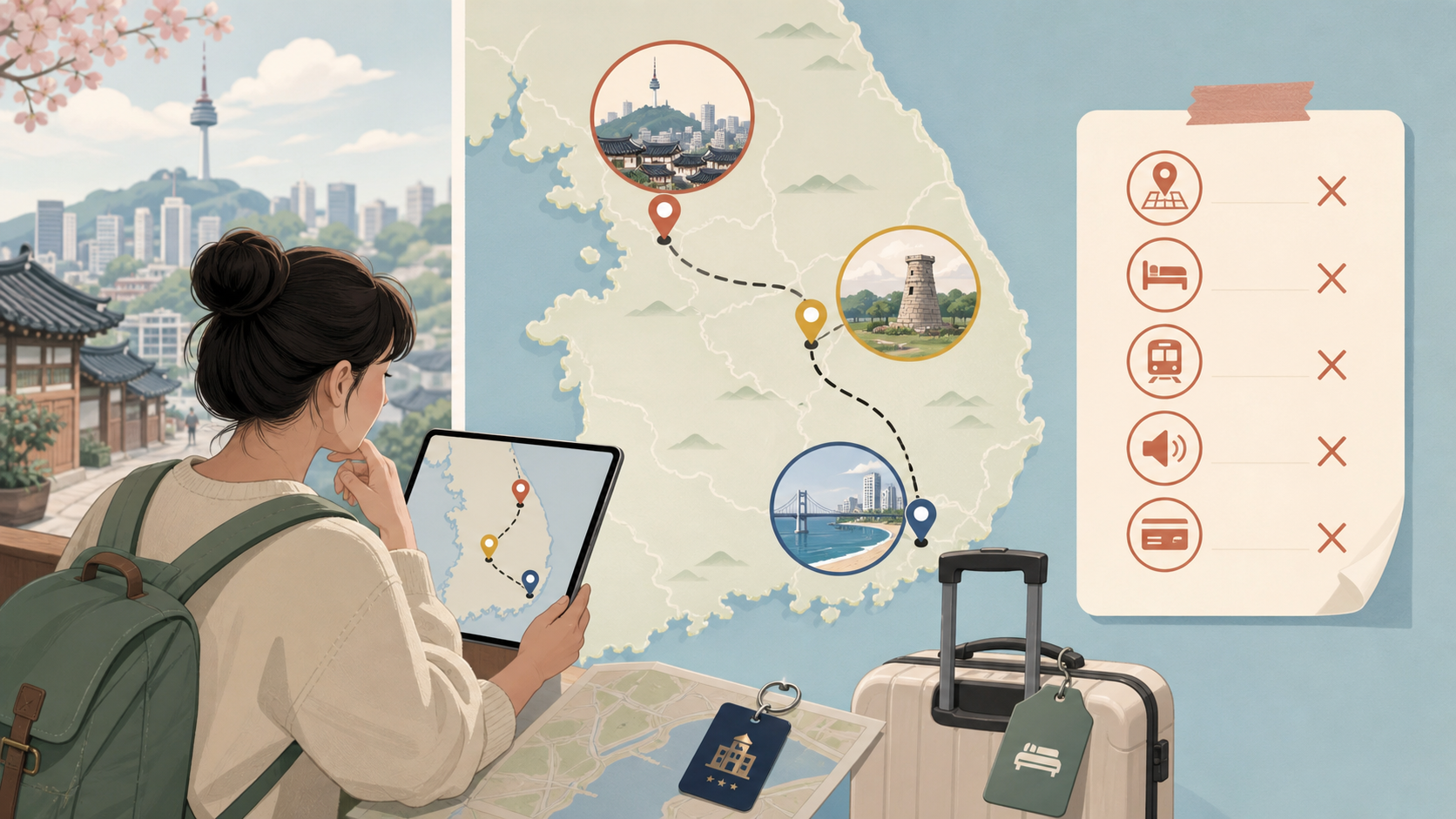
Hotels can make or break a first Korea trip. The risk is not only choosing a bad hotel. It is choosing a hotel that looks good online but makes the route harder every day: too far from useful transport, awkward after a late flight, inconvenient with luggage, or located in the wrong part of the city for your actual plans.
For first-time visitors, the best hotel is not always the highest-rated room or the cheapest deal. It is the hotel that fits your arrival, route, neighborhood style, daily transport, and energy level. This guide focuses on the hotel booking decisions that create the biggest trip risks, so you can spend wisely without being pushed into unnecessary upgrades.
For the full planning framework, start with the Korea trip planning guide.
Quick answer: the biggest Korea hotel booking mistakes
The most common hotel booking mistakes are:
- Booking a hotel before deciding the route.
- Choosing a room before choosing the neighborhood.
- Saving money on the nightly rate but paying with time, taxis, and stress.
- Ignoring airport transfer convenience on the first night.
- Treating all Seoul areas as equally convenient.
- Choosing the wrong Busan base for your travel style.
- Booking too many one-night stays.
- Locking non-refundable rates before the itinerary is stable.
- Not checking station access for intercity travel days.
- Forgetting luggage storage, check-in time, and room size realities.
A hotel is not just accommodation. On a Korea trip, it is part of your transport system.
Mistake 1: Booking hotels before deciding your route
Many travelers start with hotel search because it feels concrete. But if you book hotels before the route is clear, you may trap yourself into a poor city order or too many transfers.
Before booking, decide:
- How many nights you have in Korea.
- Whether you are staying only in Seoul or adding another city.
- Whether Busan, Gyeongju, or Jeonju belongs in the trip.
- Whether you must return to Seoul before departure.
- How many hotel changes you are willing to handle.
A first trip usually works better with fewer strong bases than with too many short stays. For example, Seoul plus Busan can be a clean first-time route. Seoul, Busan, and Gyeongju can work well with enough nights. But adding cities just because hotels are available can make the trip feel like luggage management instead of travel.
Use the Korea transport and arrival guide to understand route flow before locking rooms.
Mistake 2: Choosing the hotel before the neighborhood
This is the most important hotel mistake in Korea. A hotel can have good reviews and still be wrong for your trip if the area does not match your plans.
Neighborhood affects:
- Airport transfer convenience.
- Subway and train access.
- Evening food options.
- Shopping and cafe access.
- How tired you feel at the end of each day.
- Whether taxis become a daily habit.
- How easy it is to move luggage between cities.
In Seoul, first-time visitors often compare Myeongdong, Hongdae, Insadong/Jongno, Gangnam, and other areas without understanding how different they feel. The right choice depends on whether you care more about classic sightseeing, nightlife, shopping, airport access, food, or subway convenience. Before booking, read the where to stay in Seoul for first-time visitors guide.
In Busan, the neighborhood choice changes the whole trip. Haeundae, Seomyeon, Nampo, and other areas are not interchangeable. Compare them with the best areas to stay in Busan guide before choosing a hotel.
Mistake 3: Treating the cheapest room as the cheapest trip
A cheaper hotel can be a good decision. But it is not automatically the cheapest trip.
A low nightly rate may cost more if it causes:
- Long subway rides every morning and evening.
- More taxi use after dinner.
- Wasted time on short stays.
- Harder airport transfers.
- Awkward walks with luggage.
- Less flexibility for rest breaks.
- Missed plans because the location is tiring.
For first-time visitors, the better question is not “which hotel is cheapest?” It is “which hotel reduces friction for the route I am actually taking?”
A well-located mid-range hotel can create better value than a nicer room far from your daily plans. This is especially true for short trips, family trips, late arrivals, and routes with multiple city transfers.
Mistake 4: Ignoring the first night airport transfer
Your first hotel should be chosen together with your arrival plan. After a long flight, small inconveniences feel bigger: transfers, stairs, long station walks, late-night food, and confusing directions.
Before booking the first night, check:
- Which airport you arrive at.
- What time you land.
- Whether public transport still makes sense.
- Whether an airport bus, train, taxi, or private transfer is better for your group.
- How far the hotel is from the final stop.
- Whether the hotel has late check-in.
- Whether the neighborhood has food options when you arrive.
For many first-time visitors, Incheon Airport is the starting point. Review the Incheon and Gimpo airport transportation guide before booking your first hotel.
If you are choosing between common Seoul bases, compare the practical transfer routes:
The first night is not the best place to gamble on a difficult location just to save a small amount.
Mistake 5: Booking non-refundable hotels too early
Non-refundable rates can be useful when your itinerary is final and the savings are meaningful. They are risky when your route, city order, or flight timing is still uncertain.
Avoid non-refundable bookings when:
- You have not finalized how many nights each city gets.
- You are still deciding between Busan, Gyeongju, or Jeonju.
- Your flights are not booked.
- You may change arrival or departure airports.
- You are traveling during a season when plans may shift because of weather or events.
- You are booking multiple rooms for a group.
A safer sequence is to reserve refundable hotels in good areas first, then consider switching to a cheaper non-refundable rate closer to the trip if the plan is stable. This keeps you positioned for future price comparison, hotel deals, and better room options without forcing a bad itinerary.
Mistake 6: Not checking station access on transfer days
A hotel that is fine for sightseeing may be annoying on a train or bus day. If you are traveling from Seoul to Busan, Busan to Gyeongju, or adding Jeonju, station access becomes part of the hotel decision.
Check:
- How long it takes to reach the station with luggage.
- Whether the route requires stairs or difficult transfers.
- Whether a taxi is realistic at your departure time.
- Whether the hotel can store luggage before check-in or after check-out.
- Whether your next hotel is convenient from the arrival station.
Transfer days already consume energy. Do not make them harder by booking hotels that look central for sightseeing but are awkward for luggage movement.
This is especially important if your route includes smaller stops. For Gyeongju, check where to stay in Gyeongju for first-time visitors before assuming any location will work. For Jeonju, use the where to stay in Jeonju guide to understand the tradeoff between hanok atmosphere and transport convenience.
Mistake 7: Booking too many one-night stays
One-night stays can be useful, but they are often overused in first Korea itineraries. Every hotel change has hidden costs:
- Packing and unpacking.
- Checkout timing.
- Luggage storage.
- Station transfers.
- Early check-in uncertainty.
- Less evening flexibility.
- More chances for delays or fatigue.
A one-night stay makes sense when the stop has a clear purpose and the route supports it. It is less useful when it exists only because the map looks efficient.
For most first-time visitors, two or three nights in a base is more comfortable than constantly changing hotels. If you want to add Gyeongju or Jeonju, make sure the stay has enough time to feel worthwhile.
Mistake 8: Ignoring room size and bed setup
Korea hotel rooms can be smaller than some first-time visitors expect, especially in central Seoul and budget categories. A compact room may be completely fine for solo travelers or couples with light luggage. It can be frustrating for families, friends sharing a room, or travelers with large suitcases.
Check before booking:
- Actual room size, not just photos.
- Bed type and number of beds.
- Whether the room fits open luggage.
- Bathroom layout.
- Elevator access.
- Air conditioning or heating notes by season.
- Whether reviews mention noise, stairs, or cramped space.
Do not automatically overpay for space, but do not ignore it either. The right room size depends on how long you are staying, how much luggage you have, and whether the hotel is a short stop or your main base.
Mistake 9: Forgetting check-in, luggage storage, and late arrivals
Hotel logistics matter more than travelers expect. A good price is less useful if your arrival day is awkward.
Check:
- Standard check-in and check-out times.
- Whether the hotel offers luggage storage.
- Whether reception is 24 hours.
- Late check-in rules.
- Early check-in cost or availability.
- Whether the property is a full hotel, guesthouse, apartment, or unmanned stay.
- Instructions for self check-in if applicable.
This is especially important after international flights, early train arrivals, and final-day departures. If your hotel cannot store luggage, you may need station lockers or another workaround. That can be fine, but it should be planned rather than discovered when tired.
Mistake 10: Choosing atmosphere without checking daily convenience
Atmospheric stays can be a highlight in Korea. Hanok stays, boutique hotels, beach hotels, and stylish neighborhoods can all be worth it. The mistake is choosing atmosphere while ignoring daily logistics.
Ask:
- Is this stay the main experience or just a base?
- Will I still enjoy the location after dark?
- How will I reach food, stations, and sightseeing?
- Is luggage movement realistic?
- Am I paying for atmosphere I will barely have time to enjoy?
A hanok stay in Jeonju or a historical-feeling base in Gyeongju can be memorable if the route gives it enough time. A beach stay in Busan can be excellent if your trip is built around that rhythm. But if you are using the hotel only to sleep between long transfer days, convenience may matter more than mood.
Mistake 11: Not matching hotel style to traveler type
Different travelers need different hotel decisions. A good hotel for one trip can be a poor hotel for another.
Solo travelers
Prioritize safe late-night access, transport convenience, and a neighborhood you will enjoy alone. A smaller room may be fine if the location is strong.
Couples
Balance atmosphere and convenience. It can be worth paying more for a neighborhood that makes evenings easy, especially in Seoul, Busan, Gyeongju, or Jeonju.
Families
Room layout, luggage, elevators, food access, and shorter transfers matter more. Avoid hotel choices that require complicated station changes every day.
Friends sharing rooms
Check bed setup carefully. A “double room” may not mean what the group expects. Confirm whether you need twin beds, multiple rooms, or a larger family room.
Older travelers
Prioritize elevator access, shorter walks, simple transfers, and hotels near useful transport. A convenient base is often worth more than a stylish but awkward property.
Mistake 12: Not comparing total value before booking
Hotel booking should support the whole trip budget. The right choice is rarely the absolute cheapest or the most expensive. It is the best total value for your route.
Compare hotels using these questions:
- Does the location reduce daily travel time?
- Is the airport transfer straightforward?
- Is the station access good for intercity travel?
- Are food and convenience stores nearby?
- Will the room size work for the number of nights?
- Is cancellation flexible enough for the stage of planning?
- Are there hidden costs such as taxis, breakfast, luggage issues, or late check-in problems?
- Does the hotel match how you actually travel?
This approach supports smart monetization decisions later: comparing booking platforms, choosing refundable versus non-refundable rates, deciding whether breakfast is worth it, and knowing when a room upgrade saves real friction rather than just feeling nicer.
A practical Korea hotel booking checklist
Before you book, confirm:
- The route is mostly stable.
- The neighborhood fits your first-time priorities.
- The hotel is convenient from the airport or station.
- The cancellation policy matches your confidence level.
- The room type and bed setup are correct.
- Luggage storage is available or you have a backup.
- Late arrival or early departure is possible.
- Reviews mention no deal-breaking noise, access, or cleanliness issues.
- The total cost still makes sense after transport and convenience are included.
If several hotels look similar, choose the one that makes your hardest day easier. For most first-time visitors, that is arrival day, transfer day, or the final night.
Related Guides
- Korea trip planning guide
- Korea transport and arrival guide
- Incheon and Gimpo airport transportation guide
- Incheon Airport to Myeongdong
- Incheon Airport to Hongdae
- Where to stay in Seoul for first-time visitors
- Best areas to stay in Busan
- Where to stay in Gyeongju for first-time visitors
- Where to stay in Jeonju for first-time visitors
Before you pay: hotel policies, luggage storage, check-in times, bedding, and refund rules can vary by property and booking platform, so confirm the latest conditions on the exact booking page before you commit.
Final advice
For a first Korea trip, hotel booking is not just about finding a nice room. It is about reducing risk.
Choose the route first, then the neighborhood, then the hotel. Be careful with non-refundable rates until the itinerary is stable. Check airport and station access before committing. Spend where convenience protects the trip, and save where the location still works.
The best hotel decision is the one that makes your days easier, not just the one that looks best in search results.