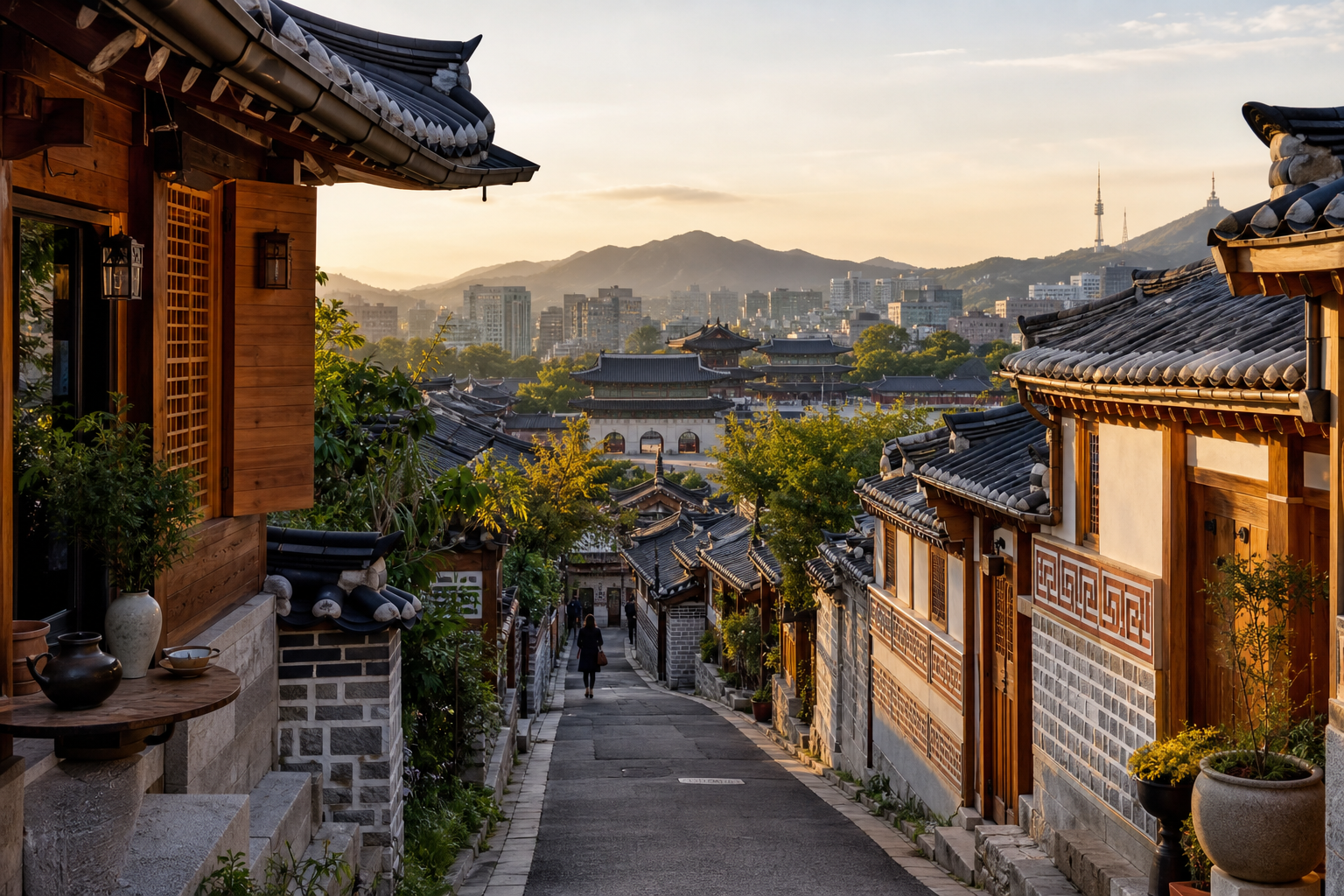
Some travelers come to Seoul mainly for shopping. Others come for nightlife.
And some come for something else entirely.
They want:
- palace courtyards
- hanok streets
- traditional tea houses
- slow walks through older neighborhoods
- a feeling that the historical side of Seoul is part of the trip every day
If that is your travel style, the best hotel area decision is different.
You are not just asking:
- “Where is convenient?”
You are really asking:
- “Which part of Seoul helps the traditional side of the city feel easiest and strongest?”
For culture-first travelers, the best shortlist is usually:
- Jongno
- Insadong
- Bukchon access
These are not identical answers.
If you want the short version:
- Jongno is the best broad base for most traditional-culture travelers
- Insadong is best if you want walkable traditional atmosphere around you
- Bukchon access is best if hanok scenery and palace-adjacent mood matter more than broad hotel-base practicality
For most culture-first first-time visitors, Jongno is the strongest default.
The short answer
If you want the cleanest decision possible, use this:
- choose Jongno for the strongest all-around culture-first base
- choose Insadong for walkable traditional atmosphere, tea houses, and visitor-friendly heritage feel
- choose Bukchon access if you want the strongest hanok-and-palace mood nearby and are willing to be more specific about your base logic
If you are unsure, choose Jongno.
Why? Because it gives you the best overall balance of:
- culture-first neighborhood logic
- palace and heritage access
- broad usefulness for a real Seoul trip
- less risk of choosing a base that is beautiful in concept but too narrow in practice
That is the important distinction.
The most photogenic traditional area is not always the best general place to stay.
Why this decision matters more for culture-first trips
When traditional culture is a main priority, your base does more than save transit time.
It affects:
- how often you naturally walk through heritage areas
- whether the city feels historically textured or just something you visit in blocks
- how easy it is to build slower, more atmospheric days
- whether your hotel area supports your trip mood or fights it
For nightlife travelers, the right district is about evening energy. For culture-first travelers, the right district is about daily atmosphere and route logic.
That is why this is a different stay decision from the usual Myeongdong vs Hongdae question.
Jongno: best broad base for culture-first travelers
For most travelers whose main Seoul priority is traditional culture, Jongno is the best overall answer.
Why? Because it gives you the broadest historical logic without over-narrowing your trip.
Visit Seoul editorial guidance specifically highlights the backstreets of Jongno as places with stories, history, and culture of their own. That framing matters because Jongno is not just one attraction zone. It is a wider heritage-minded part of Seoul.
Why Jongno works so well
Jongno is strong because it gives you:
- broad access to palace and heritage zones
- a historically meaningful district identity
- a better all-around base for travelers who want tradition to shape the trip
- more room to build multiple culture-first days without overcommitting to one tiny pocket
This is important.
If you stay in Jongno, you are not only staying near one famous site. You are staying in an area with stronger overall historical logic.
Who should choose Jongno
Jongno is usually the best fit for:
- first-time visitors whose main priority is traditional culture
- travelers who want access to multiple heritage zones
- people who want palaces, older streets, and cultural atmosphere to anchor the trip
- visitors who want a practical answer, not just the most romanticized one
Jongno’s downside
Its weakness is not cultural value. Its weakness is that it is more specific than broad convenience-first districts like Myeongdong.
If your trip is mainly about:
- shopping
- nightlife
- very late evenings
- a more obviously modern city atmosphere
then Jongno may not be the right emotional center of the stay.
But for culture-first travel, it is the strongest default.
Insadong: best for walkable traditional atmosphere
If Jongno is the broad culture-base answer, Insadong is the more immediate atmosphere answer.
Insadong works well for travelers who want traditional culture not just nearby, but visible and felt in the rhythm of the neighborhood.
Visit Seoul’s Insa-dong-themed content reinforces the area’s identity as a recognizable culture corridor within Jongno. That is exactly why it appeals to visitors.
Why Insadong works so well
Insadong is strong for:
- walkable heritage atmosphere
- traditional-street feel
- tea houses and craft-oriented mood
- travelers who want cultural ambience around them, not only at destination stops
If your ideal Seoul day includes drifting through cultural streets, stopping for tea, browsing traditional craft-oriented spaces, and feeling that the area itself supports the trip mood, Insadong becomes very attractive.
Who should choose Insadong
Insadong is usually the best fit for:
- travelers who want the most immediate traditional atmosphere
- visitors who prefer slower, strolling-style days
- culture-first travelers who want visitor-friendly heritage energy
- people who care about ambience almost as much as logistics
Insadong’s downside
Its strength is also its limitation.
Insadong is more mood-specific.
If you want the broadest possible culture-first base with a little more flexibility, Jongno often stays stronger. If you want the city’s traditional side to feel present right around your hotel area, Insadong gains ground.
That means Insadong is excellent, but not always the broadest default.
Bukchon access: best for hanok-and-palace atmosphere
Bukchon access is the most emotionally powerful answer for some travelers.
Why? Because Bukchon carries one of the strongest visual identities in traditional Seoul.
Existing live-site content already treats Bukchon Hanok Village as one of Seoul’s most beloved traditional areas, and that is exactly why many travelers are drawn to staying near it.
Why Bukchon access is so appealing
Bukchon access is strongest for:
- hanok atmosphere
- photogenic traditional streets
- palace-adjacent cultural mood
- travelers who want the traditional visual side of Seoul to feel especially close
This is the answer for people who are not just asking for convenience. They are asking for mood density.
Who should choose Bukchon access
Bukchon access is usually best for:
- travelers who care deeply about hanok scenery
- visitors whose Seoul dream is built around palace-and-tradition imagery
- people who want the stay itself to feel culturally distinctive
- slower travelers who understand that atmosphere can matter as much as pure efficiency
Bukchon access’s downside
This is where discipline matters.
The most iconic traditional area is not automatically the best universal place to stay.
Bukchon access can be emotionally attractive and still not be the strongest general answer for every traveler.
If your trip needs:
- broader hotel flexibility
- wider overall routing ease
- a less specialized base
then Jongno or Insadong may still be the smarter choice.
Bukchon access is powerful as an atmosphere choice. It should not be treated as an automatic default just because it photographs beautifully.
Jongno vs Insadong vs Bukchon access by category
This is where the choice becomes more practical.
Best for first-time culture-first visitors overall
Winner: Jongno
Jongno is the strongest default because it gives culture-first travelers the broadest and most usable base logic.
Best for palace access
Winner: Jongno
If palace-focused planning is a major part of the trip, Jongno’s broader historical geography makes it the cleanest answer.
Best for hanok atmosphere
Winner: Bukchon access
This is Bukchon’s lane. If hanok mood is your main emotional criterion, it wins.
Best for tea houses, crafts, and traditional-street feel
Winner: Insadong
Insadong has the clearest walkable traditional visitor-corridor energy.
Best for broader Seoul trip balance
Winner: Jongno
If you want a culture-first answer that still holds together as a wider Seoul base, Jongno is the best balance point.
Best for slower walking-focused trips
Winner: Insadong or Bukchon access, depending on atmosphere priority
If your trip pace is gentle and mood-driven, those two become especially compelling.
Best for travelers who want culture without overcomplicating logistics
Winner: Jongno
This is why Jongno remains the best default culture answer.
Choose Jongno if…
Choose Jongno if most of these are true:
- traditional culture is your main priority
- you want the strongest broad base, not the narrowest romantic one
- you want palace and heritage access across more than one tiny pocket
- you want culture-first logic without overcomplicating the rest of the trip
Jongno is the best answer when you want culture to lead the trip, but still need a practical hotel base.
Choose Insadong if…
Choose Insadong if most of these are true:
- you want traditional atmosphere right around you
- tea houses, craft mood, and heritage-street energy matter a lot
- you prefer slower strolling over hyper-efficient routing
- you want culture to feel immediate, not just nearby
Insadong is the right answer when your ideal stay is as much about ambience as about access.
Choose Bukchon access if…
Choose Bukchon access if most of these are true:
- hanok scenery matters more than broad convenience
- you want palace-adjacent traditional mood as a central emotional part of the trip
- you are willing to choose a more atmosphere-specific base
- you understand that strongest heritage mood is not always the same as strongest all-around hotel logic
Bukchon access is the right answer when the feeling of staying near traditional Seoul matters deeply to you.
Who should avoid each option?
Avoid Jongno if…
- your trip is mainly about shopping, nightlife, or modern city energy
- traditional culture is only a minor add-on rather than the main lens
Avoid Insadong if…
- you want the broadest all-around Seoul base more than a focused culture corridor
- you care less about atmosphere and more about pure general utility
Avoid Bukchon access if…
- you are choosing mostly for broad convenience
- you want stronger nightlife or late-night district energy
- you are attracted mainly by photos rather than actual trip-style fit
My recommendation for most traditional-culture visitors
If you want one practical ranking, use this:
1) Jongno
Best overall culture-first base because it balances heritage logic, palace access, and broader stay practicality.
2) Insadong
Best for travelers who want traditional atmosphere to be immediately walkable and emotionally present.
3) Bukchon access
Best for hanok-mood seekers, but more specific and less universal as a default hotel-base answer.
That is the culture-specific ranking.
But here is the important correction:
If traditional culture is not actually the main lens of your trip, then broader first-time stay logic may still win. In that case, go back to Where to Stay in Seoul for First-Time Visitors.
That distinction matters just as much here as it did in the nightlife page.
What this means for different trip styles
For shorter first trips
Jongno becomes even stronger.
Shorter trips benefit from a base that is culturally rich without being too narrow in logic.
For slower heritage-focused trips
Insadong and Bukchon access become more attractive.
If your trip pace is slower and mood-driven, atmosphere gains value relative to raw efficiency.
For broader Korea trips
Jongno is usually still the safest culture-first answer because it keeps the logic broader and cleaner.
How to make any culture-first base work better
1. Match the base to your real priority
Do not choose Bukchon access just because the imagery is attractive if your real trip priority is broader convenience.
Be honest about whether you want:
- heritage access
- heritage atmosphere
- or the strongest all-around culture-first base
Those are related, but not identical.
2. Size Seoul correctly
If you are still deciding how long to stay in Seoul, answer that first with How Many Days in Seoul Do You Really Need?
Culture-first trips often benefit from a slower pace, which can affect your area choice.
3. Use the heritage cluster properly
This page works best when paired with the site’s cultural destination assets:
- Bukchon Hanok Village Guide
- Gyeongbokgung Palace Guide
- Hanok Stay: Experience a Night in Traditional Korean Houses
- Traditional Craft Experiences: Discover the Beauty of Korean Art
That turns the stay decision into a usable planning path.
Final decision guide
Use this if you want the cleanest answer.
Choose Jongno if…
- you want the strongest broad traditional-culture base
- you want palace and heritage access with better all-around practicality
- you want culture-first logic without over-narrowing the trip
Choose Insadong if…
- you want walkable traditional atmosphere around you
- tea houses, crafts, and heritage-street mood matter most
- you want a slower and more ambience-driven stay
Choose Bukchon access if…
- hanok scenery is the emotional center of the trip
- you want the strongest traditional visual atmosphere nearby
- you accept that the best mood choice is not always the broadest practical choice
Related guides
Use these next depending on what you still need to decide:
- Where to Stay in Seoul for First-Time Visitors
- Bukchon Hanok Village Guide
- Gyeongbokgung Palace Guide
- Hanok Stay: Experience a Night in Traditional Korean Houses
- Traditional Craft Experiences: Discover the Beauty of Korean Art
- How Many Days in Seoul Do You Really Need?
- 7 Common Korea Travel Mistakes First-Time Visitors Make and How to Avoid Them
Final takeaway
There is no single culture-focused Seoul base that wins for everyone.
But there is a clear practical ranking.
- Jongno is the best broad default for traditional-culture travelers
- Insadong is best for walkable atmosphere
- Bukchon access is best for strongest hanok-and-palace mood
If you want the safest culture-first answer, choose Jongno. If you want atmosphere right around you, choose Insadong. If you want the strongest visual traditional mood and accept a narrower logic, choose Bukchon access.
That is the decision framework that actually helps.