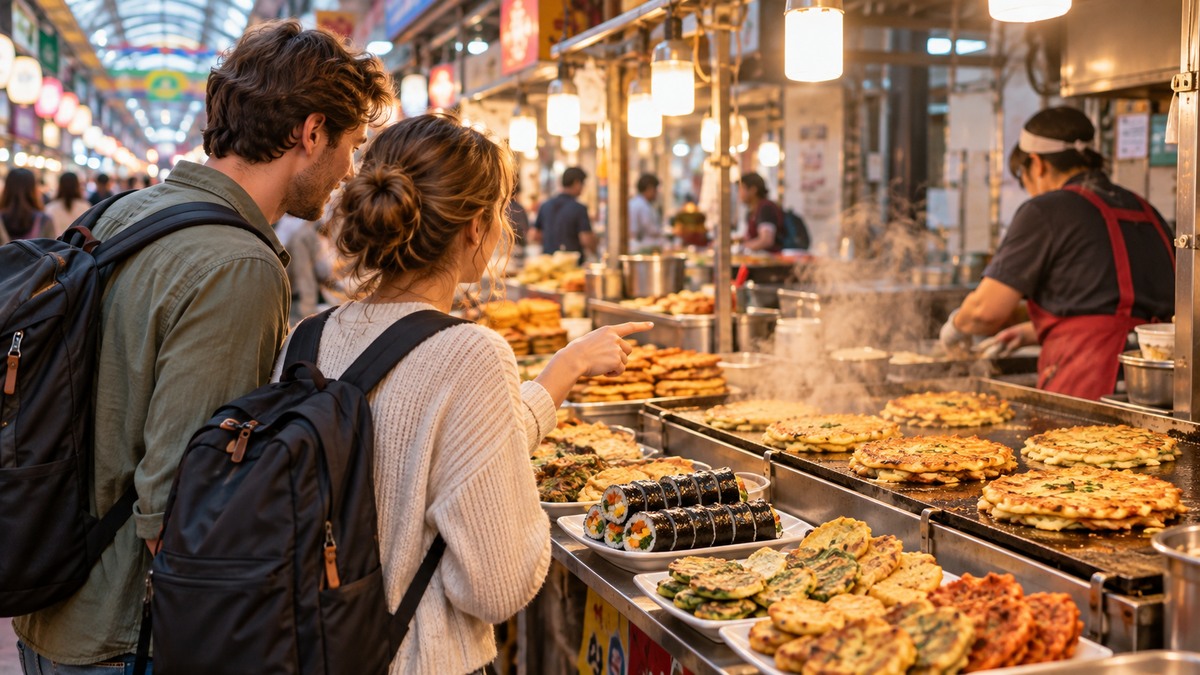
Gwangjang Market works best as a focused food stop inside a central Seoul day, not as a checklist challenge. For a first visit, choose two or three dishes instead of trying to sample everything. A practical order is one savory item such as bindaetteok, one small bite such as mayak gimbap, and one dish that suits your group.
Fast decision box
- Best for: first-time Seoul visitors who want a compact traditional-market food stop
- Go via: Jongno 5-ga Station, Line 1, Exit 8
- Food-alley hours: officially listed as 09:00–23:00; confirm the stall you want
- Allow: about 60–90 minutes as an editorial estimate for a focused visit; longer for queues, shopping, or a specific restaurant
- Bring: a physical payment card plus Korean won as backup
- Skip or shorten it if: your group needs a quiet reserved table, detailed ingredient control, or a fixed menu
Is Gwangjang Market worth adding to a first Seoul trip?
Yes, if you want a food-centered stop that fits naturally into a central Seoul day. Gwangjang works especially well after a palace, Jongno, Cheonggyecheon, or Dongdaemun-area route because you do not need to turn it into a separate full-day excursion.
It is less useful if you are adding it only because every Seoul checklist includes it. Travelers who prefer a quiet reserved table or a fixed menu may enjoy one planned restaurant more than an open-ended market walk.
Who should go—and who should skip it?
Add Gwangjang Market if you:
- want to try several Korean foods in one compact area;
- are already sightseeing in Jongno or central Seoul;
- enjoy counter seating and watching food being prepared;
- can share dishes with your group instead of ordering a full portion at every stop.
Skip it or use it as a short walk-through if you:
- need detailed ingredient or allergen control;
- do not eat raw beef and the group mainly wants yukhoe;
- prefer a quiet, reserved dining setup;
- expect every vendor to have identical hours, prices, or payment methods;
- have only a few hours in Seoul and would create a long cross-city detour to reach it.
Gwangjang Market hours and the best time to go
The official Visit Seoul and VISITKOREA listings separate the main market from the food area:
| Area | Officially listed hours | Important caveat |
|---|---|---|
| General market | 09:00–18:00 | General market sections are listed as closed on Sundays |
| Food alley / food street | 09:00–23:00 | Listed as open year-round, but individual stall hours vary |
| Guje shopping street | 10:00–19:00 | Listed as closed on Sundays |
If shorter waits matter more than peak meal atmosphere, an editorially sensible approach is to avoid typical lunch and dinner periods. This is planning guidance rather than an official market crowd timetable, and conditions vary by day and vendor.
Sunday requires extra care. Official tourism listings say the food street is open year-round while other market sections close on Sundays. That does not guarantee that every food vendor will open. If one specific stall matters to you, verify it separately on the day.
How to get to the food alley without wasting time
The simplest route in the official Visit Seoul directions is:
- Take Seoul Subway Line 1 to Jongno 5-ga Station.
- Use Exit 8.
- Follow current map directions to Gwangjang Market; Visit Seoul lists the market about 62 meters from that exit.
Save the market name in Korean—광장시장—in Naver Map or KakaoMap before leaving your hotel. This helps if English place-name search returns several entrances or nearby businesses.
For broader transit preparation, use the Seoul subway guide for foreigners and the Korea travel apps guide.
What to eat: build a short list, not a seven-course challenge
The official Visit Seoul page names bindaetteok, assorted savory pancakes, mayak gimbap, sundae, head meat, yukhoe, and Korean-style meatballs among the market’s well-known foods. Treat that as a menu of possibilities, not a requirement to order all of them.
Bindaetteok: the easiest first shared dish
Bindaetteok is a thick savory pancake made from ground mung beans. It is fried, filling, and usually easier to share than to eat alone as one stop in a longer tasting route.
Choose it if your group wants a hot, savory market classic. Skip or share a smaller amount if oily fried food will make the rest of the visit less enjoyable.
Mayak gimbap: useful as a smaller bite
These small rice rolls are easier to split and combine with another dish. They make sense when you want variety without committing to another full plate.
The nickname is common marketing language; the practical reason to order them is portion size and convenience, not hype.
Yukhoe: only if everyone understands it is raw beef
Yukhoe is seasoned raw beef. Order it only if your group actively wants raw beef and is comfortable choosing a suitable specialist restaurant or stall. It is not a default “must-eat” for every visitor.
If anyone in the group avoids raw meat, choose a cooked dish instead.
Sundae and assorted jeon: choose by appetite, not checklist pressure
Korean sundae is blood sausage, not an ice-cream dessert. Assorted jeon are pan-fried or battered savory items. Both can work well in a group because you can compare a few pieces without making one person finish every dish.
Before ordering, point to the exact item, confirm the portion, and ask the total price. Do not assume that an English dish name means the same portion at every vendor.
How to pay without creating friction
VISITKOREA’s current Gwangjang Market listing marks cards as accepted at market level. The recommendations below are precautions for any trip where one payment method is essential; they are not evidence that a specific Gwangjang vendor rejects foreign cards.
Use a simple backup plan:
- Bring one physical internationally enabled card.
- Keep a second payment method separate if possible.
- Carry some Korean won for stalls where cash is easier or a card fails.
- Confirm the total before handing over payment.
- Do not rely on a phone wallet as your only method.
For the wider trip setup, read How to Pay in Korea in 2026. That guide covers cards, Korean won, ATMs, T-money, and foreign-card limitations beyond the market.
An editorial 60- to 90-minute market plan
This time range is a planning framework for one loop and two or three orders, not an official duration. Add time for shopping, a long queue, or a restaurant that is the main purpose of your visit.
Step 1: enter with one goal
Decide whether your priority is a meal, a three-item tasting, or a quick look. A vague “try everything” plan usually leads to duplicate orders and food fatigue.
Step 2: walk one loop before ordering
Use the first 10 minutes to see portions, seating, queues, and posted menus. This makes it easier to compare without treating the busiest visible stall as the only option.
Step 3: order one anchor dish
Choose bindaetteok, a cooked noodle or dumpling dish, or another filling item your group can share. Then add one smaller bite only if everyone still wants it.
Step 4: keep the rest of the day geographically tight
Pair the market with central Seoul rather than crossing the city twice. On a short trip, Gwangjang fits better into a Jongno, palace, Cheonggyecheon, or Dongdaemun day than into a Gangnam-heavy route.
The 3-day Seoul itinerary for first-time visitors explains how to group districts without wasting time on backtracking.
Common first-visit mistakes
Arriving with no portion strategy
Several famous dishes are filling. Share where practical and pause before placing the next order.
Ordering raw beef because it appears on every list
Yukhoe is optional. Choose food based on your group’s preferences and dietary needs, not on a checklist.
Building a route around a viral stall
A long queue can consume the entire visit. If the value is the market experience rather than one named vendor, set a queue limit and choose an alternative.
Source and freshness note
This guide was checked on September 22, 2026 against the official Visit Seoul and VISITKOREA Gwangjang Market listings. Hours, vendor participation, menus, prices, and payment terminals can change independently, so recheck a named vendor when it is central to your plan.
Related Guides
- 3-Day Seoul Itinerary for First-Time Visitors
- How to Pay in Korea in 2026
- Seoul Subway Guide for Foreigners
- Korea Travel Apps for First-Time Visitors
FAQ
Is Gwangjang Market open on Sunday?
Official tourism listings say the food street is open year-round, while the general market and some shopping sections close on Sundays. Individual food stalls may still choose not to open, so verify any specific vendor.
What food should a first-time visitor try?
Start with one shareable savory dish such as bindaetteok, then add a smaller item such as mayak gimbap. Order yukhoe only if everyone understands that it is raw beef and actively wants it.
Final verdict
Add Gwangjang Market when it fits a central Seoul day and you want a compact food experience. Keep the visit focused on the dishes your group actually wants.
Official sources
- Visit Seoul, “Gwangjang Market”: https://english.visitseoul.net/shopping/Gwangjang-Market/ENP000286
- VISITKOREA, “Gwangjang Market”: https://english.visitkorea.or.kr/svc/whereToGo/locIntrdn/rgnContentsView.do?vcontsId=106345