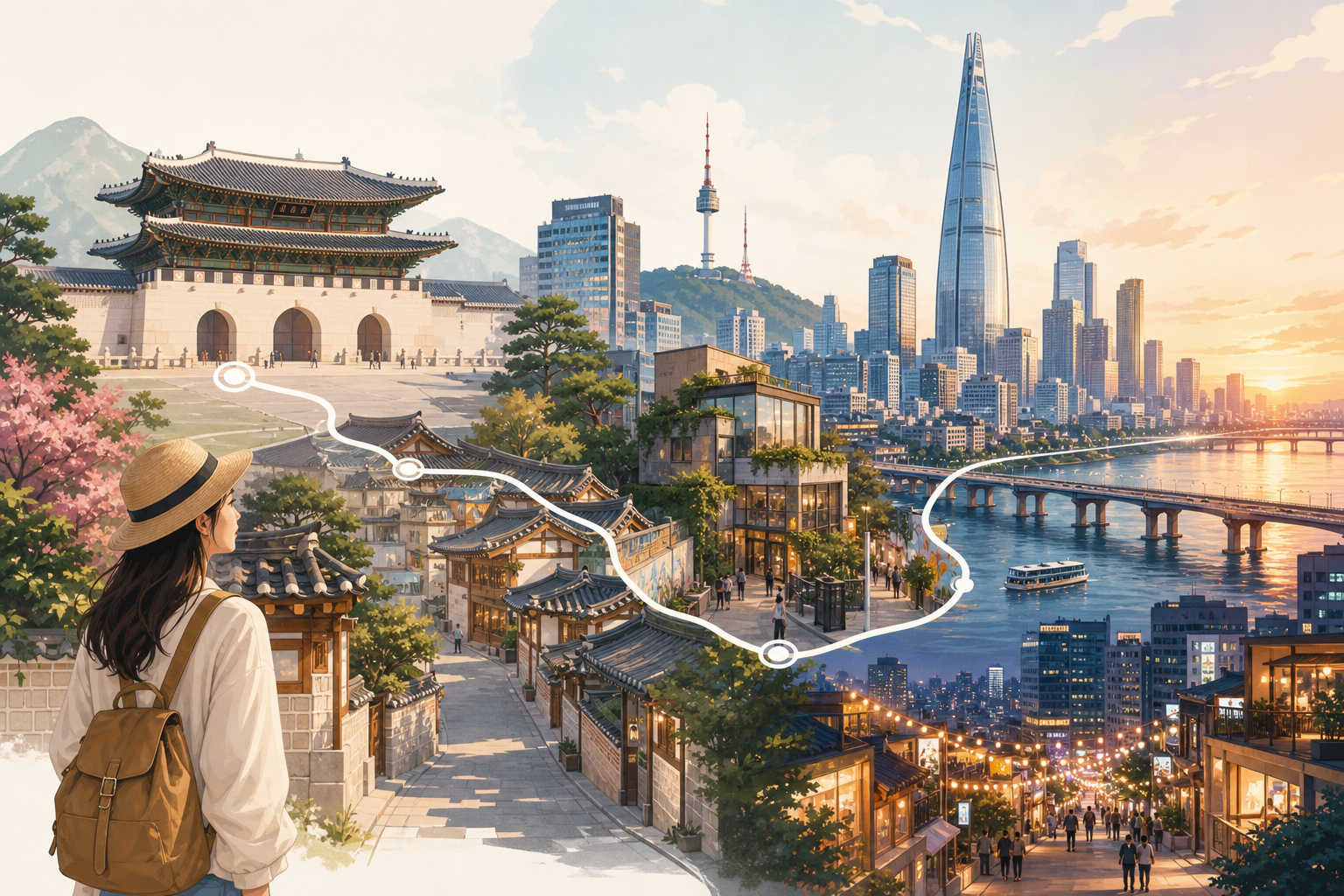
A lot of first-time Seoul itineraries have one major flaw.
They look exciting on paper, but they make no geographic sense.
They tell you to do:
- a palace in the morning
- a far shopping district at lunch
- a different side of the city in the afternoon
- another distant neighborhood at night
That is how a 3-day trip starts feeling rushed, expensive, and strangely less memorable.
The smarter goal is not to “see everything.” The smarter goal is to see Seoul in a shape that actually works.
If you only have 3 days in Seoul, the right approach is:
- keep one day focused on the classic historic-central core
- keep another day focused on one modern or youthful side of the city
- protect your arrival and departure energy instead of pretending you have three perfect full days
That is how you avoid backtracking. That is how you make a short first trip feel good.
The short answer
Yes, 3 days is enough for a worthwhile first Seoul trip.
But only if you stay selective.
The best version is not a city-completion challenge. It is a clean first look at Seoul that gives you:
- one strong classic Seoul day
- one strong neighborhood-personality day
- one light arrival or flexible day that keeps the trip from becoming brittle
For most first-time visitors, the safest base is Myeongdong. If nightlife, cafés, and younger energy matter more, Hongdae can be the stronger fit.
The key rule is simple:
- group areas logically instead of chasing attractions one by one across the map
Before you start: how to make a 3-day Seoul trip work
A short Seoul trip improves dramatically when a few decisions are made well before you start the itinerary.
1) Choose a practical hotel base
Your hotel area changes how efficient the whole trip feels.
For many first-time visitors, Myeongdong is the strongest default because it keeps the broader city easy to use.
Hongdae is a better fit if you want:
- more youthful energy
- more cafés and evening activity near the hotel
- cleaner airport-rail logic from Incheon
A weak hotel base makes every day harder. A strong one makes a 3-day trip feel larger than it is.
2) Protect arrival day from unrealistic plans
If day 1 starts after a flight, do not treat it like a full sightseeing day.
That is one of the most common short-trip mistakes.
Arrival friction matters:
- airport transfer time
- check-in timing
- luggage
- weather
- how tired you actually feel
A short trip improves when day 1 is designed to absorb reality instead of denying it.
3) Use route logic, not attraction fame
The best 3-day itinerary is not the one with the biggest attraction count. It is the one with the least wasted motion.
That means:
- keep central historic areas together
- keep youthful / nightlife-heavy districts together
- do not jump north, south, and back again just because three places are famous
4) Keep one flexible block
Three days is short enough that small disruptions matter.
Rain, tired feet, slow mornings, shopping detours, or a long meal can all change the day.
A good itinerary has enough discipline to work, and enough flexibility not to collapse.
3-day Seoul itinerary overview
Use this as the clean default shape:
- Day 1: arrive, settle in, and keep the first evening easy
- Day 2: do the classic Seoul core well
- Day 3: choose the Seoul mood you want to remember most
That structure works because it reflects how first trips actually feel.
You do not need three giant sightseeing marathons. You need one smooth arrival, one strong anchor day, and one day that gives Seoul its personality.
Day 1: Arrive, settle in, and keep the first Seoul evening easy
Day 1 should protect your energy, not test it.
If you land in Seoul and try to immediately force a full city itinerary, you waste attention on logistics when you should be stabilizing the trip.
What to do on day 1
Keep the structure simple:
- get from the airport to your hotel efficiently
- check in or drop your luggage
- take one nearby walk
- eat an early dinner
- keep the evening open-ended
That is enough.
If you stay in Myeongdong, a short evening around the area works well because it gives you a simple first-night structure with food, brightness, and easy walking.
If you stay in Hongdae, a lighter café-and-street evening also works well because the area naturally supports casual first-night energy without requiring a huge plan.
What not to do on day 1
Do not try to combine:
- airport arrival
- palace sightseeing
- multiple neighborhoods
- a heavy shopping session
- a big late-night finish
That is not efficient. It is amateur scheduling.
The first evening should make day 2 stronger. That is its job.
Day 2: Do the classic Seoul core efficiently
This is the most important day of the itinerary.
If this is your first time in Seoul, day 2 should handle the classic central-historic cluster in one disciplined route.
The strongest logic is usually some version of:
- palace area
- Bukchon / nearby traditional streets
- Insadong
- Myeongdong later in the day if that fits your base or shopping interest
Why this works:
- the areas belong to the same broader first-time Seoul story
- they create a satisfying mix of historic, cultural, and walkable city experience
- they are much more efficient together than when broken apart across different days
What this day should feel like
It should feel like:
- classic Seoul
- architecture and history
- walking, browsing, and eating at a human pace
- a strong first-time orientation day
It should not feel like a sprint.
How to approach the day well
Keep the day selective.
Do not try to “complete” every palace-adjacent sight. Do not turn every traditional street into a mandatory stop. Do not add a far district in the middle just because it is famous.
The value of this day comes from cohesion.
You are giving Seoul a clear center of gravity. That matters more than maximizing count.
Best fit for this day
This day is especially strong for travelers who want:
- the classic first-Seoul experience
- a strong mix of culture and city atmosphere
- a route that feels meaningful without being chaotic
If traditional atmosphere matters a lot to you, this is also the day that naturally connects with Insadong-style Seoul planning and more culture-oriented stay logic.
Day 3: Choose the Seoul mood you want to remember
Day 3 should not repeat day 2.
This is where many itineraries fail. They keep stacking “important” places without asking what kind of Seoul memory the traveler actually wants.
Your third day should be your personality day.
That means choosing one broad mood and committing to it.
Option A: Hongdae / Yeonnam day
Choose this if you want:
- youthful energy
- cafés
- street life
- creative neighborhood feeling
- a livelier evening finish
This is the strongest option for travelers who want Seoul to feel modern, social, and energetic.
It also works well if you are staying in Hongdae, because the day becomes even more efficient.
Option B: slower traditional / café-style day
Choose this if you want:
- a gentler pace
- more browsing than chasing
- a more atmospheric Seoul memory
- a softer urban day instead of a louder one
This version is especially useful for travelers who liked the classic core and want a second day that still feels textured without becoming repetitive.
Option C: modern Seoul / shopping-focused day
Choose this if you want:
- a more polished city feel
- modern shopping districts
- trend-forward Seoul
- a different contrast from the palace / Bukchon side of the trip
This works for travelers who want Seoul to feel more contemporary and metropolitan, not only historic.
The rule for day 3
Do not try to combine all three moods.
That is exactly how backtracking returns.
Pick one shape. Do it well. Let the day breathe.
If your arrival day is almost lost
Some travelers effectively do not have a real day 1.
Maybe you land late. Maybe check-in eats the evening. Maybe the weather is poor. Maybe the airport transfer takes more out of you than expected.
In that case, use this adjustment:
- keep day 1 as a pure arrival/reset day
- make day 2 your classic core day
- make day 3 your personality day
- accept that this is still a valid 3-day Seoul trip
This is important.
A short trip does not fail just because one day becomes lighter. It fails when travelers panic and start overstuffing the remaining days.
Protecting structure is more important than protecting ego.
Where to stay for this itinerary
For most first-time visitors doing this route, the two strongest bases are:
- Myeongdong
- Hongdae
Stay in Myeongdong if:
- you want the safest broad first-time default
- you want simpler all-around city use
- you are doing a short highlights-focused Seoul trip
- you want the itinerary to feel practical more than trendy
Stay in Hongdae if:
- nightlife or café culture matters more
- you want stronger neighborhood personality near the hotel
- you want cleaner airport-rail logic from Incheon
- you are comfortable making the trip feel slightly more style-driven
For many travelers, Myeongdong wins the overall 3-day default.
But if the Seoul memory you want is more youthful and energetic, Hongdae can be the better emotional fit.
What to cut so the itinerary does not break
This matters as much as what to include.
The easiest way to ruin a 3-day Seoul trip is to keep adding “just one more thing.”
Cut these first:
1) Distant day trips by default
A short first Seoul trip usually does not improve by forcing a far side trip.
2) Too many north-of-river and south-of-river jumps in one day
Big city crossings create invisible fatigue.
3) Overscheduled arrival and departure windows
Flights distort perfect plans. Accept that early.
4) Every famous district in one trip
You do not need to cover all of Seoul to have a successful first visit. You need a trip shape that still feels good on the ground.
My recommendation for most first-time visitors
If I had to give one clean default, it would be this:
Day 1
- arrive
- settle in
- do one easy evening near your base
Day 2
- do the classic Seoul historic-central core
- keep the day walkable and selective
Day 3
- choose one personality lane:
- Hongdae / Yeonnam
- slower traditional / café atmosphere
- modern shopping / polished city feel
That is the right structure because it gives you:
- a clean arrival
- a strong first-time Seoul anchor day
- a personalized final day instead of repetitive sightseeing
For most travelers, this is far better than trying to cram five disconnected major districts into three days.
Final judgment
Three days in Seoul is enough for a strong first trip.
But only if you respect the city’s size. Only if you group areas logically. Only if you stop trying to win by attraction count.
The best 3-day Seoul itinerary is not the busiest one. It is the one that feels coherent from airport arrival to final evening.
That is what makes the trip memorable.
Related guides
Use these next if you want to sharpen the plan:
- How Many Days in Seoul Do You Really Need? if you are still deciding whether 3 days is enough
- Where to Stay in Seoul for First-Time Visitors if you have not picked your base yet
- Myeongdong vs Hongdae if you are choosing between Seoul’s two most common first-time hotel areas
- Incheon Airport to Seoul in 2026 for the broad arrival framework
- Incheon Airport to Myeongdong if you are staying there
- Incheon Airport to Hongdae if that is your base
- Best Area to Stay in Seoul for Traditional Culture if a more historic Seoul atmosphere is your priority
- Seoul Subway Guide if you want smoother city movement during the trip
Related guides for planning your trip
- How Many Days in Seoul Do You Really Need?
- Where to Stay in Seoul for First-Time Visitors
- Myeongdong vs Hongdae: Which Area Is Better for Your First Seoul Trip?
- Incheon Airport to Seoul in 2026
- Best Area to Stay in Seoul for Traditional Culture
- Seoul Subway Etiquette and Practical Tips for Foreign Travelers
- Incheon Airport to Myeongdong
- Incheon Airport to Hongdae
- Best Area to Stay in Seoul for Easy Airport Access